

The Sunday Brew #167
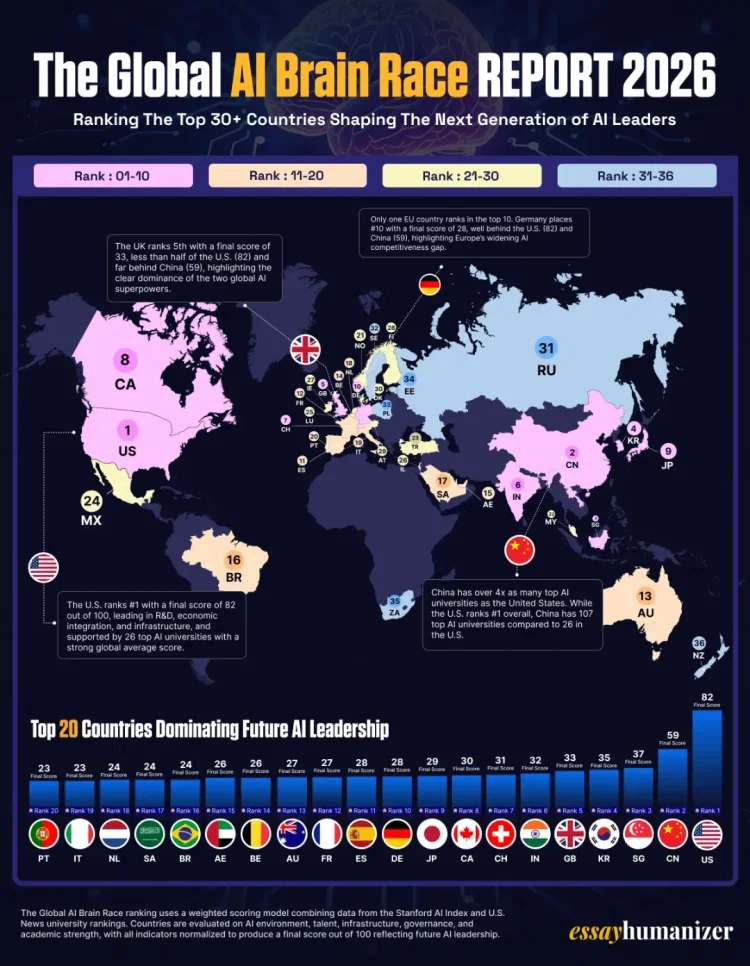
In this brew: Global AI Brain Race in a picture | The Luck Factor & Pyrrhic Victory | US strikes Iran, India's crackdown on deepfake and Denmark eliminates mother-to-child HIV

The Sunday Brew | Issue #1 March ‘26 | Free
Welcome to The Sunday Brew, weekly 1-2-3 newsletter by The Percolator. Every Sunday we drop in your inbox 1 story in a picture, 2 concepts, ideas or frameworks to expand your horizons and 3 news from the week, to keep you updated.
If you are not a paid subscriber, here is what you missed last week:


ONE STORY IN A PICTURE
TWO IDEAS, FRAMEWORKS OR CONCEPTS
This week we bring to you two Concepts - The Luck Factor & Pyrrhic Victory
The Luck Factor
The Luck Factor, popularized by psychologist Richard Wiseman, argues that what we call “luck” is largely a product of attitudes and behaviours rather than random fate alone.
He defines luck as seemingly chance events that significantly influence our lives, but shows that “lucky” people consistently behave in ways that increase the probability of good outcomes. Over years of research, Wiseman found that self-described lucky people tend to be more relaxed, open, and socially engaged, which makes them more likely to notice and act on unexpected opportunities. They build broad networks, try new activities, and place themselves in varied situations, effectively giving chance more “surface area” to work with.
A second element is intuition: lucky people report trusting gut feelings in decisions, which often reflect subtle pattern recognition by the subconscious mind.
Third, they maintain optimistic expectations, creating self-fulfilling prophecies; expecting events to go well changes how they prepare, persist, and interact, thereby increasing the odds of success.
Finally, they are resilient in the face of setbacks, quickly reframing misfortune as a learning opportunity and actively looking for ways to turn bad breaks into future advantages.
In sum, The Luck Factor reframes luck as a mindset and skill set: by cultivating openness, social connection, intuition, positive expectation, and resilience, people can systematically “manufacture” more of the good fortune that others mislabel as mere chance.
🚀
Pyrrhic Victory
A Pyrrhic victory is a win so costly that it is indistinguishable from defeat. It describes situations where you technically prevail on the battlefield, in politics, in business, or in personal conflicts, but the resources, lives, reputation, or long‑term position you sacrifice outweigh any benefits gained.
The term comes from King Pyrrhus of Epirus, who defeated the Romans at battles like Heraclea and Asculum in the 3rd century BCE, but lost so many of his irreplaceable troops that he is reported to have said that another such victory would ruin him.
In modern usage, “Pyrrhic victory” captures the idea of winning the battle but losing the war: your immediate objective is achieved, yet you emerge weakened, exhausted, or strategically worse off than your opponent. It is often invoked as a caution against short‑sighted strategies, ego-driven fights, or zero‑sum thinking where you push to “win” at any cost.
For example, a company might crush a competitor through a price war but destroy its own margins and brand in the process, or a person might win an argument while permanently damaging a relationship. The concept encourages stepping back and asking whether the price of victory is aligned with your deeper goals, and whether some “wins” are better avoided than achieved.
An Earnest Appeal
The Percolator is built like a magazine, but without the team or organisation. It takes research, writing, editing, and a steady rhythm to publish longform essays twice a week. Paid subscriptions make this work possible, and sustainable.
If you’ve found value here, I’d love for you to consider upgrading. Paid subscribers unlock every essay, can comment and join the chat, and a chance to feature their own notes and stories.
👉 Please upgrade to paid and help keep the brew strong. It costs less than two coffees a month, but unlike coffee, the energy lasts longer.
THREE NEWS FROM THE WEEK
US-Israel Strikes Iran Spark Gulf Missile Crisis
The United States and Israel’s surprise joint offensive on Iran has plunged the Middle East into its most dangerous crisis in decades, triggering a cascade of missile exchanges that have drawn multiple Gulf states into the line of fire.
The strikes, involving hundreds of sorties on Iranian command, missile, and air defence sites, were billed by Washington as an effort to cripple Tehran’s military and prevent it from ever acquiring nuclear weapons. Iran’s leadership, reeling from the reported killing of Supreme Leader Ayatollah Ali Khamenei, vowed open-ended retaliation.
Within hours, Iran unleashed waves of ballistic missiles and drones at Israel and US bases across the region, shattering the long‑held assumption that Gulf monarchies could remain insulated from direct Iranian fire. Explosions and interceptions were reported over the UAE, Qatar, Kuwait, Bahrain, Jordan and Saudi Arabia, with at least one death confirmed in Abu Dhabi and a reported strike on the US Fifth Fleet support facilities in Bahrain. Civil aviation hubs in Kuwait and the UAE also came under threat, forcing widespread airspace closures and flight diversions.
Diplomatic shockwaves have followed the military escalation. The United Nations and European leaders condemned both the scale of US‑Israeli strikes and Iran’s decision to hit third countries hosting American forces. Oil prices spiked as traders weighed risks to production and tanker traffic near the Strait of Hormuz, even as Gulf producers signalled readiness to stabilise supplies. With Washington demanding that Iran end uranium enrichment, curb missiles and abandon its regional proxies, the region now faces an unpredictable mix of open warfare, economic disruption and political upheaval.
➖
India Mounts Multi-Front Crackdown on Deepfakes With New IT Rules, PIL, and Women-Led Police Unit
India is escalating its response to the deepfake menace through coordinated legal, regulatory, and policing measures.
A new Public Interest Litigation in the Punjab and Haryana High Court seeks a standalone national law specifically targeting deepfakes, demanding penalties of up to seven years’ imprisonment, heavy fines, and minimum statutory damages of ₹10 lakh for victims, along with watermarking, disclosure norms, and blocking of unsafe apps and platforms. The petition, filed by advocate Ravinder Singh Dhull, argues that hyper-realistic AI-generated forgeries threaten democratic processes and calls for an Indian framework modelled on recent EU, US, and South Korean approaches.
At the executive level, the Centre has notified amendments to the IT (Intermediary Guidelines and Digital Media Ethics Code) Rules, 2021, effective 20 February 2026, creating India’s first detailed regime for synthetically generated information and deepfakes. Platforms must now remove flagged unlawful content, including deepfakes, within three hours of a government or court order, down from the earlier 36 hours, and act even faster—within about two hours—for highly sensitive non-consensual sexual deepfakes. The rules also mandate labelling of AI-generated content and stronger traceability and grievance redressal obligations for intermediaries.
On the ground, Gurugram Police have formed a six-member women-led cyber team tasked with taking down deepfake images and AI-generated pornography within five hours of a complaint, backed by a new helpline for confidential reporting, home visit options, and counselling support for victims.
➖
Denmark Becomes First EU Country to Eliminate Mother-to-Child Transmission of HIV and Syphilis
The World Health Organization (WHO) has certified Denmark as the first country in the European Union to eliminate mother-to-child transmission of HIV and syphilis, marking a major public health milestone.
Elimination in this context means that at least 95% of pregnant women are tested and treated for these infections, and that new infant infections remain below 50 per 100,000 live births over multiple years. Denmark met these strict benchmarks between 2021 and 2024, supported by strong antenatal care, universal health coverage, and integrated screening during pregnancy.
WHO leaders highlighted that Denmark’s achievement shows how sustained political commitment, investment in primary care, and rights-based maternal and child health services can protect both pregnant women and new-borns.
The country’s robust data systems, laboratory capacity, and emphasis on equal access to care were central to driving transmission rates down to zero among infants. Danish Health Minister Sophie Løhde described the validation as the result of decades of work by health professionals, midwives and public health teams, grounded in a universal health system “built on equal access for all.”
Denmark now joins 22 other countries and territories worldwide that have been validated for eliminating mother-to-child transmission of HIV, syphilis or hepatitis B, or recognized as being on the path to elimination. The country is also working toward adding hepatitis B to achieve “triple elimination,” with WHO supporting the next steps in that process.


The Sunday Brew by The Percolator brings to you curated news on tech, business & entrepreneurship, from across the internet to give your week a perfect start.
Share your thoughts and opinions on the topics covered in this newsletter by leaving a comment and joining the conversation.