

The Sunday Brew #179
In this brew: Carbon Capture Methods in a picture | Combinatorial Innovation & The Long Tail | Spacetime Crystal Breakthrough, Classical Algorithm Beats Quantum Claim, & IMO Sets Autonomous Ship Code

The Sunday Brew | Issue #4 May ‘26 | Free
Welcome to The Sunday Brew, weekly 1-2-3 newsletter by The Percolator. Every Sunday we drop in your inbox 1 story in a picture, 2 concepts, ideas or frameworks to expand your horizons and 3 news from the week, to keep you updated.
If you are not a paid subscriber, here is what you missed last week:


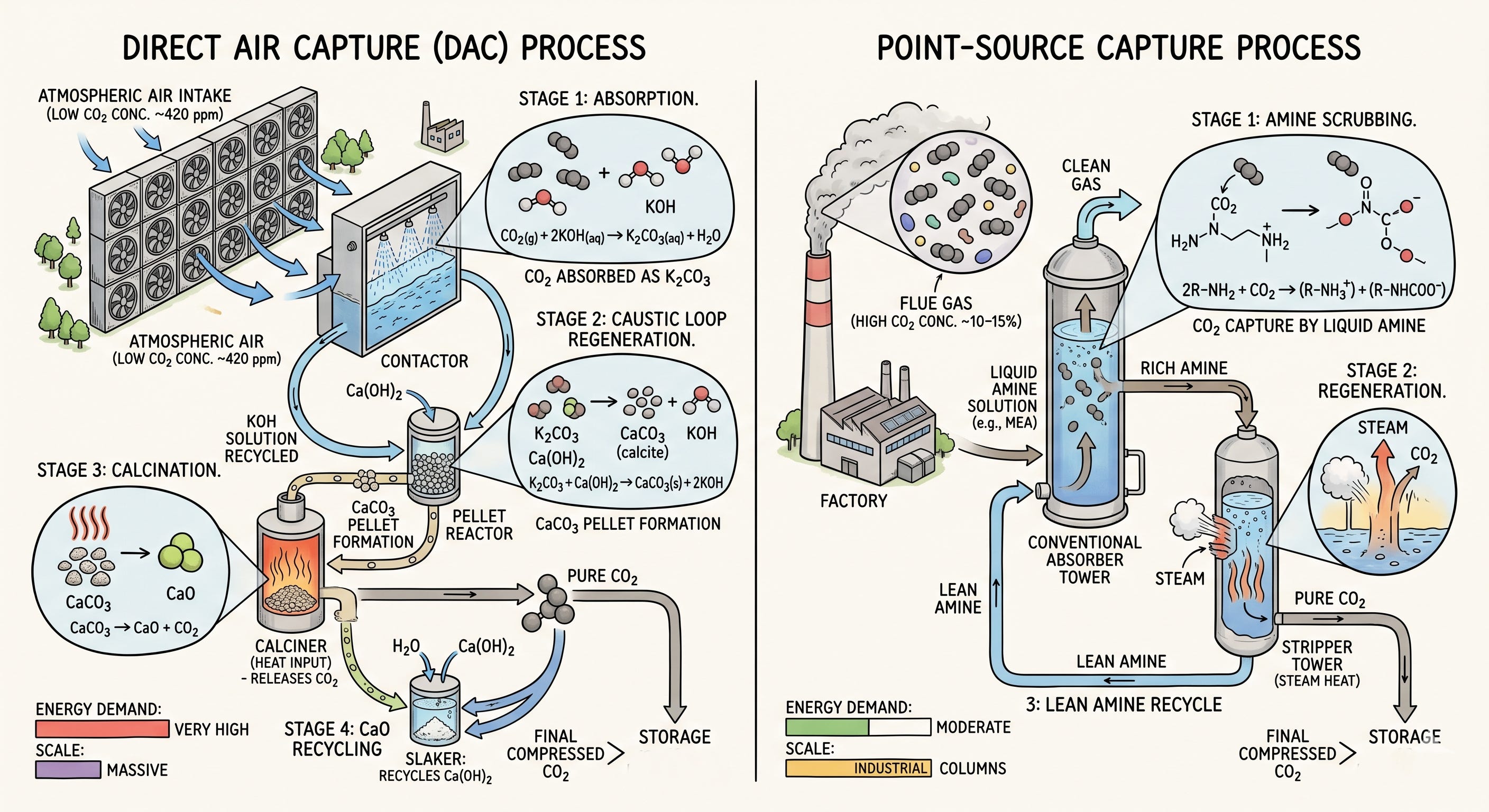
ONE STORY IN A PICTURE
Carbon Capture Methods: DAC bs Point Source Capture
TWO IDEAS, FRAMEWORKS OR CONCEPTS
This week we bring to you two Concepts: Combinatorial Innovation & The Long Tail
Combinatorial Innovation
Combinatorial innovation refers to the process of creating new value by integrating existing technologies or ideas in novel ways.
It suggests that the most significant advancements often result from the clever arrangement of previously established components rather than the invention of entirely new ones. This concept rests on the premise that as the number of available technologies increases, the potential for new combinations grows exponentially. This phenomenon is frequently observed in the digital economy, where software and hardware are layered to produce services that would have been impossible in isolation.
By treating existing innovations as building blocks, a developer can focus on the unique logic of the combination rather than the underlying infrastructure. This reduces the cost and time required to bring a new product to market because the foundational elements are already mature and tested.
For founders and working professionals, combinatorial innovation offers a practical pathway to growth that does not require massive research and development budgets. It encourages leaders to look across different industries to find tools that can be repurposed to solve specific problems within their own field.
By utilising the progress made by others to create proprietary value, professionals can maintain a competitive edge by rapidly iterating on existing systems to deliver enhanced efficiency.
🚀
The Long Tail
The long tail is a concept in economics and business that describes a strategy of targeting many niche markets rather than focusing solely on a few mainstream products.
It is typically illustrated using a probability distribution curve where the “head” represents the most popular items and the “tail” consists of a vast number of unique products that sell in relatively low volumes.
In traditional retail environments, physical shelf space is limited, which forces businesses to prioritise high-demand goods to maintain profitability. Conversely, the rise of digital platforms and e-commerce has lowered the costs of storage and distribution, enabling companies to offer an expansive inventory that includes obscure or specialised items.
While an individual niche product might generate only modest revenue, the cumulative sales from the countless items in the tail can equal or surpass the income from the few popular hits at the head. This shift has altered consumer habits, as people are now able to find goods that cater to their specific tastes rather than accepting mass-produced alternatives.
For founders and working professionals, the long tail offers a strategic advantage by highlighting the potential of underserved market segments. By utilising digital tools to reach these audiences, a business can achieve substantial scale without the need to compete directly for the most popular keywords or products.
This perspective encourages leaders to focus on precision and customisation, allowing them to build a loyal customer base within niches that larger organisations often overlook.
An Earnest Appeal
The Percolator is built like a magazine, but without the team or organisation. It takes research, writing, editing, and a steady rhythm to publish longform essays twice a week. Paid subscriptions make this work possible, and sustainable.
If you’ve found value here, I’d love for you to consider upgrading. Paid subscribers unlock every essay, can comment and join the chat, and a chance to feature their own notes and stories.
👉 Please upgrade to paid and help keep the brew strong. It costs less than two coffees a month, but unlike coffee, the energy lasts longer.
THREE NEWS FROM THE WEEK
Physicists Solve 30-Year Mystery of Spacetime Crystal Formation
A team of physicists from Goethe University Frankfurt and TU Wien has derived the first exact formula describing how spacetime behaves at the threshold of black hole formation, resolving a decades-old problem in theoretical physics.
The breakthrough builds on Matthew Choptuik’s 1993 discovery that collapsing matter, when finely tuned, produces a repeating, self-similar spacetime pattern, often described as a “spacetime crystal.”
Until now, this critical phenomenon could only be studied through numerical simulations. The new research introduces an analytical solution by extending Einstein’s equations into an infinite number of dimensions, where they become mathematically tractable. The team then systematically translated the results back to four-dimensional spacetime, achieving close agreement with earlier computational findings.
The work reveals that this crystal-like state represents an unstable boundary: a slight decrease in energy causes the system to disperse, while a small increase triggers the formation of a microscopic black hole. This sharp transition offers new insight into how primordial black holes could have formed in the early universe, potentially contributing to dark matter.
Beyond cosmology, the findings suggest deeper constraints on the nature of critical collapse, indicating that only specific spacetime “rhythms” are physically viable. Researchers believe the method could open new analytical pathways for studying extreme gravitational phenomena that were previously accessible only through simulations.
➖
Classical Algorithm Challenges D-Wave’s Quantum Supremacy Claim
A new study by researchers at the Flatiron Institute and Boston University has cast doubt on one of the most prominent recent claims of quantum supremacy, showing that a classical algorithm can match the performance of D-Wave’s 5,000-qubit quantum processor on a key benchmark problem.
Published in Science on May 21, the work demonstrates that a tensor-network-based approach can efficiently simulate the quantum dynamics of disordered spin systems previously touted as a task beyond the reach of classical machines.
D-Wave had claimed in March 2025 that its Advantage2 prototype solved this problem in minutes, estimating that classical supercomputers would take nearly a million years and consume immense energy. However, the new findings suggest that such estimates significantly overstated the difficulty. Using optimized tensor network techniques, researchers were able to reproduce the same results with high accuracy, in some cases running initial simulations on a standard laptop using the ITensor library.
The breakthrough hinges on compressing quantum information into structured mathematical representations, enabling classical systems to handle problems once assumed to require quantum hardware. While the results do not diminish the long-term promise of quantum computing, they highlight a recurring pattern: advances in classical algorithms continue to challenge and refine claims of quantum advantage.
The study underscores a shifting frontier, where demonstrating true quantum supremacy is becoming increasingly difficult. As classical methods improve, the threshold for meaningful quantum breakthroughs is rising, reinforcing the need for more rigorous benchmarks and cautious interpretation of performance claims in the rapidly evolving quantum computing landscape.
➖
IMO Approves First Global Code for Autonomous Ships
The International Maritime Organization (IMO) has adopted the world’s first global safety code for autonomous commercial vessels, marking a significant milestone in the evolution of maritime technology. Approved during the 111th session of the Marine Safety Committee in London, the Maritime Autonomous Surface Ships (MASS) Code establishes a unified framework to regulate vessels capable of operating with reduced or no human intervention.
Set to come into effect on July 1, 2026, on a voluntary basis, the code introduces a goal-based approach to ensure that autonomous ships meet safety, security, and environmental standards equivalent to conventional crewed vessels. It incorporates existing international regulations such as collision avoidance rules while introducing new requirements tailored to autonomous operations, including continuous situational awareness, remote system monitoring, and resilience under degraded operating conditions.
The framework also addresses practical challenges unique to unmanned ships, such as remote anchoring capabilities, emergency towing without onboard crew, and advanced system redundancies. Industry stakeholders are expected to invest significantly in research and development to meet these technical standards.
The voluntary phase will serve as a testing ground for regulators and operators, with insights feeding into a mandatory version of the code. The IMO aims to formalize the MASS Code under the SOLAS convention by 2030, with enforcement expected from 2032. The move reflects a broader effort to balance innovation with safety as autonomous shipping begins to transition from experimental to operational reality.


The Sunday Brew by The Percolator brings to you curated news on tech, business & entrepreneurship, from across the internet to give your week a perfect start.
Share your thoughts and opinions on the topics covered in this newsletter by leaving a comment and joining the conversation.