

The Scalability Wall: Why 2D Materials Remain Stuck in Development
Lets examine the engineering hurdles preventing the mass production of graphene, focusing on chemical vapour deposition limits and the complex transfer processes required for industrialisation.

The Founder’s Brew | Issue #3, May ‘26 | Premium
Welcome to The Founders’ Brew, your Thursday ritual of sharp insight, data-backed thinking, and practical tools for modern founders. Each week we unpack one essential theme from the start-up world — combining frameworks, case studies, and field-tested resources you can apply immediately.
If you’re reading this on the free plan, you’re missing the deep dive, founder frameworks, and downloads that follow. Upgrade to The Founders’ Brew Premium to unlock full essays, data visuals, and subscriber-only templates.
» » » Check out subscribers’ benefits.
In this issue of The Founders' Brew, we examine the technical hurdles that prevent graphene from moving beyond laboratory prototypes into large-scale industrial applications.
Although the material's properties are well documented, the engineering required for mass production has encountered a scalability wall. This analysis focuses on the limitations of chemical vapour deposition and the significant yield losses associated with the transfer process.
By understanding these physical constraints, entrepreneurs can better navigate the transition from research to commercial production. We move past common hype to provide a realistic assessment of the sector and the practical paths toward reliable manufacturing.
The Prototype Trap
The Thermal and Chemical Limits of Growth
The Transfer and Metrology Barrier
The Feedstock and Purity Crisis
Strategy Beyond the Wall
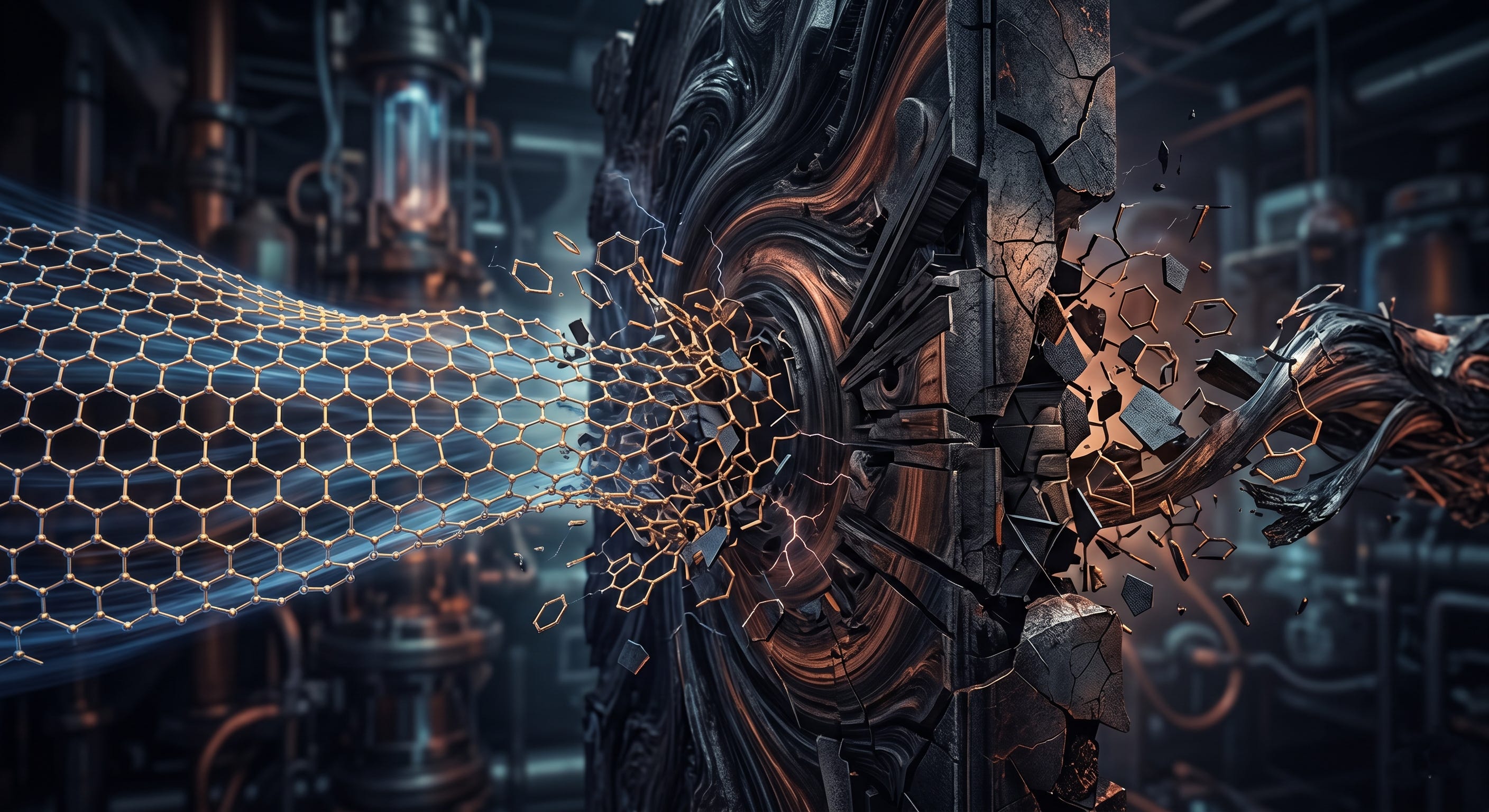
The industrialisation of graphene has reached a technical plateau that requires a shift from laboratory precision to engineering reliability. While the theoretical benefits of two-dimensional materials are well documented, the transition to high-volume manufacturing remains obstructed by the difficulty of maintaining structural integrity at scale.
Entrepreneurs entering this space must recognise that the primary challenge is no longer the synthesis of the material itself, but the development of repeatable processes that can produce uniform sheets without the prohibitive costs associated with current methods.
The prevailing method for creating high-quality graphene, known as Chemical Vapour Deposition (CVD), relies on the growth of carbon atoms on a metal substrate. While this process produces excellent results for small-scale prototypes, it introduces significant complications when expanded to industrial proportions. The requirement to transfer the atomic layer from its growth foil to a final surface often results in micro-tears and chemical contamination, which effectively degrades the electronic properties that made the material attractive in the first place. This transfer bottleneck is a primary reason why many graphene-based technologies remain trapped in the development phase.
To move beyond this scalability wall, the industry must focus on integration techniques that bypass the need for delicate handling. This involves a move toward direct growth on functional surfaces or the use of graphene nanoplatelets for applications where atomic perfection is less critical than structural reinforcement.
For the founder, the strategic priority is to identify applications where the material performance justifies the current manufacturing complexity, rather than waiting for a universal production solution that may remain out of reach.
Success in this sector depends on an engineering philosophy that prioritises yield stability and process integration over the pursuit of theoretical purity.
🚀
