

The Sunday Brew #178
In this brew: Space-Manufactured Fiber Optic in a picture | Disruptive innovation & First Principles | Morgan Stanley lifts S&P 500, Anthropic's Secondary Crackdown & Figure AI's Live Demo

The Sunday Brew | Issue #3 May ‘26 | Free
Welcome to The Sunday Brew, weekly 1-2-3 newsletter by The Percolator. Every Sunday we drop in your inbox 1 story in a picture, 2 concepts, ideas or frameworks to expand your horizons and 3 news from the week, to keep you updated.
If you are not a paid subscriber, here is what you missed last week:


ONE STORY IN A PICTURE
The Journey of a Space-Manufactured Fiber Optic
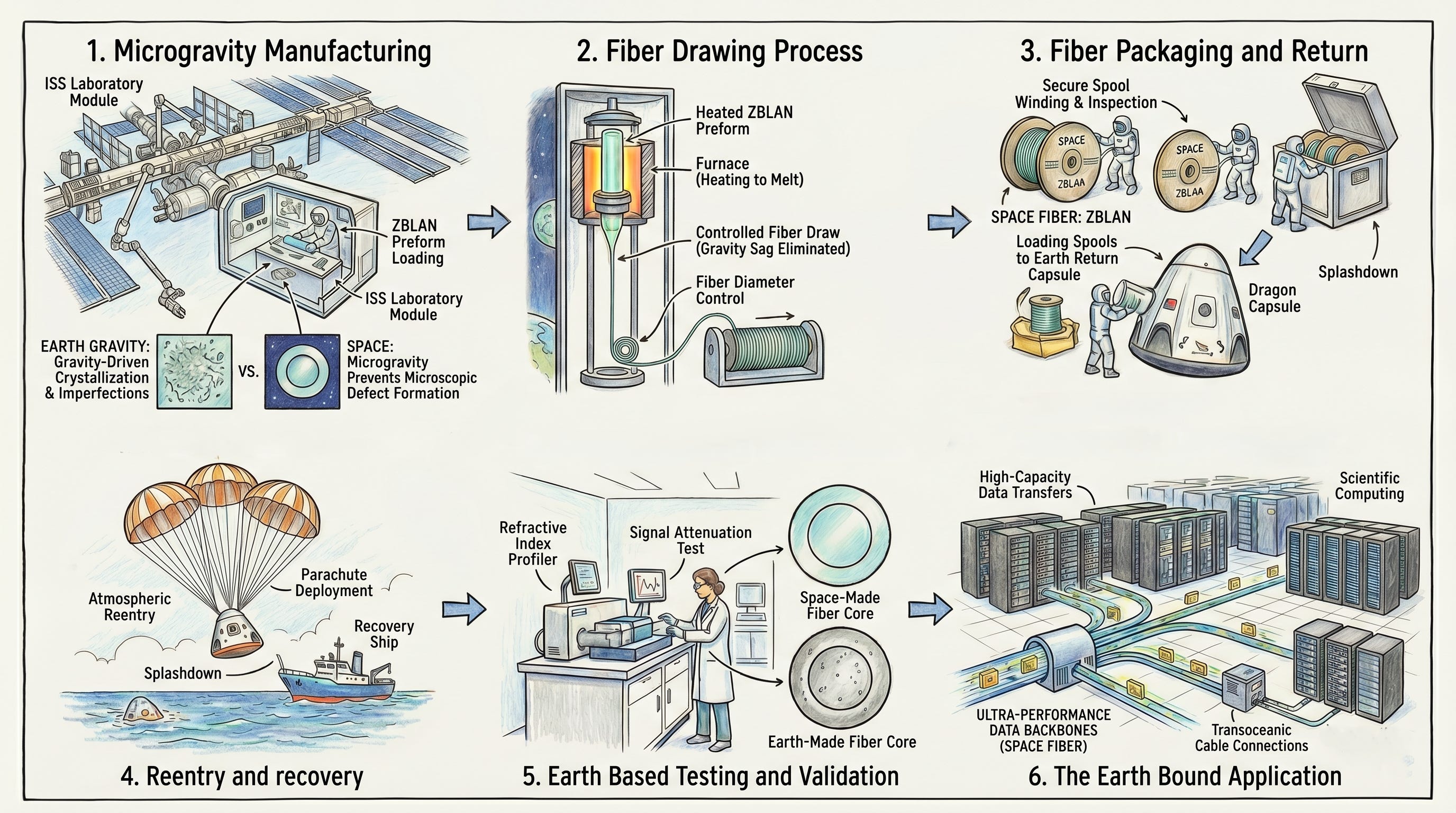
TWO IDEAS, FRAMEWORKS OR CONCEPTS
This week we bring to you two Concepts: Disruptive Innovation & First Principles
Disruptive Innovation
Disruptive innovation describes a process by which a smaller company with limited resources successfully challenges established incumbent businesses.
This phenomenon typically begins when the entrant targets overlooked segments of the market, providing a functional and more affordable alternative to existing products. Incumbents often focus on improving their offerings for their most demanding and profitable customers, which frequently results in products that are too complex or expensive for the broader population. The disruptor enters at the bottom of the market or creates an entirely new market by offering a simpler or more convenient solution.
As the newcomer improves its performance and moves upmarket, it maintains the advantages that drove its initial success, such as a lower cost base or a more efficient delivery model. Eventually, the mainstream customers of the incumbent begin to adopt the entrant's offering, which leads to a shift in market leadership.
This process is distinct from mere competition, as it relies on a fundamental change in how value is delivered rather than just making a better version of an existing product.
For founders and working professionals, this concept provides a strategic framework for identifying market entries that avoid direct confrontation with well-capitalised rivals. It encourages leaders to remain vigilant regarding competitors who serve the low end of the market, as these players often represent the greatest long-term threat to stability.
By understanding these dynamics, professionals can better decide when to protect their core business and when to invest in simpler, more accessible business models that might otherwise be ignored.
🚀
First Principles
First Principles or first principles thinking is a problem-solving strategy that involves breaking down complex challenges into their most basic, foundational truths.
Rather than relying on assumptions or historical precedents, this method requires an individual to deconstruct a situation until only the basic elements remain. Once these fundamental components are identified, one can build an entirely new solution from the ground up. This approach stands in contrast to reasoning by analogy, which relies on existing models and common knowledge to make incremental improvements.
By stripping away the layers of conventional wisdom, a person can see a problem for what it truly is rather than how it has been perceived by others. This mental model encourages rigorous inquiry and the rejection of the status quo in favour of logic and empirical evidence. It is a demanding process because it requires the abandonment of familiar shortcuts, yet it often reveals opportunities that are invisible to those who follow established patterns.
For founders and working professionals, first principles thinking is a tool for innovation and efficient resource allocation. It allows leaders to identify the core constraints of a project and develop strategies that are independent of industry norms.
By questioning the underlying reasons for how things are currently organised, professionals can create effective systems and products that provide a genuine advantage. This mindset is useful when navigating uncertain markets or designing new technologies where traditional benchmarks do not apply. It ensures that decisions are based on objective reality rather than the consensus of the crowd.
This approach avoids replicating the inefficiencies of competitors and allows for more precise problem-solving.
An Earnest Appeal
The Percolator is built like a magazine, but without the team or organisation. It takes research, writing, editing, and a steady rhythm to publish longform essays twice a week. Paid subscriptions make this work possible, and sustainable.
If you’ve found value here, I’d love for you to consider upgrading. Paid subscribers unlock every essay, can comment and join the chat, and a chance to feature their own notes and stories.
👉 Please upgrade to paid and help keep the brew strong. It costs less than two coffees a month, but unlike coffee, the energy lasts longer.
THREE NEWS FROM THE WEEK
Morgan Stanley Lifts S&P 500 Target as AI Dominance Fuels Rally, Raises Concentration Concerns
Morgan Stanley has raised its outlook for the S&P 500, betting that artificial intelligence will continue to power U.S. equities even as concerns grow over the market’s increasing dependence on a narrow set of technology giants.
The bank now expects the index to reach 8,000 by the end of 2026, with a 12-month target of 8,300, driven primarily by strong earnings growth rather than multiple expansion.
The optimism reflects a market increasingly shaped by AI. According to JPMorgan Asset Management, AI-linked companies now account for more than 57% of the S&P 500’s weighting, spanning semiconductors, hyperscale cloud players, software, and infrastructure. This marks a sharp rise from roughly a quarter of the index just three years ago, underscoring how quickly AI has moved from a thematic bet to the market’s central driver.
Corporate performance has so far supported the narrative. Over 80% of companies have beaten earnings expectations this quarter, and Morgan Stanley projects continued profit acceleration through 2028. However, the strength is highly concentrated. A handful of firms, particularly Alphabet, Amazon, and Meta, are expected to deliver the majority of future earnings growth, highlighting a structural imbalance beneath the headline gains.
That concentration is prompting unease across Wall Street. Analysts warn that without AI-linked stocks, broader market returns would be minimal, suggesting limited participation beyond the tech core. While firms like UBS and BMO share Morgan Stanley’s bullish stance, others remain cautious, noting that inflation and macro risks could test a market increasingly reliant on a single transformative technology.
➖
Anthropic’s Secondary Share Crackdown Rattles Private Markets
Anthropic has triggered a broad backlash in the private-markets world after warning that any sale or transfer of its stock not approved by its board is void and will not be recognized on its books and records. The company also named several secondary platforms and intermediaries, including Hiive and Forge Global, as unauthorized sources of access to its shares.
The immediate trigger was the surge of private-market demand for Anthropic equity, which has become one of the most sought-after assets in AI as investors race to buy exposure before a possible public listing. Anthropic said it is not merely discouraging informal trading but actively rejecting transactions that attempt to bypass its transfer restrictions through SPVs, forward contracts, tokenized securities, or similar structures.
Reactions were swift. Forge said its platform only facilitates issuer-approved transfers and asked Anthropic to remove its name from the warning, while other platforms argued they provide introductions or due diligence rather than unauthorized sales. Anthropic’s stance has also sparked debate over whether the company is protecting its cap table or overreaching into a secondary market that has become an essential source of liquidity for startup shareholders.
The implications are significant for buyers, sellers, and platforms alike. If Anthropic’s position holds, some investors who thought they owned Anthropic exposure may find their transactions unenforceable, while secondary marketplaces may face tighter scrutiny and reduced confidence from buyers. More broadly, the episode underscores that in private AI, issuer consent still matters more than market enthusiasm, and that “ownership” can be far less secure than it appears.
➖
Figure AI Robots Redefine Endurance in Live Test
Figure AI has turned a planned eight-hour demonstration into a defining moment for humanoid robotics, as its machines continue operating far beyond initial expectations in a live-streamed endurance test. What began as a controlled showcase has evolved into a real-world stress test of durability, autonomy, and industrial viability.
The company’s three Figure 03 robots have been autonomously sorting packages for over 36 continuous hours, powered by its Helix-02 neural network. Operating at speeds nearing human efficiency, the robots have processed tens of thousands of parcels while maintaining consistent performance without direct human oversight. Unlike earlier demonstrations that lasted barely an hour, this extended run signals a significant leap in system reliability.
A key innovation lies in the robots’ ability to manage themselves as a coordinated fleet. When battery levels drop, individual units seamlessly exit the workflow, navigate to charging stations, and trigger replacements—without interrupting operations. This level of autonomy, driven entirely by onboard perception and decision-making systems, marks a shift from teleoperated robotics toward true industrial independence.
The livestream, partly inspired by calls from industry experts for more rigorous real-world validation, has drawn widespread attention from investors and logistics operators. Backed by over $2.5 billion in funding and a recent $39 billion valuation, Figure AI is positioning itself at the forefront of the humanoid robotics race.
While the demonstration highlights impressive technical progress, the larger question remains whether such endurance can translate into scalable, cost-effective deployments across industries now watching closely.


The Sunday Brew by The Percolator brings to you curated news on tech, business & entrepreneurship, from across the internet to give your week a perfect start.
Share your thoughts and opinions on the topics covered in this newsletter by leaving a comment and joining the conversation.