

The Propellant Gap: Why Long-Range SpaceTech Requires Infrastructure
Learn how orbital infrastructure closes the propellant gap for deep space ventures. This founder’s guide explains the technical shifts turning orbital logistics into a strategic imperative.
The Founder’s Brew | Issue #2, May ‘26 | Premium
Welcome to The Founders’ Brew, your Thursday ritual of sharp insight, data-backed thinking, and practical tools for modern founders. Each week we unpack one essential theme from the start-up world — combining frameworks, case studies, and field-tested resources you can apply immediately.
If you’re reading this on the free plan, you’re missing the deep dive, founder frameworks, and downloads that follow. Upgrade to The Founders’ Brew Premium to unlock full essays, data visuals, and subscriber-only templates.
» » » Check out subscribers’ benefits.
In this issue of The Founders' Brew, we explore why the next era of SpaceTech depends on a fundamental transition from single-launch missions to a sustainable orbital infrastructure.
For too long, the 'propellant gap' has restricted deep space ambition, as the brutal physics of the rocket equation dictate that fuel mass exponentially compromises commercial payloads. Solving this is now a strategic necessity.
We delve into the critical technical shifts turning orbital logistics into a robust utility, analysing the engineering requirements of cryogenic storage, standard interfaces, and the logistical roadmap for off-world propellant sourcing. Founders must pivot to infrastructure-dependent architectures to unlock sustained off-world economic activity.
Today’s Issue at a Glance:
The Mass Fraction Constraint and the Limits of Earth-Bound Logistics
The Engineering of Orbital Storage and Cryogenic Stability
Standardisation of Transfer Interfaces and Docking Protocols
The Economic Logic of In-Situ Sourcing and Orbital Refinement
From Mission-Centric Design to Infrastructure-Dependent Architectures
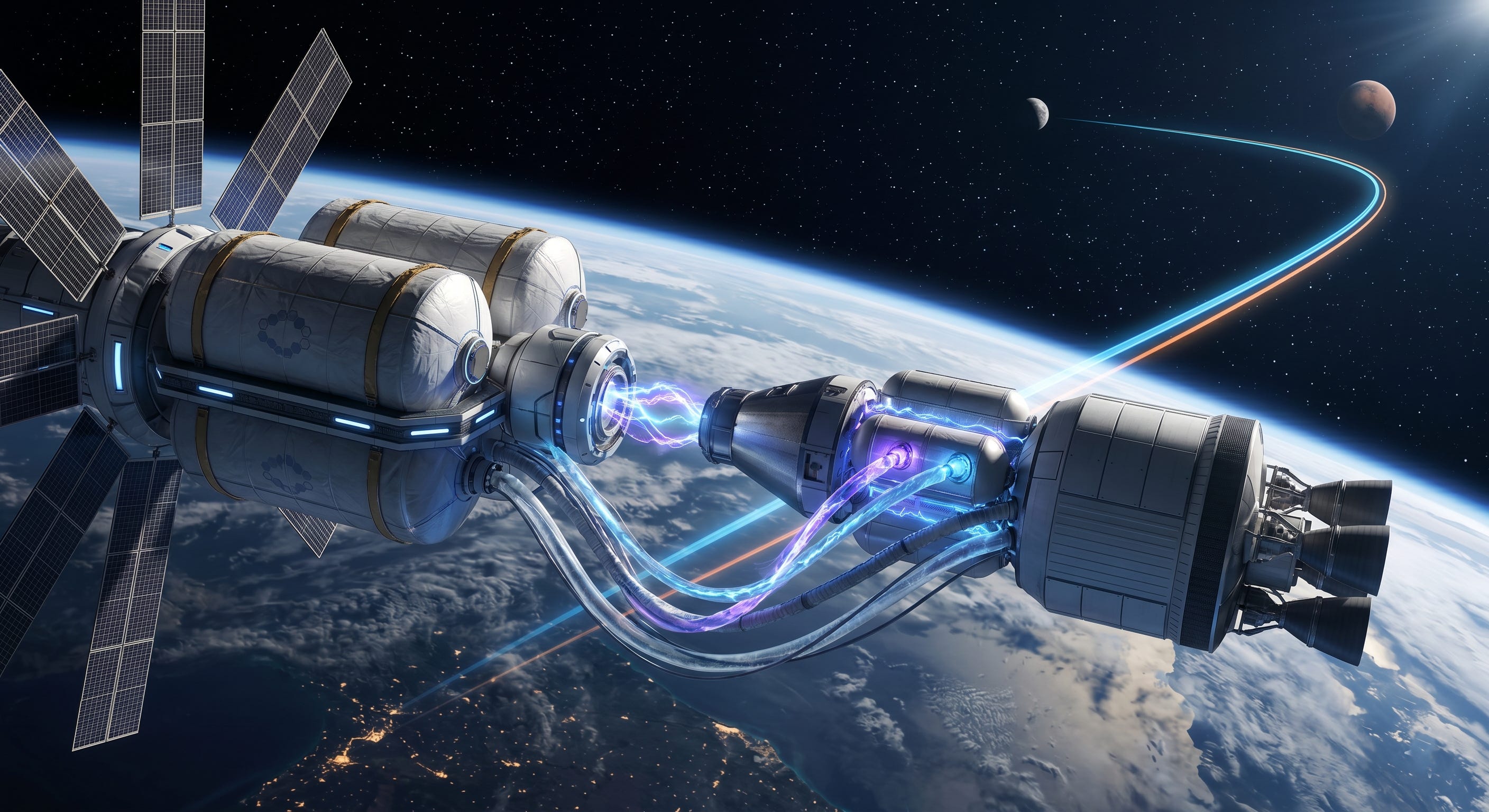
The current trajectory of space exploration is reaching a predictable bottleneck. For decades, the industry has operated under the assumption that every gram of propellant needed for a mission must be carried from the surface of the Earth. This approach, which is dictated by the unforgiving physics of the rocket equation, forces a compromise between the distance a spacecraft can travel and the complexity of the payload it can carry.
As the sector matures from short-term orbital missions to long-range commercial ventures, this single-launch model is becoming an insurmountable logistical burden.
Orbital refuelling stations represent the first significant shift towards a genuine off-world infrastructure. By decoupling the launch of the spacecraft from the acquisition of its fuel, these stations allow for smaller, more efficient launch vehicles and significantly larger payloads. The transition from mission-specific logistics to a permanent, utility-based architecture is the necessary precursor for any sustainable economic activity on the Moon or Mars.
Building this infrastructure requires more than just successful docking manoeuvres. It necessitates a new understanding of cryogenic storage in vacuum and the development of a robust market for propellant.
For founders and investors, the opportunity lies in the creation of the support systems that will underpin this network, from autonomous transfer robotics to long-term storage solutions.
The technical and economic shifts are turning orbital depots from a theoretical concept into the cornerstone of the next era of space logistics. By addressing the propellant gap today, the industry is laying the groundwork for a future where the gravity well of Earth no longer dictates the limits of our reach.
🚀
