

The Sunday Brew #164
In this brew: 4 years of The Percolator in a picture | Media Naturalness Theory & The Principle of Humanity | OpenAI building UAE ChatGPT, China's Quantum Breakthrough & Surging PC Prices


The Sunday Brew | Issue #2 Feb ‘26 | Free

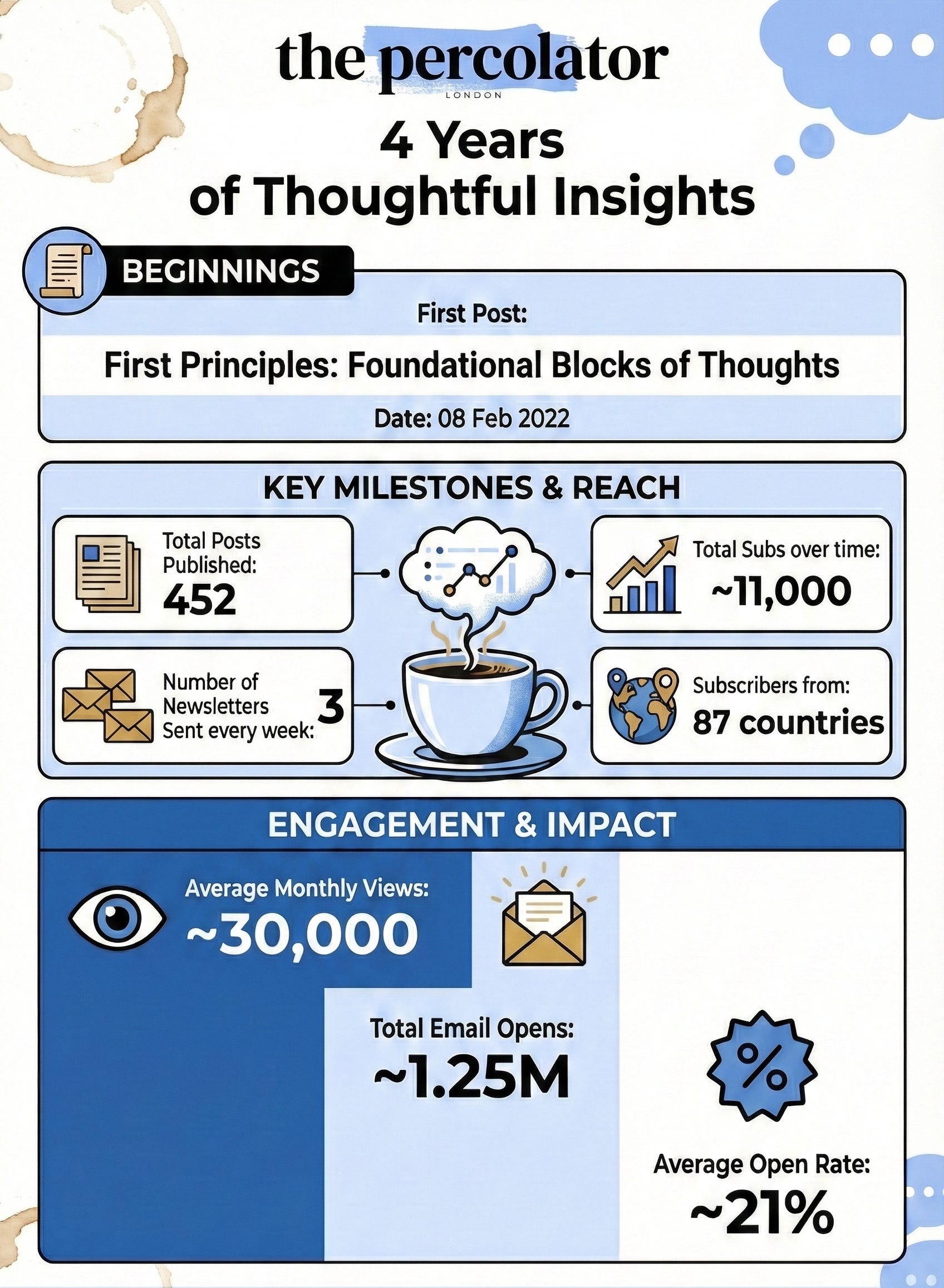
It is incredibly rewarding to mark exactly four years today since hitting publish on our very first post, on February 8, 2022.
Over these 452 issues, The Percolator has grown into a vibrant, global community of over 9000 subscribers spanning 87 countries.
Surpassing 1.25 million total email opens is a milestone that speaks volumes about your engagement, and I am deeply grateful to every one of you for inviting these insights into your inbox every week.
As we step into our fifth year, The Percolator will thrive by sharpening its focus; moving forward, we will dive deeper into frontier technologies, unpacking the specific opportunities they create and analysing their profound impact on the evolving landscapes of entrepreneurship and professional careers.
To that end, we are actively seeking partnerships with the operators and builders who are pioneering these frontiers. If you are shaping the future of technology, let's connect and explore how we can collaborate.
Welcome to The Sunday Brew, weekly 1-2-3 newsletter by The Percolator. Every Sunday we drop in your inbox 1 story in a picture, 2 concepts, ideas or frameworks to expand your horizons and 3 news from the week, to keep you updated.
If you are not a paid subscriber, here is what you missed last week:


ONE STORY IN A PICTURE
TWO IDEAS, FRAMEWORKS OR CONCEPTS
This week we bring to you two Concepts - Media Naturalness Theory & The Principle of Humanity
Media Naturalness Theory
Media Naturalness Theory, developed by Ned Kock, argues that humans are evolutionarily wired for face‑to‑face communication, making it the most “natural” and efficient medium for exchanging information.
It extends media richness theory by offering a Darwinian explanation: for more than 99% of our evolutionary history, our ancestors communicated in co-located, synchronous, face‑to‑face settings using speech, facial expressions, and body language, so our brains are optimized for that mode.
Kock defines the “naturalness” of any communication medium by how closely it approximates face‑to‑face interaction along five elements: co-location, synchronicity, facial expressions, body language, and speech.
The theory’s core hypothesis is that as a medium deviates from this natural pattern, for example, moving from in‑person meetings to text‑only email, three things happen for complex tasks: cognitive effort increases, communication ambiguity rises, and physiological arousal (engagement, alertness) decreases.
These effects matter most in demanding, collaborative activities like business process redesign, product development, or online learning, where misinterpretations or overload are costly.
Importantly, Media Naturalness Theory does not claim low‑naturalness media always produce worse outcomes. It allows for “compensatory adaptation”: over time, people learn to offset the limitations of lean media (for example, through clearer writing norms or emojis), so teams can still reach similar or even better results despite higher initial cognitive load.
🚀
The Principle of Humanity
The Principle of Humanity is a guideline for interpreting other people that tells us to start by assuming they are broadly reasonable, and that their beliefs and desires are connected to the world in ways very similar to our own.
Coined by philosopher Richard Grandy in 1973, it refines Donald Davidson’s “principle of charity,” which says we should, as far as possible, interpret others so that most of what they believe comes out true and coherent by our lights. The principle of humanity adds that we should also treat the other person as if, in their position, we would have roughly the same beliefs and wants, given their evidence and circumstances.
In practice, this means resisting the temptation to see people as alien, stupid, or malicious when we confront views we dislike. Instead, we ask: “If I had their background, information, and constraints, could I see why this would make sense?” This doesn’t force us to agree with them or deny that people can be wrong; rather, it frames disagreement as a clash between roughly comparable agents trying to navigate the same world, instead of a battle between the rational and the irrational.
Applied online, the principle of humanity pushes us to read even bad takes as humanly motivated by fear, loyalty, incentives, or partial information, before we reach for contempt.
An Earnest Appeal
The Percolator is built like a magazine, but without the team or organisation. It takes research, writing, editing, and a steady rhythm to publish longform essays twice a week. Paid subscriptions make this work possible, and sustainable.
If you’ve found value here, I’d love for you to consider upgrading. Paid subscribers unlock every essay, can comment and join the chat, and a chance to feature their own notes and stories.
👉 Please upgrade to paid and help keep the brew strong. It costs less than two coffees a month, but unlike coffee, the energy lasts longer.
THREE NEWS FROM THE WEEK
OpeanAI & G42 partner to build localized ChatGPT for UAE Government
OpenAI is partnering with Abu Dhabi-based AI firm G42 to develop a customized version of ChatGPT for exclusive use by the UAE government, marking one of the first major national-level localizations of the chatbot.
The system will be fine-tuned to handle Emirati Arabic and other local language nuances while aligning responses with the country’s political outlook and speech restrictions, including signalling when content may violate local laws. This move illustrates how U.S. AI companies are increasingly willing to build region-specific models that embed local regulatory and ideological constraints as they expand globally.
G42, chaired by UAE National Security Advisor Sheikh Tahnoon bin Zayed Al Nahyan, sits at the centre of the country’s AI industrial policy and already has a broad strategic partnership with OpenAI across sectors such as finance, energy, and healthcare. The collaboration builds on plans announced in 2025 for “Stargate UAE,” a one-gigawatt AI data centre in Abu Dhabi that will be among the world’s most powerful facilities when completed, providing critical compute for large-scale model deployment.
In parallel, Abu Dhabi’s sovereign-backed AI investment platform MGX participated in a 6.6 billion dollar secondary share sale that valued OpenAI at about 500 billion dollars, and has signalled its intent to remain a major investor in future rounds and in the multibillion-dollar Stargate data centre initiative.
Together, the custom ChatGPT, massive UAE-hosted compute build-out, and escalating capital flows underscore how OpenAI and the Emirati state are tightly interweaving technological, political, and financial interests in the next phase of global AI infrastructure.
➖
China Achieves 100km Device-Independent Quantum Communication Breakthrough
Chinese scientists have achieved a landmark in secure quantum communication by performing device-independent quantum key distribution (DI-QKD) over 100 kilometres of optical fibre, a distance 100 times greater than previous records.
The experiment, led by Jian-Wei Pan and his team at the University of Science and Technology of China, was published in Science on February 4, 2026, marking a major step toward practical, un-hackable communication networks.
DI-QKD ensures data security based purely on the laws of quantum mechanics, rather than on trust in hardware components. It uses entangled particles to generate encryption keys, with security verified through Bell inequality violations that rule out eavesdropping. In the experiment, the team trapped single rubidium-87 atoms at both ends of the fibre, used lasers to stabilize them, and entangled the atoms via single photons. They applied quantum frequency conversion to shift photon wavelengths into telecom bands, minimizing transmission losses.
Over 624 hours, the system produced 1.2 million heralded Bell pairs at 11 kilometres and maintained a positive key rate up to 100 kilometres, confirming long-distance feasibility. Experts like ETH Zürich’s Renato Renner hailed it as a technological “enormous achievement,” suggesting real-world quantum networks are now within reach.
Still, challenges remain: DI-QKD setups are complex and costly, making commercialization years away. Pan’s team now aims to extend the method to satellite-based systems, envisioning a future of secure, global quantum communication.
➖
AI Boom Triggers Global PC Price Surge Amid Prolonged Chip Shortage
The global PC industry is bracing for widespread price hikes as AI-driven demand intensifies pressure on memory and storage supply chains.
System builder PowerGPU warned customers that existing inventories reflect the last of current pricing before sharp increases hit next week, marking another escalation in hardware costs fuelled by component shortages. Research firms IDC, Counterpoint, and TrendForce link the crisis to artificial intelligence data centres’ surging consumption of DRAM and NAND chips forecast to reach 70 percent of global memory output by 2026. Prices for DRAM, NAND, and high-bandwidth memory have already soared between 55 and 110 percent compared to last year.
Major PC vendors including Dell, HP, and Lenovo have confirmed incoming price adjustments of 15–20 percent, as component suppliers struggle to meet demand. Dell’s COO Jeff Clarke described the current surge as the fastest memory cost escalation he’s witnessed.
Analysts say relief remains distant: Samsung and SK Hynix, which dominate DRAM production, expect supply constraints to persist until 2027 due to limited cleanroom capacity and cautious production strategies. Kingston reports NAND wafer prices jumping 246 percent year-over-year, with the majority of the increase occurring within just two months.
In response, several major brands are exploring sourcing memory chips from Chinese manufacturers; an unprecedented move underscoring the depth of the shortage. For now, consumers and PC integrators alike face a new era of sustained high prices and unpredictable lead times as AI’s hardware appetite reshapes global semiconductor economics.


The Sunday Brew by The Percolator brings to you curated news on tech, business & entrepreneurship, from across the internet to give your week a perfect start.
Share your thoughts and opinions on the topics covered in this newsletter by leaving a comment and joining the conversation.