

The Burnout-Capital Paradox
More funding, more stress. Understand how capital pressure fuels burnout and apply the Founder Load Index to restore balance and focus.

The Founder’s Brew | Issue #1, Feb ‘26 | Premium
Welcome to The Founders’ Brew, your Thursday ritual of sharp insight, data-backed thinking, and practical tools for modern founders. Each week we unpack one essential theme from the start-up world — combining frameworks, case studies, and field-tested resources you can apply immediately.
If you’re reading this on the free plan, you’re missing the deep dive, founder frameworks, and downloads that follow. Upgrade to The Founders’ Brew Premium to unlock full essays, data visuals, and subscriber-only templates.
» » » Check out subscribers’ benefits.
In this issue, we confront the stress hidden behind capital raises. Our term of the week, Founder Load Index, quantifies decision fatigue. The Main Brew, “The Burnout-Capital Paradox,” unpacks how funding pressure breeds exhaustion. The Takeaway includes the FLI Self-Assessment, and Add the Beans asks: How do you detect early signs of founder burnout?
💡STARTUP WORD OF THE WEEK
Founder Load Index (FLI)
Founder Load Index quantifies the combined weight of decisions, meetings, and emotional strain a founder handles weekly. When FLI exceeds sustainable thresholds, burnout probability spikes.
Tracking FLI enables proactive redistribution of cognitive and operational load. Reducing it through system design, not willpower, preserves performance over long build cycles.
☕️THE MAIN BREW
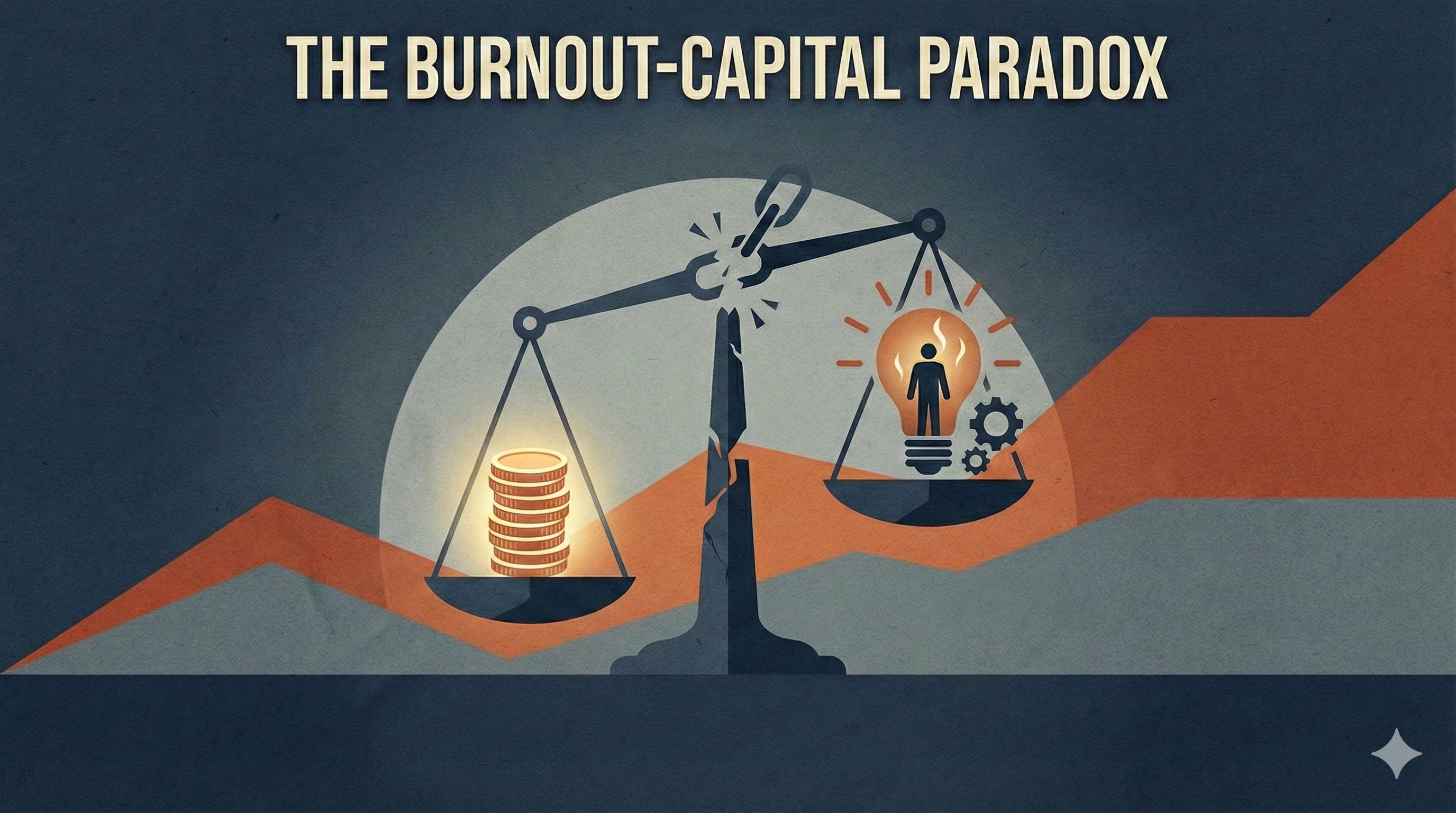
The Burnout-Capital Paradox
Raising capital is widely treated as a turning point that reduces risk, increases control, and creates strategic freedom. Founders internalize a simple equation: more capital equals more optionality. In practice, the equation rarely holds. Across early and growth-stage companies, funding events often coincide with rising cognitive load, longer working hours, and declining personal resilience.
Instead of relieving pressure, capital frequently amplifies it.
This tension defines what can be called the Burnout-Capital Paradox. The same capital that extends runway also multiplies expectations. New stakeholders appear, reporting cadence intensifies, and decisions that once affected a small team now cascade across dozens or hundreds of people. Hiring accelerates, but coordination costs rise faster. Ambiguity increases, not decreases, because the organization expands before systems mature. Founders become the default integrators of unfinished processes.
Recent founder surveys from 2024 and 2025 show a consistent pattern. Reported stress levels increase after seed extensions and Series A rounds, not before them. Burnout risk correlates less with company survival anxiety and more with performance pressure tied to valuation, growth targets, and investor narratives.
Capital changes the nature of stress rather than eliminating it.
Founder Load Index is a composite measure that tracks decision volume, meeting density, people management burden, growth pacing, and personal recovery capacity. Unlike traditional metrics such as revenue or runway, FLI focuses on the founder as a constrained system. When FLI rises faster than organizational capability, burnout becomes a structural outcome rather than a personal failure.
Most founders respond to rising load by working harder or delaying rest. That response often accelerates the problem. The paradox is not that founders burn out despite success. It is that success, when structured incorrectly, produces burnout by design.
🚀
