

The Sunday Brew #189
In this brew: The Battery Density Timeline in a picture | The Black Swan Theory & Paradigm Shift | EU AI Act enforcement, Quantum threat to Bitcoin, and China AI law push

The Sunday Brew | Issue #1, Aug‘26 | Free
Welcome to The Sunday Brew, weekly 1-2-3 newsletter by The Percolator. Every Sunday we drop in your inbox 1 story in a picture, 2 concepts, ideas or frameworks to expand your horizons and 3 news from the week, to keep you updated.
If you are not a paid subscriber, here is what you missed last week:


ONE STORY IN A PICTURE
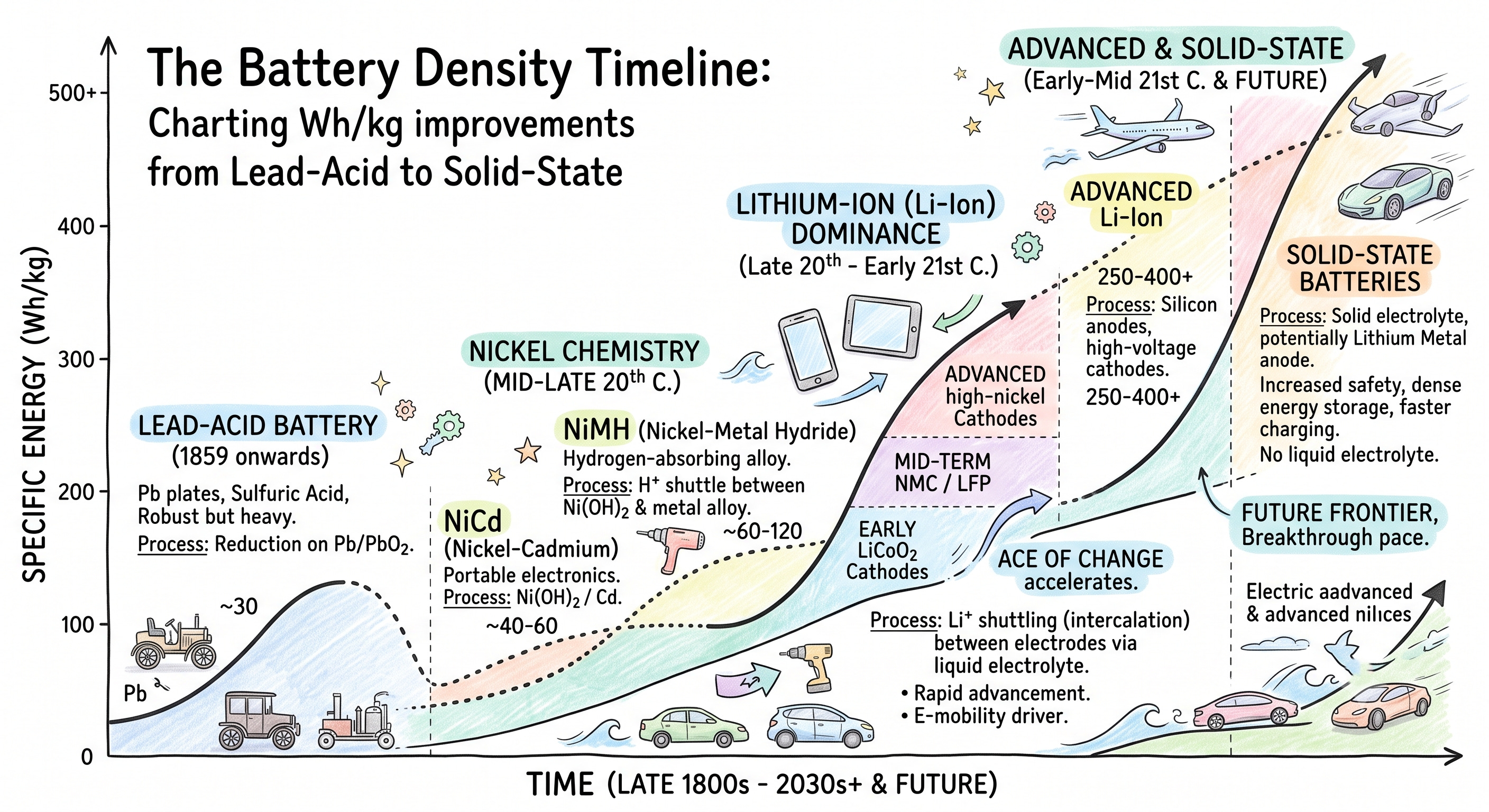
The Battery Density Timeline
TWO IDEAS, FRAMEWORKS OR CONCEPTS
This week we bring to you two Concepts: The Black Swan Theory & Paradigm Shift
The Black Swan Theory
The Black Swan theory describes highly improbable occurrences that fundamentally alter operational environments and carry significant structural consequences.
Because these extreme outliers exist completely outside the boundaries of historical precedent, standard statistical models are inherently incapable of predicting them. Professionals relying on normal distributions and past data routinely miscalculate the true exposure of their systems to severe shocks. The core vulnerability within these models stems from the flawed assumption that historical patterns represent the absolute limits of future possibilities.
Following such an occurrence, observers typically construct retrospective narratives to explain the specific sequence of events that led to the outcome. This cognitive bias creates the illusion that the disruption was foreseeable and could have been prevented with more rigorous analysis. By rationalising the anomaly after the fact, organisations develop a false sense of security regarding their analytical capabilities. This retrospective logical structuring masks the fundamental unpredictability of the event and encourages an ongoing reliance on flawed forecasting methods for subsequent planning cycles.
Navigating environments characterised by extreme unpredictability requires abandoning the attempt to forecast unprecedented disruptions accurately. Professionals must instead concentrate on constructing robust architectures capable of absorbing severe shocks without experiencing complete failure. Strategic planning should focus on identifying hidden vulnerabilities and maintaining sufficient capital reserves to survive extreme market dislocations.
By shifting the primary objective from precise prediction to structural resilience, organisations can withstand severe anomalies and maintain continuous operations when the next unforecastable event inevitably materialises.
🚀
Paradigm Shift
A paradigm shift represents a fundamental restructuring of the foundational assumptions and operational rules that govern a specific discipline.
In standard practice, professionals operate within an established framework to solve problems and interpret data. As operational anomalies accumulate that the current model cannot explain, structural friction emerges. Rather than marginally adjusting the existing parameters, a complete replacement of the underlying conceptual structure becomes necessary. This transition forces practitioners to abandon previously accepted methodologies and adopt an entirely new cognitive baseline for evaluating information.
When these structural transitions occur, the criteria for valid data and correct methodology change entirely. Observations that were previously dismissed as irrelevant noise are suddenly recognised as critical indicators under the new framework. This requires professionals to rebuild their analytical tools from the ground up. The difficulty stems from the fact that the old framework often actively resists the new principles, making the transition highly disruptive to established workflows. Success during these periods demands rigorous intellectual flexibility and the willingness to discard outdated cognitive maps when empirical evidence demands a different approach.
Organisations navigating these changes must actively identify when their core operating assumptions no longer align with objective reality. Strategic leaders should monitor accumulating anomalies within their environments instead of dismissing them as mere statistical outliers. By recognising the early indicators of a structural transition, teams can proactively recalibrate their analytical models before external pressures force a sudden collapse of their systems.
Adapting to these shifts ensures that decision-making frameworks remain aligned with the actual conditions governing the environment.
🚀
An Earnest Appeal
The Percolator is built like a magazine, but without the team or organisation. It takes research, writing, editing, and a steady rhythm to publish longform essays twice a week. Paid subscriptions make this work possible, and sustainable.
If you’ve found value here, I’d love for you to consider upgrading. Paid subscribers unlock every essay, can comment and join the chat, and a chance to feature their own notes and stories.
👉 Please upgrade to paid and help keep the brew strong. It costs less than two coffees a month, but unlike coffee, the energy lasts longer.
THREE NEWS FROM THE WEEK
EU launches enforcement team as AI Act nears full effect
The European Union has launched a new AI enforcement team in Brussels as the bloc moves closer to fully activating its landmark AI Act.
The unit, unveiled just days before key provisions take effect, is designed to monitor compliance by AI companies operating in Europe and abroad, including major players in the US and China.
The new team will focus on a range of potential violations, from deepfakes and sexually explicit AI-generated content to cyber threats targeting public infrastructure. The European Commission says the expanded enforcement capacity is meant to ensure that companies follow the bloc’s new transparency and safety standards as AI systems become more powerful and widely deployed.
Under the latest rules, companies will be required to clearly label chatbot interactions and mark AI-generated text, images, audio and video with digital watermarks so synthetic content can be identified. The Commission has also introduced whistleblower and compliance tools to allow tech workers and users to report illegal conduct confidentially.
Officials say non-compliance could trigger fines of up to 15 million euros, or 3% of a company’s global annual revenue. The move comes amid growing concern over frontier AI safety, following recent disclosures of unauthorized hacking incidents involving advanced AI models during testing.
Alongside the regulatory push, the EU is also investing heavily in AI infrastructure, including plans for seven AI giga-factories that could help reduce Europe’s dependence on foreign computing power and boost its competitiveness against the US and China.
➖
IBM quantum milestone reignites debate over Bitcoin security
IBM’s latest quantum computing milestone has revived concerns over the long-term security of Bitcoin, as researchers and industry leaders warn that advances in the field could eventually threaten the cryptography protecting the world’s largest cryptocurrency.
The company, alongside Algorithmiq, said it had demonstrated quantum advantage on a specific simulation task, a development that adds fresh urgency to debates over how quickly the industry must prepare for a post-quantum future.
The concern centres on Bitcoin addresses whose public keys have already been exposed on the blockchain. According to the BIP-361 proposal under discussion among Bitcoin developers, more than 34% of Bitcoin’s supply, about 6.8 million BTC, is held in such addresses, making them theoretically vulnerable if a sufficiently powerful quantum computer can run Shor’s algorithm against elliptic curve cryptography.
While current quantum machines remain far from that capability, the pace of progress has alarmed institutions. In response, a group of major firms including BlackRock, Fidelity Digital Assets, Coinbase, Strategy, Block, Galaxy Digital, Anchorage Digital, ARK Invest and Blockstream recently launched the Bitcoin Security Consortium, committing $15 million over three years for security research and open-source development. Galaxy Digital has separately introduced a quantum readiness initiative with developer grants worth up to $5 million, while Coinbase has formed an advisory board on quantum computing.
IBM CEO Arvind Krishna said the technology could begin contributing measurably to revenue by 2028 or 2029, underscoring why the sector is treating quantum risk as a race against time.
➖
China to speed up national AI law amid US split
China’s National Development and Reform Commission has said it will accelerate work on a national artificial intelligence law, underscoring Beijing’s effort to put AI development under a clearer and more centralized regulatory framework.
The move is part of China’s broader push to support rapid innovation while tightening oversight around security, safety, and control of advanced technologies.
According to the report, NDRC spokesperson Jiang Yi outlined the plan during a press conference reviewing first-half economic performance. The proposed law is expected to form part of China’s 15th Five-Year Plan, covering 2026 to 2030, and could help guide investment into the country’s fast-growing AI and computing infrastructure sector.
The announcement comes as Chinese AI companies continue to gain global attention. Firms such as DeepSeek and Moonshot AI have released large-scale open-source models, while Chinese large models have reportedly crossed 10 billion downloads worldwide. That momentum has strengthened calls inside China for a unified legal framework that can support the sector’s expansion without sacrificing state oversight.
The development also highlights a widening contrast with the United States, where federal AI regulation remains fragmented. Several competing proposals are circulating in Washington, but no comprehensive national AI law has yet emerged, leaving the regulatory debate unsettled as both countries race to shape the future of artificial intelligence.


The Sunday Brew by The Percolator brings to you curated news on tech, business & entrepreneurship, from across the internet to give your week a perfect start.
Share your thoughts and opinions on the topics covered in this newsletter by leaving a comment and joining the conversation.