

The Sunday Brew #186
In this brew: The Scale of Data in a picture | Gall’s Law & Brooks’s Law | China Flags Claude Code Risk, Mitsubishi Enters Humanoid Robotics, and Tencent Eyes Manus Buyback

The Sunday Brew | Issue #2 July‘26 | Free
Welcome to The Sunday Brew, weekly 1-2-3 newsletter by The Percolator. Every Sunday we drop in your inbox 1 story in a picture, 2 concepts, ideas or frameworks to expand your horizons and 3 news from the week, to keep you updated.
If you are not a paid subscriber, here is what you missed last week:


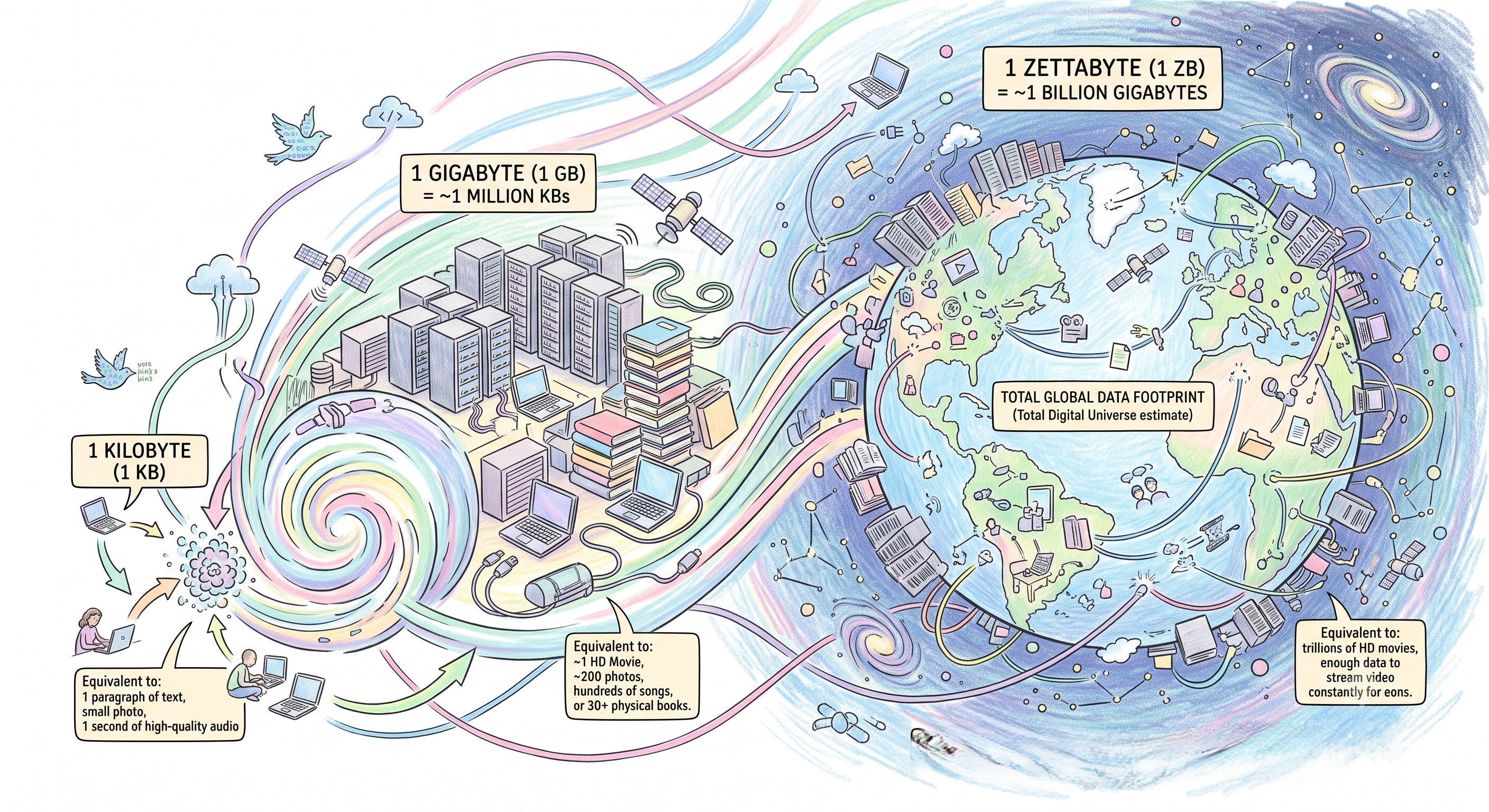
ONE STORY IN A PICTURE
The Scale of Data
TWO IDEAS, FRAMEWORKS OR CONCEPTS
This week we bring to you two Concepts: Gall’s Law & Brooks’s Law
Gall’s Law
Gall’s Law dictates that any functional complex system invariably evolves from a simpler system that operated successfully.
When developing highly advanced technical architectures, teams often attempt to design a complete, multi-faceted solution from the top down. This approach generally fails because injecting high levels of complexity at the initial stage introduces hidden dependencies and cascading failure points that are impossible to predict. A complex design created from scratch is fundamentally flawed because it lacks the empirical testing and environmental feedback required to validate its core assumptions.
To achieve reliable operation in ambitious projects, professionals must begin by constructing a minimal, functioning prototype. Once this foundational layer proves robust under operational conditions, engineers can methodically integrate subsequent layers of complexity. This iterative process ensures that each new variable is grounded in a stable baseline, allowing teams to isolate and correct errors before they compromise the entire structure. The evolution from simple to complex represents a structural necessity for building resilient technical frameworks rather than just a preferred development strategy.
Leaders directing high-stakes technical projects must therefore resist the urge to deploy fully integrated systems prematurely. Development efforts should be concentrated on proving the basic mechanisms first to establish a reliable foundation. By acknowledging that complexity is an emergent property of successful iteration rather than an initial design condition, organisations can avoid the significant resource drain associated with fundamental system failures. This disciplined progression ensures the final output remains both highly capable and structurally sound.
🚀
Brooks’s Law
Brooks’s Law observes that injecting additional personnel into an already delayed technical project will further impede its progress.
When managing advanced engineering initiatives, leaders often assume that human effort scales linearly and that doubling the workforce will halve the completion time. This calculation fails because specialised development work requires significant coordination and contains tasks that must be completed sequentially. As team size increases, the number of communication channels grows exponentially, creating a substantial administrative burden that slows down actual productive output.
Furthermore, integrating new engineers into an unproven system demands considerable time and resources. The original team members must pause their critical path activities to train the new arrivals on specific technical architectures and theoretical constraints. This diversion of focus causes an immediate drop in overall productivity. The new personnel also require time to understand the nuances of the experimental systems before they can contribute meaningfully. Consequently, the project suffers a short-term deceleration that often outweighs any long-term capacity gains, pushing the delivery date further into the future.
Project managers facing schedule overruns on ambitious technical builds must resist the instinct to increase headcount blindly. A more effective strategy involves reassessing the core architecture, reallocating existing specialists to clear bottlenecks, or adjusting the final delivery scope. Acknowledging the strict limits of parallel processing in advanced engineering prevents teams from exacerbating delays through counterproductive expansion. Maintaining a highly aligned group of experts often provides the most reliable path to completing highly difficult technical challenges.
🚀
An Earnest Appeal
The Percolator is built like a magazine, but without the team or organisation. It takes research, writing, editing, and a steady rhythm to publish longform essays twice a week. Paid subscriptions make this work possible, and sustainable.
If you’ve found value here, I’d love for you to consider upgrading. Paid subscribers unlock every essay, can comment and join the chat, and a chance to feature their own notes and stories.
👉 Please upgrade to paid and help keep the brew strong. It costs less than two coffees a month, but unlike coffee, the energy lasts longer.
THREE NEWS FROM THE WEEK
China Warns of Security Risks in Anthropic’s Claude Code, Company Denies Backdoor Claims
China’s National Vulnerability Database (NVDB) has issued a security warning alleging that Anthropic’s Claude Code contained a concealed monitoring mechanism capable of collecting user-related data without explicit consent.
The advisory, published under the Ministry of Industry and Information Technology, identified affected software versions released between April and June and urged organizations to investigate usage, restrict network access, and upgrade to newer versions.
The alert follows findings by an independent security researcher who identified steganographic markers embedded within system prompts. These markers reportedly enabled the software to infer whether users were accessing the tool from China through proxies or indirect channels by analyzing signals such as timezone settings, network endpoints, and infrastructure links.
Anthropic acknowledged the presence of the mechanism, stating it was introduced in March as an experimental measure to prevent unauthorized access and limit model distillation. The company rejected claims that the feature constituted a backdoor, describing it instead as a narrowly scoped anti-abuse safeguard that has since been removed in updated releases.
Anthropic also reiterated that its services were not authorized for use in China and disclosed that it had banned a large number of accounts linked to unauthorized access. The development comes amid heightened scrutiny of foreign technology tools in China and reflects broader tensions over AI governance, data security, and cross-border access to advanced models.
➖
Mitsubishi Motors to Mass-Produce Humanoid Robots with University of Tokyo Start-up
Mitsubishi Motors has entered into a partnership with Highlanders, a robotics start-up originating from the University of Tokyo, to jointly develop and mass-produce humanoid robots, the company said. Production is expected to begin as early as 2027 at Mitsubishi’s Kyoto facility, with a planned monthly capacity of up to 1,000 units.
The automaker intends to initially deploy the robots within its own manufacturing operations, where they will be used for tasks such as transporting components and assisting in engine assembly. The in-house deployment is expected to generate operational data to refine performance and reliability before broader commercialization.
Mitsubishi Motors said it will leverage its expertise in mass production, quality control, and mechatronics to scale manufacturing of humanoid robots, a segment that has faced challenges in achieving industrial-scale output. The company is also considering supplying the robots to external customers over time, signaling a potential expansion beyond its core automotive business.
The collaboration comes as Japanese manufacturers face increasing labor shortages due to an aging population and declining workforce. It also reflects a broader trend within the automotive industry, where companies are exploring new applications of manufacturing capabilities amid structural shifts, including the transition to electric vehicles.
Mitsubishi Motors has previously invested in Highlanders and indicated it may increase its financial commitment as the partnership progresses.
➖
Tencent in Talks to Become Largest Shareholder in AI Start-up Manus After Meta Deal Unwinds
Tencent Holdings is in talks to become the largest shareholder in AI start-up Manus as investors move to unwind Meta’s approximately $2 billion acquisition of the company, according to reports.
The proposed deal would see Tencent join a consortium that includes Manus’s early backers, such as ZhenFund and HSG, to buy back the company at or above the original valuation, with plans to raise about $1 billion from external investors.
The development follows intervention by Chinese regulators earlier this year, which effectively blocked the Meta-Manus transaction on national security grounds. Authorities cited concerns over the transfer of advanced artificial intelligence capabilities to a foreign entity, prompting efforts to reverse the deal.
Manus, developed by Butterfly Effect, emerged as a prominent player in 2025 after launching an agentic AI platform designed to execute complex tasks with minimal human input. The start-up drew significant global attention and was viewed as strategically important in the evolving AI landscape.
Meta had intended to integrate Manus’s technology into its broader artificial intelligence ecosystem, but the acquisition became entangled in rising geopolitical tensions between China and the United States.
If completed, the Tencent-led buyback would represent a rare reversal of a major cross-border technology acquisition, underscoring increasing regulatory scrutiny and the growing role of national security considerations in global AI investments.


The Sunday Brew by The Percolator brings to you curated news on tech, business & entrepreneurship, from across the internet to give your week a perfect start.
Share your thoughts and opinions on the topics covered in this newsletter by leaving a comment and joining the conversation.