

The Sunday Brew #184
In this brew: Quantum Computing Timeline in a picture | The Adjacent Possible & Critical Mass | World's first Nuclear-Hydrogen Plant, Quantum-Safe Encryption Breakthrough & Pax Silica Summit 2026

The Sunday Brew | Issue #4 June‘26 | Free
Welcome to The Sunday Brew, weekly 1-2-3 newsletter by The Percolator. Every Sunday we drop in your inbox 1 story in a picture, 2 concepts, ideas or frameworks to expand your horizons and 3 news from the week, to keep you updated.
If you are not a paid subscriber, here is what you missed last week:


ONE STORY IN A PICTURE
Quantum Computing Timeline
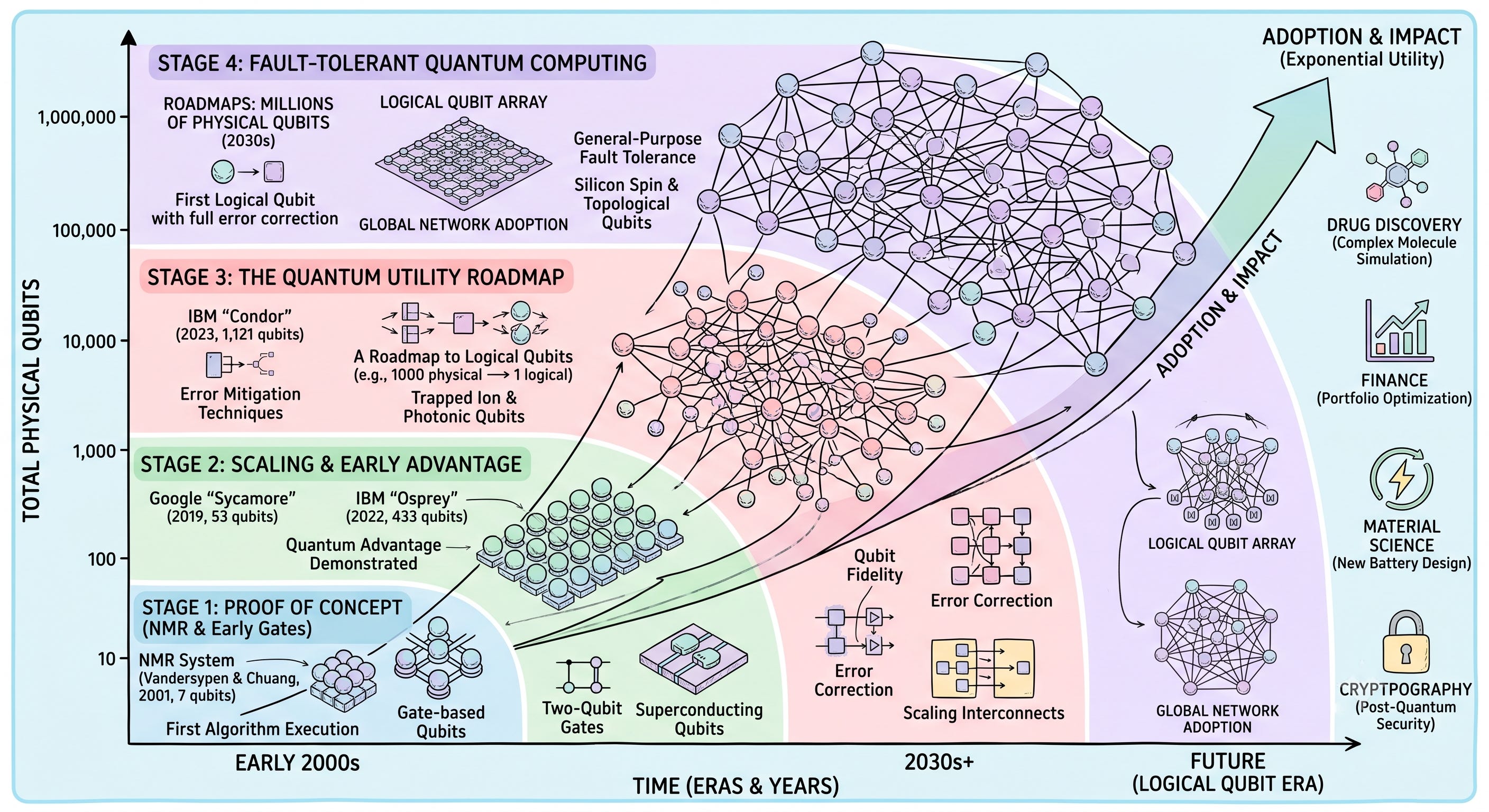
TWO IDEAS, FRAMEWORKS OR CONCEPTS
This week we bring to you two Concepts: The Adjacent Possible & Critical Mass
The Adjacent Possible
The adjacent possible represents the immediate boundaries of technological development that can be achieved using existing resources.
Rather than predicting distant future states, this framework focuses on the new combinations of current tools and established processes that are technically feasible today. Every new development expands this boundary by introducing novel components into the system. As an industry progresses along the technology curve, the available combinations multiply. This expansion dictates the practical trajectory of commercial product development.
Organisations attempting to bypass the adjacent possible by designing products that require non-existent infrastructure frequently fail. A viable technical product relies on an ecosystem of supporting technologies being readily available. Early internet video platforms, for instance, struggled because the supporting bandwidth and compression algorithms had not yet matured. Once these underlying technical constraints were resolved, high-definition streaming shifted into the adjacent possible and became commercially viable. Strategic planning requires a rigorous assessment of exactly which capabilities are currently within reach instead of projecting distant visions.
Research and development teams must therefore concentrate their capital on the edges of this established boundary. By identifying the intersections of newly matured technologies, firms can engineer practical solutions that the market is structurally prepared to absorb. This methodology reduces the capital risk associated with speculative research while ensuring continuous iteration along the technology curve. Sustaining technological progress ultimately requires a disciplined focus on executing the precise next step that current capabilities permit.
🚀
Critical Mass
Critical mass refers to the precise threshold where a product or platform achieves sufficient adoption to grow autonomously.
Before this point, user acquisition relies entirely on continuous marketing expenditure and direct sales efforts to overcome the initial friction of market entry. Once a product crosses this adoption boundary, the dynamic fundamentally shifts. The network effects inherent in the technology begin to generate their own momentum, meaning the value of the platform increases naturally as more participants join. This autonomous growth reduces the reliance on external capital and transitions the business model into a sustainable phase of expansion.
This principle is highly visible in the deployment of multi-sided marketplaces and communication standards. In the early stages of a new platform, operators must often subsidise participation to build a foundational user base. A messaging application holds minimal utility for its first few users, but as user density increases, the service becomes structurally indispensable to the broader community. Upon reaching critical mass, the accumulated user base acts as a powerful retention mechanism while simultaneously attracting new participants. This established density also creates formidable barriers for competing technologies attempting to enter the same space, as they must overcome both the financial cost of development and the established network of the incumbent.
For management teams and investors, understanding this inflection point dictates capital allocation. Strategies often necessitate prioritising rapid market penetration and user acquisition over short-term profitability to ensure the product reaches self-sustenance. If an enterprise exhausts its funding before crossing this boundary, the technology typically fails regardless of its underlying capabilities. Therefore, the primary commercial objective during a product launch is to identify and achieve the specific market density required to trigger these autonomous feedback loops.
🚀
An Earnest Appeal
The Percolator is built like a magazine, but without the team or organisation. It takes research, writing, editing, and a steady rhythm to publish longform essays twice a week. Paid subscriptions make this work possible, and sustainable.
If you’ve found value here, I’d love for you to consider upgrading. Paid subscribers unlock every essay, can comment and join the chat, and a chance to feature their own notes and stories.
👉 Please upgrade to paid and help keep the brew strong. It costs less than two coffees a month, but unlike coffee, the energy lasts longer.
THREE NEWS FROM THE WEEK
Kalpakkam, India Hosts World’s First Nuclear-Hydrogen Plant
India has inaugurated the world’s first hydrogen production facility powered by nuclear process heat at the Indira Gandhi Centre for Atomic Research in Kalpakkam, Tamil Nadu, turning a long-standing laboratory concept into a working technology demonstrator. The project uses the Copper-Chlorine thermochemical cycle, developed by BARC, and heat from the Fast Breeder Test Reactor to produce hydrogen without relying on fossil fuels or electricity as the main energy input.
The significance of the launch goes beyond symbolism. Hydrogen is widely viewed as a key industrial fuel for decarbonizing sectors that are hard to electrify, and this facility shows that nuclear energy can play a role not only in power generation but also in producing clean process heat for industrial applications. Officials said the plant was built as a technology demonstrator, meaning its immediate goal is to validate performance, gather operational data, and refine the Cu-Cl process before any larger-scale deployment.
What makes the Kalpakkam facility notable is the combination of indigenous development and strategic ambition. According to the Department of Atomic Energy, the project reflects years of research, engineering, fabrication, testing, and commissioning by BARC and IGCAR, and it strengthens India’s clean hydrogen mission while supporting energy security and long-term sustainable development goals. It also reinforces the broader role of Kalpakkam in India’s three-stage nuclear programme, especially after the Prototype Fast Breeder Reactor achieved first criticality earlier this year.
For India, the launch is less about immediate commercial hydrogen output and more about proving a future pathway. If the demonstrator performs well, it could open the door to a new class of low-carbon hydrogen systems built around continuous nuclear heat, a valuable advantage for industries that need reliable, 24/7 fuel supply.
➖
ISO Adopts Quantum-Resistant Classic McEliece With Warwick Co-Designer
ISO’s adoption of Classic McEliece signals that the global standards system is starting to treat quantum-safe encryption as an operational necessity rather than a future possibility.
Co-designed by an international team that includes Dr Varun Maram of the University of Warwick, the code-based cryptographic scheme has now moved from specialist research into formal standardization, giving governments, enterprises, and infrastructure providers a clearer path to long-term protection.
The development matters because quantum computers, once powerful enough, could undermine widely used public-key systems that secure everything from communications to financial data. Classic McEliece offers a different approach by relying on error-correcting codes rather than the factoring and discrete-log problems that underpin older systems. That alternative has appealed to security planners looking for something resilient not just against today’s attackers, but also against the “harvest now, decrypt later” risk that makes encrypted data vulnerable in the years ahead.
Its broader momentum is also notable: Mullvad VPN has already integrated it, Germany’s Federal Office for Information Security has endorsed it for long-term confidentiality, and NIST is expected to continue evaluating it alongside its own post-quantum framework. The result is a rare convergence of academic credibility, public-sector endorsement, and commercial adoption. For the cybersecurity industry, the message is straightforward: post-quantum migration is no longer theoretical, and the standards race is now shaping how quickly that migration will happen.
➖
Pax Silica summit expands to 35 nations as Washington pushes AI supply-chain security
The second Pax Silica Summit concluded in Washington on June 26, 2026, with 35 countries endorsing a Joint Statement on AI Opportunity that calls for stronger, more resilient supply chains for the technologies underpinning artificial intelligence.
The summit, launched by the U.S. State Department in December 2025, is designed to build a new economic-security consensus around AI infrastructure, critical minerals, semiconductors, and logistics.
The gathering reflects a broader U.S. effort to turn AI supply chains into a strategic policy arena, not just a commercial one. Officials framed the initiative as a way to reduce bottlenecks and improve reliability across the global hardware stack that powers AI systems, from energy inputs to advanced manufacturing and transport.
The roster of participants signals widening international interest in the project, with governments from Europe, Latin America, Central Asia, the Gulf, and Asia joining the conversation. That diversity suggests Pax Silica is evolving into a multilateral platform for countries that want access to AI’s growth potential without overdependence on fragile or concentrated supply chains.
At the same time, the summit carries an unmistakable geopolitical edge. By linking AI opportunity to supply-chain resilience, Washington is positioning itself around the industrial foundations of the AI era, where competition is increasingly about who controls the materials, manufacturing, and transport networks that make the technology possible.


The Sunday Brew by The Percolator brings to you curated news on tech, business & entrepreneurship, from across the internet to give your week a perfect start.
Share your thoughts and opinions on the topics covered in this newsletter by leaving a comment and joining the conversation.