

The Sunday Brew #183
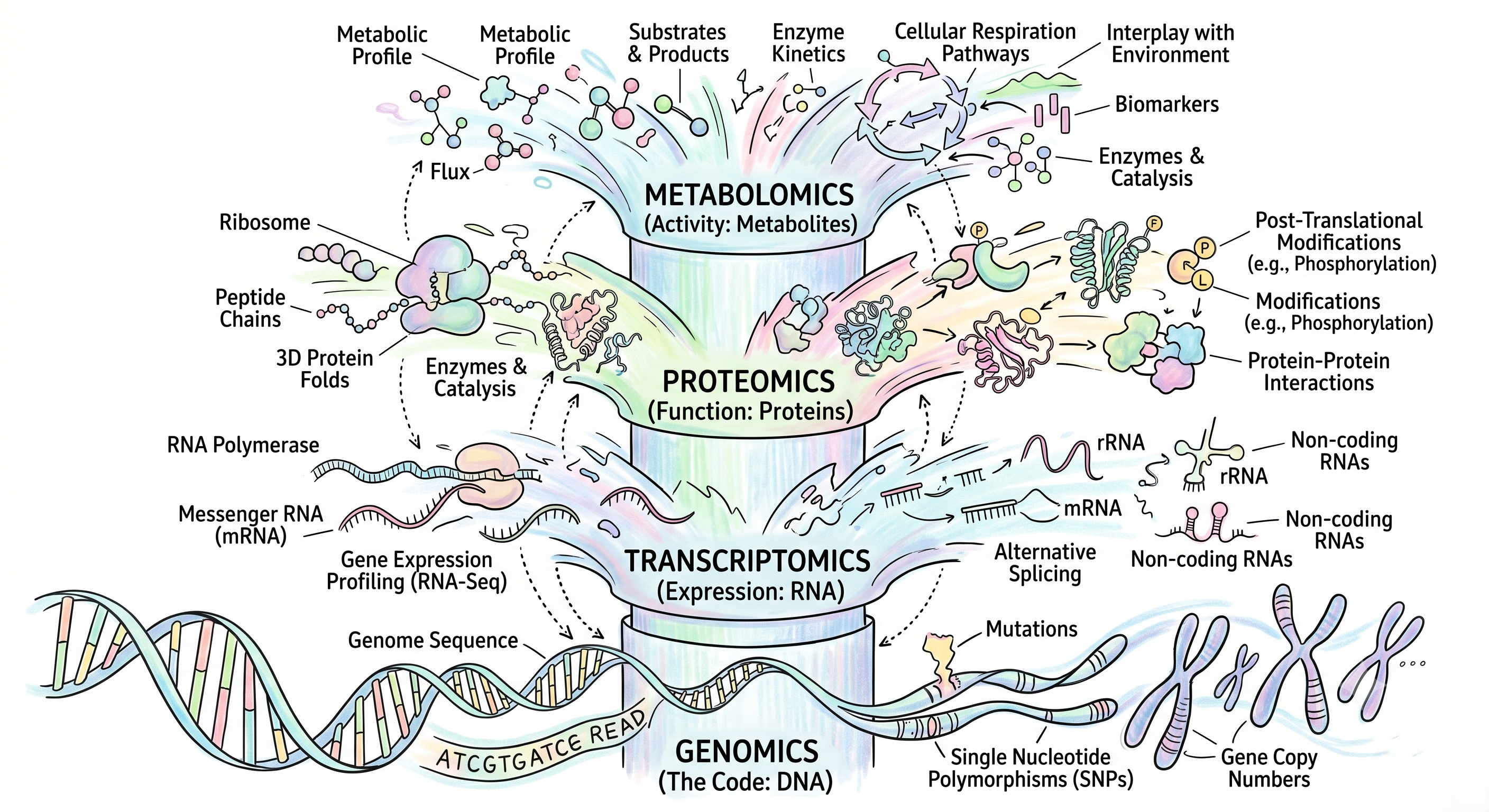
In this brew: The Multiomics Stack in a picture | Computational Irreducibility & Radical Candour | Quantum leap in materials, EU widens tech crackdown & Local AI goes mainstream

The Sunday Brew | Issue #3 June‘26 | Free
Welcome to The Sunday Brew, weekly 1-2-3 newsletter by The Percolator. Every Sunday we drop in your inbox 1 story in a picture, 2 concepts, ideas or frameworks to expand your horizons and 3 news from the week, to keep you updated.
If you are not a paid subscriber, here is what you missed last week:


ONE STORY IN A PICTURE
The Multiomics Stack
TWO IDEAS, FRAMEWORKS OR CONCEPTS
This week we bring to you two Concepts: Computational Irreducibility & Radical Candour
Computational Irreducibility
Computational irreducibility asserts that the future states of certain complex systems cannot be predicted using mathematical shortcuts. To determine their outcomes, observers must simulate every intermediate step of the process.
In advanced scientific modelling, this principle highlights a strict limitation in predictive analytics. While classical mechanics relies on formulas to forecast trajectories instantaneously, modern research frequently involves non-linear dynamics where data compression is impossible. The system itself acts as the most efficient mechanism for calculating its own behaviour.
This reality presents distinct structural challenges for frontier engineering disciplines. When researching novel meta-materials or modelling high-altitude aerodynamics, teams encounter environments where local interactions generate highly unpredictable macroscopic states. Because analytical solutions do not exist for these phenomena, researchers must deploy substantial computational resources to execute complete iterative simulations. The absence of a predictive shortcut dictates that progress in these domains remains tightly bound to raw processing capabilities.
Recognising this inherent limitation demands a specific shift in research methodology. Instead of attempting to derive closed-form equations for fundamentally chaotic environments, organisations must prioritise high-fidelity empirical simulations. This strategy acknowledges that specific physical constraints cannot be bypassed through mathematical deduction. Consequently, capital allocation must focus directly on scaling hardware infrastructure to accommodate the unavoidable processing demands of advanced system design.
🚀
Radical Candour
Radical candour operates as a management framework that requires leaders to balance genuine empathy with clear, unambiguous feedback.
Within a founding team or corporate hierarchy, maintaining operational efficiency relies on addressing performance issues without hesitation. The model demands that leaders establish a baseline of professional investment in their staff, which subsequently permits them to deliver stringent critiques regarding work quality. By building a foundation of trust, managers ensure that necessary corrections are received as functional guidance rather than personal attacks.
When managers fail to apply this methodology, they typically default to obscuring criticism to protect morale. This reluctance to address substandard work directly results in compounding errors and severe operational inefficiencies. Alternatively, aggressive correction delivered without existing mutual respect breeds resentment and accelerates employee attrition. For an organisation to function optimally, feedback must bypass diplomatic softening and address the precise root of a problem. Providing unvarnished criticism confirms that a leader respects their colleague enough to treat them as a capable professional who can process objective data.
For founders, establishing this communication standard is a structural requirement for scaling operations. When technical teams operate under tight resource constraints, miscommunications regarding product viability carry significant financial penalties. Radical candour minimises these risks by fostering an environment where technical disagreements are surfaced immediately. By removing the cognitive load associated with deciphering vague feedback or navigating office politics, organisations enable their staff to focus entirely on executing complex deliverables. This transparent communication model ultimately aligns individual performance with the overarching strategic objectives of the business.
🚀
An Earnest Appeal
The Percolator is built like a magazine, but without the team or organisation. It takes research, writing, editing, and a steady rhythm to publish longform essays twice a week. Paid subscriptions make this work possible, and sustainable.
If you’ve found value here, I’d love for you to consider upgrading. Paid subscribers unlock every essay, can comment and join the chat, and a chance to feature their own notes and stories.
👉 Please upgrade to paid and help keep the brew strong. It costs less than two coffees a month, but unlike coffee, the energy lasts longer.
THREE NEWS FROM THE WEEK
Scientists Detect Large-Scale Quantum Entanglement in ‘Strange Metal’ Crystal
Physicists from TU Wien and Rice University have experimentally detected large-scale quantum entanglement inside a macroscopic crystal, offering a breakthrough link between quantum information theory and solid-state physics.
The study, published in Nature Physics (June 2026), focuses on a “strange metal” composed of cerium, palladium, and silicon, materials known for their unconventional electrical behaviour. Using neutron scattering experiments at the Institut Laue-Langevin in France, researchers observed that particles inside the crystal do not behave independently. Instead, they act collectively in entangled groups of at least nine particles.
To quantify this, the team applied quantum Fisher information, a tool from quantum information theory that detects multipartite entanglement. Unlike traditional approaches, this method captures how strongly a system responds as a whole, revealing correlations invisible at the individual particle level. Crucially, entanglement was found to peak at the material’s quantum critical point, a transition boundary between quantum phases. This provides direct evidence that strong quantum correlations may underpin the anomalous properties of strange metals, including their unusual electrical resistance and low-noise current flow.
The findings build on earlier work showing suppressed electrical noise in such materials, suggesting that coordinated quantum behaviour stabilizes current. Researchers now see potential applications in quantum metrology, where entangled systems can enable ultra-precise measurements.
Beyond a single material, the study signals a broader shift: quantum entanglement is not just a microscopic curiosity, but a measurable, functional property in complex, real-world systems, opening new pathways for quantum technologies.
➖
EU Expands Digital Markets Act Scrutiny to Cloud and iOS Ecosystems
The European Union is intensifying enforcement of its Digital Markets Act (DMA), extending scrutiny beyond app stores and search engines into cloud infrastructure and operating systems. In parallel developments, regulators have moved against Amazon Web Services (AWS), Microsoft Azure, and Apple, signalling a broader push to curb dominance across critical digital layers.
The European Commission is preparing preliminary findings that AWS and Microsoft Azure may qualify as “gatekeepers” under the DMA, despite not meeting traditional thresholds. A formal designation would impose strict obligations, including interoperability mandates, limits on vendor lock-in, and bans on self-preferencing. These measures aim to open the cloud market to smaller players and reduce dependency on dominant providers. Final decisions are expected by late 2026, with enforcement likely from 2028.
Simultaneously, Italy’s competition authority (AGCM) has launched the first national-level DMA probe into Apple’s compliance with interoperability rules. The investigation focuses on whether third-party cloud services can access the same system-level capabilities as Apple’s iCloud on iOS and iPadOS. This marks a significant step in decentralized DMA enforcement, where national regulators complement EU-wide oversight.
Together, these actions highlight the EU’s evolving regulatory strategy: shifting from platform-level interventions to deeper infrastructure layers that underpin the digital economy. For Big Tech, this signals sustained regulatory pressure not just on consumer-facing services, but on foundational technologies shaping market access and competition.
➖
Small AI Models Challenge Cloud Dominance with Major Efficiency Gains, Stanford Study Finds
A new Stanford University study suggests that small, locally run AI models are rapidly closing the performance gap with large cloud-based systems, while dramatically reducing energy use and costs.
The research evaluated over 20 language models with up to 20 billion parameters across one million real-world queries, finding that local models can handle 88.7% of tasks accurately, exceeding 90% in creative and business-oriented use cases.
While large models still dominate complex reasoning, smaller models now match their performance in roughly half of such scenarios, a sharp improvement from just 8% two years ago. The study introduces a key metric, “intelligence per watt”, which has improved 5.3x since 2023, driven by both model optimization and hardware advances.
The economic implications are significant. Using an “oracle” routing system that assigns queries to local models when feasible could reduce energy consumption by over 80% and costs by nearly 74%. Even less accurate routing systems deliver substantial efficiency gains.
The findings challenge assumptions underpinning the AI industry’s heavy investment in centralized infrastructure. As local models improve, reliance on expensive cloud compute may decline, raising questions about long-term revenue models for major AI providers.
The trend is already visible: companies like IBM and Nvidia are increasingly endorsing smaller, efficient models for practical applications, especially in agentic AI systems. With local query coverage rising from 23.2% in 2023 to over 70% in 2025, the study signals a shift toward more distributed, cost-effective AI deployment.


The Sunday Brew by The Percolator brings to you curated news on tech, business & entrepreneurship, from across the internet to give your week a perfect start.
Share your thoughts and opinions on the topics covered in this newsletter by leaving a comment and joining the conversation.