

The Sunday Brew #182
In this brew: The Sovereign AI Race in a picture | Leapfrogging & Emergence | SpaceX's Mega IPO, US limits AI export and India Cracks Brainstem Code

The Sunday Brew | Issue #2 June‘26 | Free
Welcome to The Sunday Brew, weekly 1-2-3 newsletter by The Percolator. Every Sunday we drop in your inbox 1 story in a picture, 2 concepts, ideas or frameworks to expand your horizons and 3 news from the week, to keep you updated.
If you are not a paid subscriber, here is what you missed last week:


ONE STORY IN A PICTURE
The Sovereign AI Race
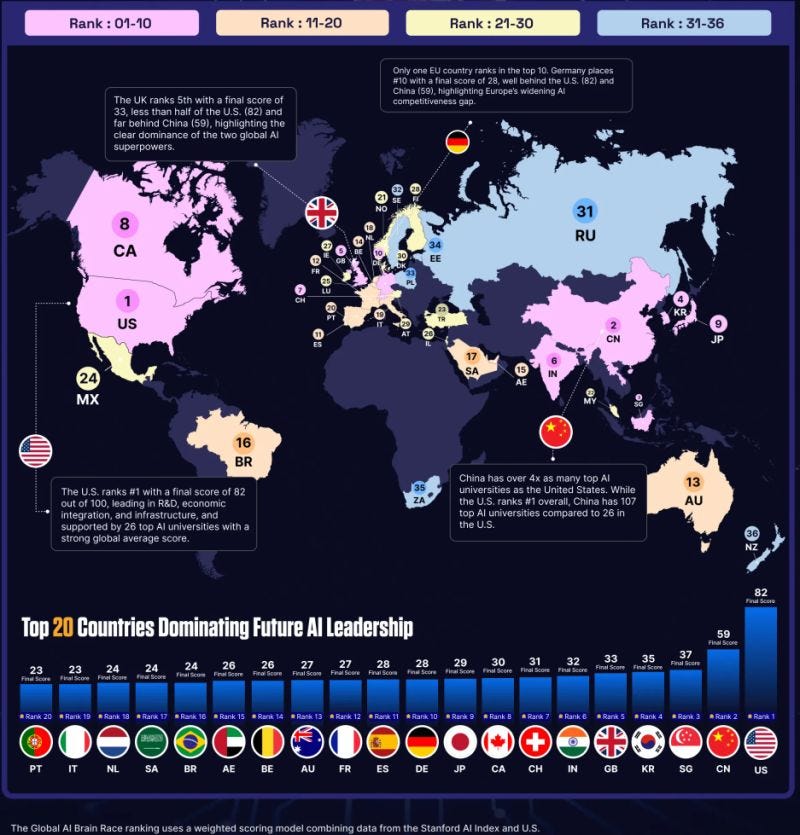
TWO IDEAS, FRAMEWORKS OR CONCEPTS
This week we bring to you two Concepts: Leapfrogging & Emergence
Leapfrogging
Leapfrogging occurs when developing nations bypass intermediate stages of technological progression to adopt advanced systems directly.
Traditionally, the technology curve assumes a linear progression where infrastructure evolves through sequential phases. However, nations lacking legacy systems, such as extensive copper-wire telecommunications networks, face lower switching costs and fewer structural impediments to adopting newer standards. This absence of existing infrastructure allows these economies to allocate capital directly towards modern alternatives like cellular networks and mobile broadband. Consequently, the adoption curve in these regions exhibits a steep vertical trajectory rather than the gradual slope seen in developed markets.
The classic illustration of this phenomenon is the circumvention of landline telephony in favour of mobile communications. Building a national grid of physical telephone cables requires massive capital expenditure, prolonged deployment timelines, and significant maintenance operations. By deploying wireless towers, developing countries achieve widespread connectivity at a fraction of the cost and time. This rapid deployment fundamentally alters the local economic environment. Furthermore, this initial acceleration often serves as a catalyst for subsequent technological adoption. The widespread availability of mobile devices facilitates the immediate introduction of digital financial services, bypassing traditional retail banking networks entirely.
From a strategic perspective, understanding this non-linear progression is critical for forecasting market dynamics and technology deployment. Businesses operating in these regions must design products that do not rely on transitional technologies. They must instead optimise their services for the most advanced platforms available while accommodating local resource constraints. Leapfrogging demonstrates that technological maturation in emerging markets does not simply replicate the historical timelines of industrialised nations.
🚀
Emergence
Emergence describes the phenomenon where macroscopic behaviours materialise from the local interactions of numerous simple components. Rather than being programmed or centrally directed, these large-scale patterns arise naturally when individual entities operate according to elementary rules.
In thermodynamic models, for instance, variables like temperature and pressure are not properties of individual molecules. They are emergent states that only exist when trillions of particles interact within a defined volume. This principle demonstrates that a complete system can possess functional characteristics entirely absent from its isolated parts.
This dynamic is readily observable across both biological networks and modern computational architectures. A solitary ant possesses limited cognitive capacity and operates purely on basic chemical signals. The collective colony, however, successfully executes advanced structural engineering and resource allocation based on those local interactions. Similarly, large language models produce coherent prose not through programmed linguistic comprehension, but as an emergent consequence of optimising probability distributions across billions of parameters. The foundational rule simply involves predicting the next token, while the global outcome manifests as highly sophisticated semantic generation.
Recognising this mechanism is critical for designing robust structural frameworks. When system architects attempt to manage scaling through rigid top-down controls, they frequently introduce systemic fragility. A more resilient methodology focuses on establishing reliable local rules and boundaries to allow optimal macro-structures to stabilise on their own.
By prioritising the mechanics of interaction between nodes rather than attempting to micro-manage the entire network, engineering teams can deploy systems that adapt dynamically to shifting conditions without requiring continuous central oversight.
🚀
An Earnest Appeal
The Percolator is built like a magazine, but without the team or organisation. It takes research, writing, editing, and a steady rhythm to publish longform essays twice a week. Paid subscriptions make this work possible, and sustainable.
If you’ve found value here, I’d love for you to consider upgrading. Paid subscribers unlock every essay, can comment and join the chat, and a chance to feature their own notes and stories.
👉 Please upgrade to paid and help keep the brew strong. It costs less than two coffees a month, but unlike coffee, the energy lasts longer.
THREE NEWS FROM THE WEEK
SpaceX Makes Historic Nasdaq Debut in $75 Billion IPO
SpaceX has made a landmark debut on the Nasdaq after pricing its initial public offering at $135 a share and raising about $75 billion, making it the largest IPO ever. The offering valued Elon Musk’s rocket and satellite company at roughly $1.77 trillion at pricing, placing it among the most valuable public companies from day one.
Trading opened at $150, about 11% above the offer price, and the stock continued to surge during the session, reaching an intraday high of $176.52. By the close, shares were trading around $160.95 to $161.11, up about 19% from the IPO price, while the company’s market capitalization briefly moved above $2 trillion. That performance signalled strong demand from investors eager for exposure to the company’s launch services, satellite internet business, and long-term space infrastructure ambitions.
The debut is a major milestone for SpaceX, which has spent years building dominance in commercial launches and expanding Starlink into a global communications platform. It also reflects a broader shift in public markets, where investors are increasingly willing to back frontier technology companies with bold, capital-intensive growth plans.
For Musk, the IPO is both a financing event and a symbolic one. It moves SpaceX from a tightly held private giant into the public spotlight, where quarterly results, market sentiment, and execution discipline will now matter as much as visionary storytelling.
➖
US blocks foreign access to Anthropic’s newest AI models
Anthropic has disabled access to its latest models, Fable 5 and Mythos 5, after a Trump administration export-control directive barred foreign nationals from using them, forcing the company to cut access for all customers to stay compliant.
The move marks a sharp escalation in Washington’s treatment of advanced AI as a national-security asset. The directive, reportedly sent by Commerce Secretary Howard Lutnick to CEO Dario Amodei, applies to foreign users inside and outside the United States and may require licenses for export, re-export, or transfer of the models.
Anthropic said the order was too broad to implement selectively and that the “net effect” was a global shutdown of both models. The company also said it disagrees with the government’s handling of the matter, called it a misunderstanding, and said it hopes to restore access as soon as possible.
The impact is immediate for users and customers relying on Anthropic’s top-tier systems, especially enterprises and international teams. Competitively, the restriction could reshape how frontier AI models are deployed, priced, and governed, while intensifying debate over whether export rules can realistically separate users by nationality in cloud-based AI.
Reaction has been mixed: some coverage frames the order as a national-security measure, while others warn it could set a precedent for broader AI controls and accelerate a global race to build alternatives.
➖
India Maps the Brainstem in Unprecedented Detail with Breakthrough 3D Atlas
In a quiet but consequential leap for neuroscience, India’s IIT Madras has unveiled ANCHOR:, the world’s most detailed 3D atlas of the human brainstem, marking a shift from abstract mapping to cellular precision. Developed by the Sudha Gopalakrishnan Brain Centre, the atlas charts over 200 nuclei and neural tracts across the human lifespan, integrating MRI, histology, and neurochemical data into a unified, navigable framework.
The brainstem, often overlooked in favour of the cortex, governs life’s most fundamental functions: breathing, sleep, arousal. Yet, it remains one of the least understood regions in clinical neuroscience. ANCHOR directly addresses this gap. By enabling seamless transitions from macro imaging to cellular-level insights, it offers a diagnostic and research tool that could sharpen interventions in conditions ranging from stroke and neurodegeneration to sleep disorders.
What makes this effort notable is not just its resolution, but its ambition. Built on the earlier DHARANI atlas, ANCHOR reflects India’s growing capability to lead in deep science, combining biology, computation, and engineering at scale. With over 200 contributors and global collaborations, the project signals a maturation of India’s research ecosystem, from participation to authorship.
Equally important is its open-access nature. By making the atlas freely available, IIT Madras positions ANCHOR as a global public good, accelerating discovery beyond institutional silos.
If neuroscience is ultimately about decoding consciousness and control, ANCHOR is a reminder: progress often begins with seeing clearly. And for the brainstem, we are finally beginning to.


The Sunday Brew by The Percolator brings to you curated news on tech, business & entrepreneurship, from across the internet to give your week a perfect start.
Share your thoughts and opinions on the topics covered in this newsletter by leaving a comment and joining the conversation.