

The Sunday Brew #181
In this brew: Fusion vs Fission in a picture | Cynefin Framework & Moravec’s Paradox | Neuralink Restores Voice, Creativity, Renewable Energy Reaches Tipping Point & Starlink Scales, SpaceX Eyes IPO

The Sunday Brew | Issue #1 June‘26 | Free
Welcome to The Sunday Brew, weekly 1-2-3 newsletter by The Percolator. Every Sunday we drop in your inbox 1 story in a picture, 2 concepts, ideas or frameworks to expand your horizons and 3 news from the week, to keep you updated.
If you are not a paid subscriber, here is what you missed last week:


ONE STORY IN A PICTURE
Fusion vs Fission
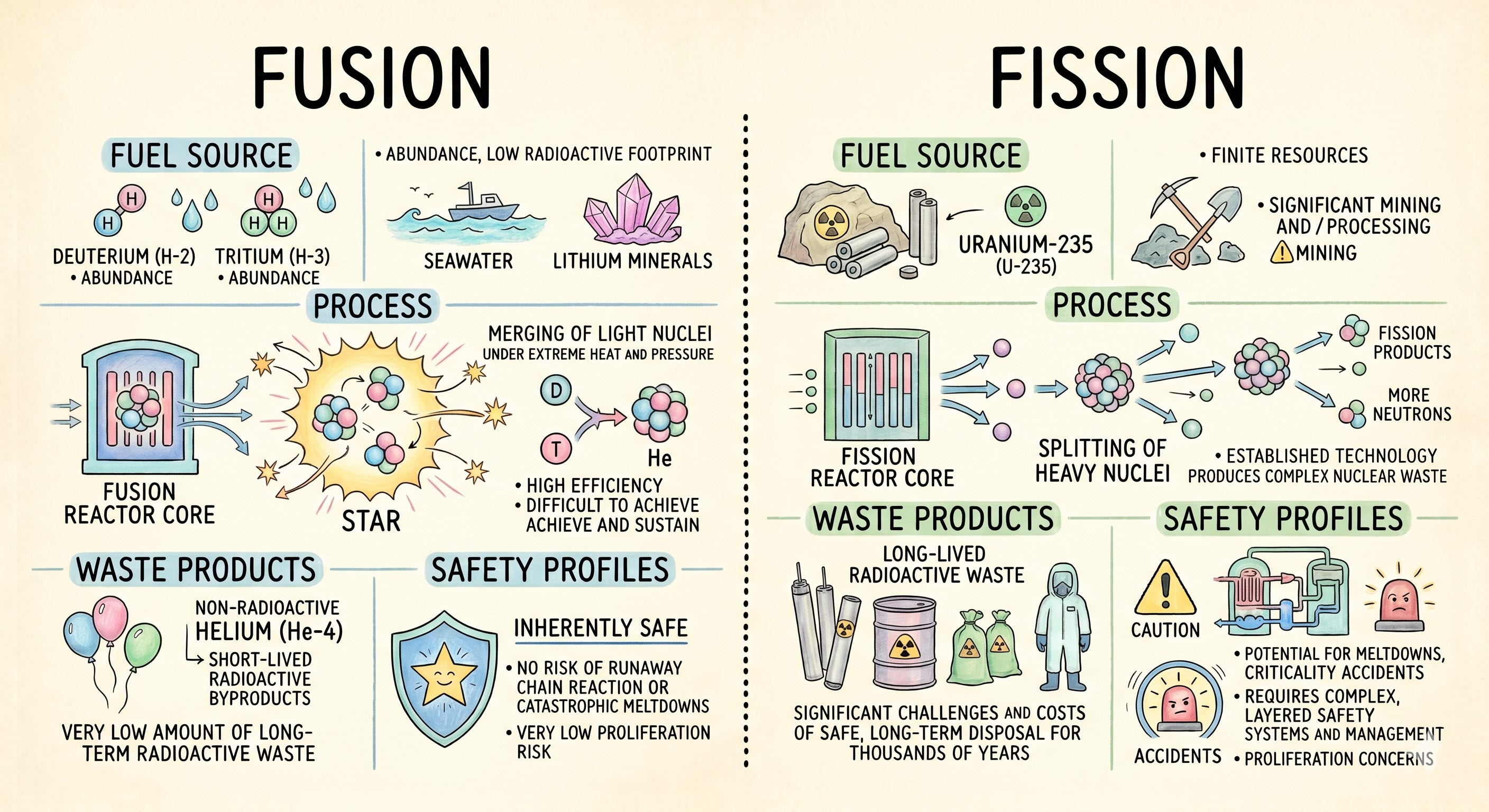
TWO IDEAS, FRAMEWORKS OR CONCEPTS
This week we bring to you two Concepts: Cynefin Framework & Moravec’s Paradox
Cynefin Framework
The Cynefin framework functions as a sense-making model that assists professionals in categorising situations to determine the appropriate decision-making response based on the current level of uncertainty.
It divides operational contexts into ordered and unordered systems. Within ordered systems, cause and effect are predictable. The Simple domain involves known knowns where clear procedures exist, requiring decision-makers to categorise the issue and respond with established best practice. The Complicated domain contains known unknowns. A relationship between cause and effect exists here but requires expert analysis to uncover, necessitating a process of sensing the problem, analysing the variables, and responding with good practice rather than a single correct answer.
As uncertainty increases, situations shift into unordered systems where outcomes cannot be predicted beforehand. The Complex domain is characterised by unknown unknowns, meaning cause and effect can only be understood in retrospect. In these environments, rigid planning is ineffective. Professionals must instead conduct safe-to-fail experiments to probe the system, sense the resulting patterns, and respond by amplifying positive outcomes.
When a system enters the Chaotic domain, there is high turbulence and no discernible connection between cause and effect. The immediate priority is stabilisation, requiring leaders to act decisively to establish order, sense where stability is forming, and respond to transition the situation back into the complex domain.
Applying this framework prevents organisations from relying on a singular approach for distinct types of problems. By accurately diagnosing their operating environment, leaders can adapt their management style to match the reality of the situation.
🚀
Moravec’s Paradox
Moravec’s Paradox articulates a counter-intuitive phenomenon within artificial intelligence and robotics where high-level cognitive processes demand far less computational power than basic sensorimotor functions.
Within frontier science and engineering, this principle explains why developing algorithms to defeat human opponents in strategic board games proved relatively straightforward. These abstract reasoning tasks follow rigid logical rules that machines can execute rapidly. Conversely, programming a machine to exhibit the fundamental perception and mobility of a human infant requires an immense allocation of processing resources. The paradox highlights an evolutionary reality: mammalian sensorimotor skills have been heavily optimised over millions of years, making them operate subconsciously and appear effortless, whereas abstract logical reasoning is a recent and cognitively demanding development.
For contemporary engineering teams designing advanced robotics, this paradigm dictates the allocation of research capital and processing power. Navigating a physical environment involves interpreting continuous data streams from multiple sensors while simultaneously executing precise mechanical adjustments to maintain balance and spatial awareness. Consequently, engineers face significant hurdles when attempting to automate tasks in unstructured environments, such as autonomous construction or dexterous object manipulation.
The primary challenge lies not in the high-level operational planning but rather in interpreting the physical world accurately and translating those interpretations into reliable mechanical action. Resolving this disparity remains a focal point for researchers working on embodied artificial intelligence, forcing them to design sophisticated neural architectures to manage the heavy volume of data required for physical interaction.
🚀
An Earnest Appeal
The Percolator is built like a magazine, but without the team or organisation. It takes research, writing, editing, and a steady rhythm to publish longform essays twice a week. Paid subscriptions make this work possible, and sustainable.
If you’ve found value here, I’d love for you to consider upgrading. Paid subscribers unlock every essay, can comment and join the chat, and a chance to feature their own notes and stories.
👉 Please upgrade to paid and help keep the brew strong. It costs less than two coffees a month, but unlike coffee, the energy lasts longer.
THREE NEWS FROM THE WEEK
Neuralink Restores Voice and Creativity to Paralyzed Patients
Neuralink’s brain-computer interface has achieved a landmark breakthrough, restoring natural speech and artistic creativity to paralyzed patients through direct neural decoding.
Brad Smith, the first ALS patient implanted, now communicates using an AI-cloned voice that matches his pre-illness tone, while Audrey Crews, a quadriplegic artist, creates artwork solely through neural signals. The N1 chip, equipped with 1,024 electrodes in the motor cortex, decodes phonemes for speech and translates intention into digital commands, bypassing damaged peripheral pathways entirely.
The technology’s clinical momentum is accelerating rapidly. Neuralink now has 21 participants across global trials, up from 12 in late 2024, and has begun high-volume device production. A next-generation implant with triple current capabilities is expected later in 2026, alongside plans to automate the surgical procedure. While devices remain investigational and unapproved by the FDA, the VOICE trial’s success, confirmed publicly by Elon Musk in March 2026, demonstrates that brain implants can restore not just communication but fundamental human expression, reshaping what’s possible for neurodegenerative and spinal injury patients.
➖
Renewable Energy Tipping Points Reshape Global Tech Landscape
World Environment Day 2026 marked a watershed moment for renewable energy, with India achieving its first non-fossil fuel capacity dominance at 283.46 GW while adding a record 44.61 GW of solar capacity in 2025-26.
The International Renewable Energy Agency confirmed India surpassed the United States as the world’s second-largest annual solar contributor, installing 37 GW versus America’s 34 GW, and overtook Japan to become the third-largest solar power producer globally. This acceleration signals that the renewable transition is no longer aspirational but technically and economically inevitable for emerging markets.
The UNEP’s “Cheaper. Cleaner. Unstoppable” report identifies five technologies: renewable energy, electric vehicles, smarter buildings, heat pumps, and food waste reduction, approaching positive tipping points where cost declines and mass adoption become self-reinforcing. With the 2026-2030 period deemed critical for embedding tipping-point strategies into national climate plans, technical professionals must recognize that decarbonization is approaching irreversible scale.
Azerbaijan’s hosting of the global observance in Baku, featuring post-conflict zero-emissions zones in Garabagh and East Zangezur, demonstrates how renewable infrastructure and ecosystem restoration can integrate at scale.
➖
Starlink Surpasses 10,000 Satellites as SpaceX Eyes Massive IPO
SpaceX’s Starlink has crossed the 10,000-satellite milestone, reinforcing its dominant position in low-Earth orbit and underscoring a tectonic shift in the commercial space economy. The constellation now accounts for roughly two-thirds of active satellites, sustained by a high-frequency launch cadence that continues to push operational scale and service reach.
Technical and regulatory challenges are mounting: deploying Musk’s envisioned 100,000 next-generation satellites, and the even more audacious proposal for up to one million orbital data centres for AI workloads will require substantial approvals, advances in on-orbit collision avoidance, and clearer economics for space-based compute. Independent analyses and industry voices caution that orbital AI data centres remain unproven at scale and could struggle to be cost-competitive until later in the decade, while astronomers and global space agencies raise concerns about debris, spectrum management, and night-sky preservation.
Concurrently, SpaceX is preparing for a potential public offering that aims for a valuation near $2 trillion, driven largely by Starlink’s rapid revenue growth and high-margin performance. Starlink generated roughly $11.4 billion in 2025 with adjusted EBITDA margins approaching 63%, positioning it as SpaceX’s primary profit engine and the linchpin of the IPO narrative.
The coming years will test systems engineering, regulatory strategy, and sustainable orbital operations as business imperatives converge with complex engineering trade-offs; the industry’s ability to reconcile commercial scale with safe, responsible stewardship of near-Earth space will determine whether these ambitions become a resilient reality or an unsustainable overreach.


The Sunday Brew by The Percolator brings to you curated news on tech, business & entrepreneurship, from across the internet to give your week a perfect start.
Share your thoughts and opinions on the topics covered in this newsletter by leaving a comment and joining the conversation.