

The Sunday Brew #180
In this brew: AI Safety Milestones in a picture | Ergodicity & Jevons Paradox | Universal Aging Code, Antarctica’s Climate Tipping Point and Samsung’s HBM4E Push

The Sunday Brew | Issue #5 May ‘26 | Free
Welcome to The Sunday Brew, weekly 1-2-3 newsletter by The Percolator. Every Sunday we drop in your inbox 1 story in a picture, 2 concepts, ideas or frameworks to expand your horizons and 3 news from the week, to keep you updated.
If you are not a paid subscriber, here is what you missed last week:


ONE STORY IN A PICTURE
AI Safety Milestones
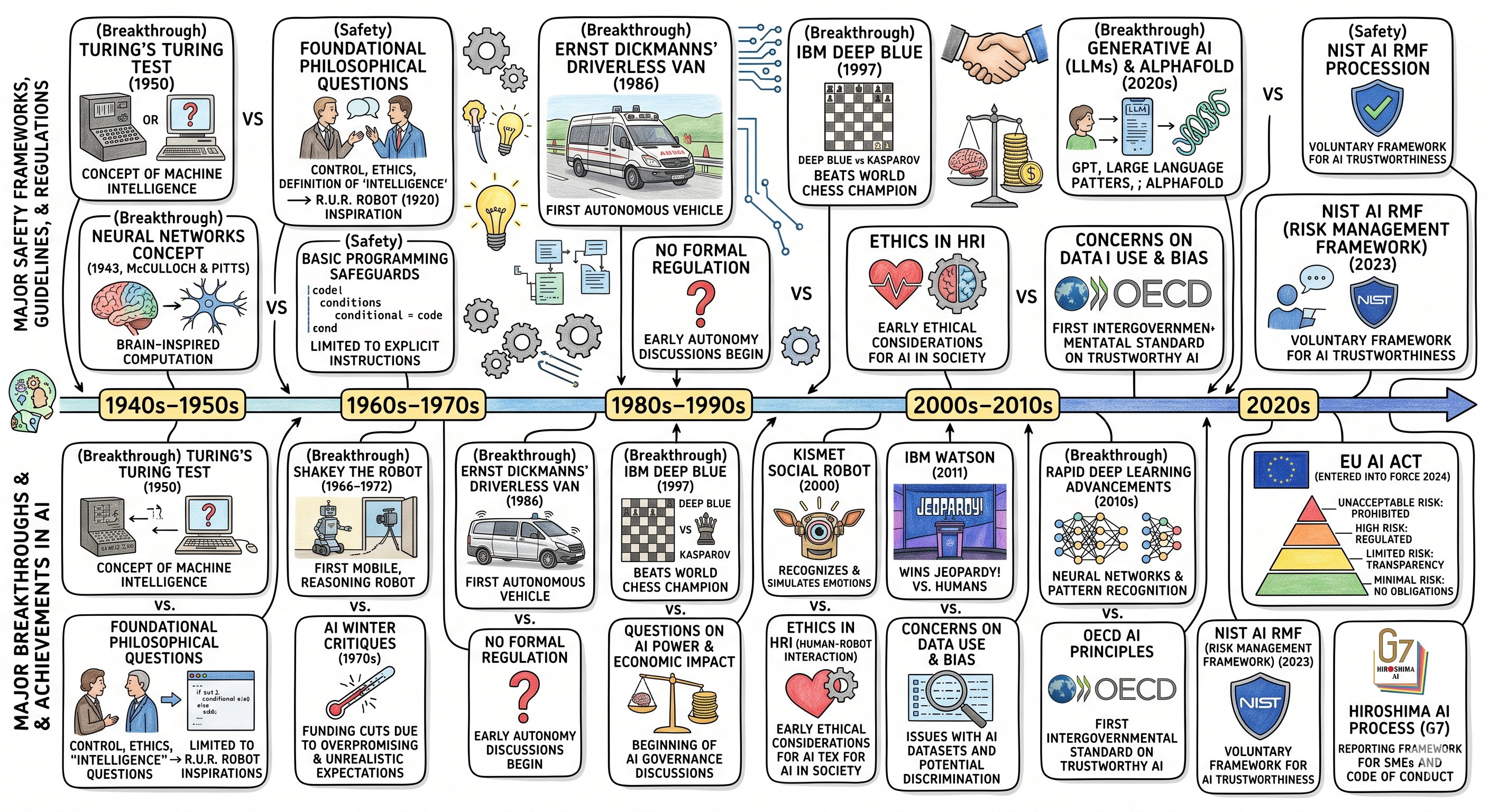
TWO IDEAS, FRAMEWORKS OR CONCEPTS
This week we bring to you two Concepts: Ergodicity & Jevons Paradox
Ergodicity
Ergodicity is a fundamental concept in statistics and physics that dictates whether the long-term average of a single system matches the average of a wide group of systems at a single point in time.
To understand this principle, you must distinguish between time averages and ensemble averages. A system is considered ergodic if tracking one subject over a long period yields the same statistical result as tracking a large crowd of subjects simultaneously.
Consider a classic thought experiment involving a casino. If one hundred people go to a casino to gamble for an hour, and one person loses all their money, the group average remains highly profitable for the venue while most individuals leave with standard returns. However, if a single person gambles in that same casino for one hundred consecutive hours, they will eventually hit a run of bad luck, lose everything, and be unable to continue. In this scenario, the system is non-ergodic because the individual’s time average ends in ruin, whereas the group’s ensemble average at any specific hour looks perfectly safe.
When you analyse data in finance, economics, or thermodynamics, you cannot safely assume ergodicity. High-risk environments are almost always non-ergodic because individual paths are subject to permanent, absorbing barriers like bankruptcy or failure.
Therefore, you must evaluate risks based on how an individual or single entity fares over time, rather than relying on misleading averages calculated across a large population.
🚀
Jevons Paradox
Jevons Paradox occurs when technological progress increases the efficiency with which a resource is used, but the rate of consumption of that resource rises rather than falls.
This counterintuitive phenomenon challenges the assumption that efficiency gains automatically lead to resource conservation. To understand this mechanism, you must look at how efficiency alters economic behaviour. When a process becomes more efficient, the effective cost of using that resource drops significantly, which stimulates demand.
The paradox was first observed by economist William Stanley Jevons in nineteenth-century Britain, where he noticed that the introduction of more efficient steam engines led to an increased total consumption of coal across the nation. Because the new engines made coal a cheaper and more productive source of energy, industries rapidly expanded their operations, and entirely new sectors emerged to utilise the technology. The massive scale of this new demand quickly outpaced the savings gained from the initial efficiency improvements.
In modern systems, you can observe this identical pattern in fuel-efficient vehicles, data storage, and digital computation. When an engine requires less fuel per mile, individuals tend to drive longer distances, and society alters its infrastructure to accommodate more driving, which ultimately increases aggregate fuel consumption.
Therefore, when you design environmental policies or resource management strategies, you cannot rely solely on technological efficiency to lower consumption. You must anticipate that making a resource cheaper and more accessible will inevitably drive up its total utilization across the wider economy.
An Earnest Appeal
The Percolator is built like a magazine, but without the team or organisation. It takes research, writing, editing, and a steady rhythm to publish longform essays twice a week. Paid subscriptions make this work possible, and sustainable.
If you’ve found value here, I’d love for you to consider upgrading. Paid subscribers unlock every essay, can comment and join the chat, and a chance to feature their own notes and stories.
👉 Please upgrade to paid and help keep the brew strong. It costs less than two coffees a month, but unlike coffee, the energy lasts longer.
THREE NEWS FROM THE WEEK
A Universal Aging Code May Redefine How We Measure Life Itself
A new study uncovering shared gene-expression signatures of aging across mammals marks a pivotal shift in how science understands, and may eventually intervene in the aging process. By analysing over 11,000 transcriptomes across multiple species and tissues, researchers have demonstrated that aging is not a fragmented, organ-specific decline but a coordinated, systemic phenomenon embedded deep within our biology.
What makes this breakthrough particularly compelling is the emergence of transcriptomic “molecular clocks” that go beyond estimating chronological age. These tools capture real-time biological deterioration by tracking gene activity tied to inflammation, cellular stress, and metabolic slowdown. In doing so, they offer a dynamic and functional measure of aging, one that correlates with mortality risk and responds to interventions.
Unlike earlier epigenetic clocks, which infer age from static DNA modifications, these new models reflect the body’s active state of decline or resilience. This opens the door to faster, more accurate testing of longevity therapies, from caloric restriction mimetics to gene-based interventions, by providing immediate feedback on whether such strategies genuinely slow biological aging.
At a broader level, the study reinforces a unifying principle: that aging, despite its outward diversity, follows a conserved molecular script across life forms. For longevity science, this convergence offers both clarity and urgency. If aging can be measured with precision, it can potentially be managed with intent. The challenge now shifts from understanding aging to responsibly reshaping it.
➖
Study Suggests Antarctic Ice Sheet Sensitivity Shifts at Key CO2 Threshold
A new study tracing Antarctica’s climate history over the past three million years delivers an unsettling insight: Earth’s largest ice sheet does not respond to warming in gradual, predictable ways. Instead, it can flip into entirely new modes of behaviour once certain thresholds are crossed.
Around one million years ago, during the Mid-Pleistocene Transition, Antarctica entered such a “new dynamical regime,” becoming far more sensitive to climate shifts after atmospheric CO2 levels fell below roughly 240 parts per million.
What makes this finding particularly urgent is not just what happened then, but what it implies now. Today’s CO2 levels exceed 420 parts per million; far beyond the threshold identified in the study. While the historical transition led to larger and more stable ice sheets under colder conditions, the reverse scenario raises concerns: could warming trigger disproportionately rapid ice loss?
The research highlights how interacting forces such as ocean cooling, falling sea levels, and bedrock uplift, once worked together to stabilize Antarctic ice. But in today’s warming world, those same systems may amplify instability instead. This challenges the conventional assumption of linear climate responses and reinforces a more uncomfortable reality: Earth systems can remain stable until they suddenly are not.
For policymakers and climate strategists, the implication is clear. Risk models based on gradual change may underestimate the speed and scale of future sea-level rise. Antarctica is not just a passive indicator of climate change; it is an active, nonlinear player. And its past suggests that once critical thresholds are crossed, the consequences may be both abrupt and irreversible.
➖
Samsung’s HBM4E Push Signals a High-Stakes Reset in the AI Memory Race
Samsung’s early shipment of HBM4E memory samples marks more than a routine product milestone; it signals an aggressive attempt to reassert relevance in the rapidly intensifying AI hardware stack. With per-pin speeds reaching up to 16 Gbps and bandwidth scaling to 3.6 TB/s, HBM4E is engineered for the data-hungry demands of large language models and next-generation AI accelerators.
By advancing its delivery ahead of schedule, Samsung is not just innovating, it is responding. Rival SK Hynix has established a clear lead in high-bandwidth memory, becoming the preferred supplier for key players like Nvidia. Samsung’s earlier delays in HBM4 production had raised concerns about its execution in a segment that is quickly becoming the backbone of AI infrastructure economics. HBM is no longer a component; it is a bottleneck and a differentiator.
The strategic alignment with Nvidia, underscored during GTC 2026, suggests Samsung is prioritizing ecosystem integration as much as raw performance. If these early samples translate into stable yields and timely mass production, Samsung could claw back market share in a space where demand visibility is unusually strong and margins are structurally high.
Yet risks remain. Accelerated timelines can expose unresolved yield issues, and the window for error is narrow given the pace at which AI workloads are scaling. Ultimately, HBM4E is not just about faster memory, it is about whether Samsung can match speed with consistency in a market that is increasingly unforgiving.


The Sunday Brew by The Percolator brings to you curated news on tech, business & entrepreneurship, from across the internet to give your week a perfect start.
Share your thoughts and opinions on the topics covered in this newsletter by leaving a comment and joining the conversation.