

The Sunday Brew #171
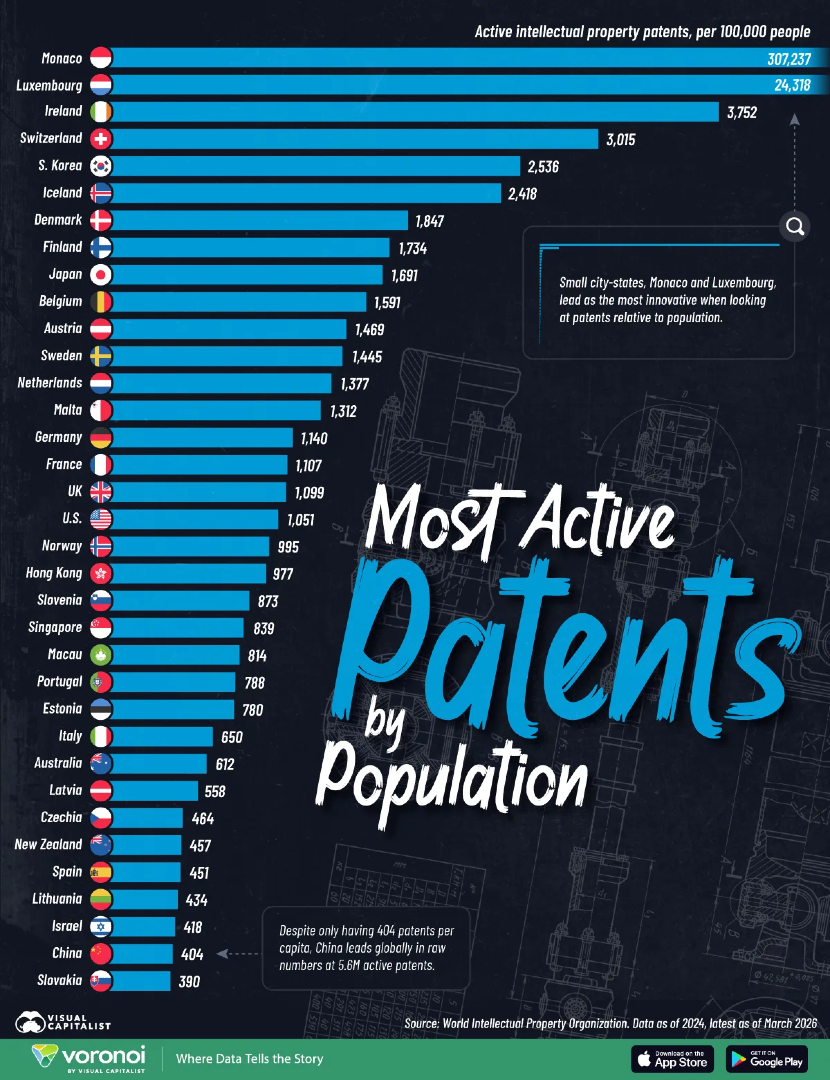
In this brew: Active Patents by Population in a picture | Fundamental Attribution Error & Shirky Principle | Solar Cell Advancement, Musk on Trump-Modi Call, & Grok takes over X feed

The Sunday Brew | Issue #4 March ‘26 | Free
Welcome to The Sunday Brew, weekly 1-2-3 newsletter by The Percolator. Every Sunday we drop in your inbox 1 story in a picture, 2 concepts, ideas or frameworks to expand your horizons and 3 news from the week, to keep you updated.
If you are not a paid subscriber, here is what you missed last week:


ONE STORY IN A PICTURE
TWO IDEAS, FRAMEWORKS OR CONCEPTS
This week we bring to you two Concepts - Fundamental Attribution Error & Shirky Principle
Fundamental Attribution Error
Fundamental Attribution Error is the tendency to explain other people’s behaviour mainly by their personality or character, while overlooking the situation they are in.
For example, if someone cuts you off in traffic, you might think they are rude or careless, even though they may be rushing to an emergency or dealing with stress.
This bias matters because it can make us judge others too quickly and too harshly. It also creates an uneven standard: we often excuse our own bad behaviour by blaming circumstances, but we assume other people’s mistakes reveal who they really are.
In everyday life, this can lead to misunderstandings at work, in relationships, and in social settings. A co-worker who misses a deadline may be labelled lazy, when the real cause might be unclear instructions, too much workload, or a personal crisis.
The error is “fundamental” because it appears so often in how people think about others, and it is an “attribution” error because it reflects a mistaken explanation of behaviour. Recognizing it helps us become more fair-minded. Before judging someone, it is useful to pause and ask what external pressures, limits, or hidden context might be influencing their actions.
Shirky Principle
The Shirky Principle says that institutions often try to preserve the very problem they were created to solve, because the problem helps justify their existence.
In practice, this means organizations can become attached to outdated systems, not always out of malice, but because change threatens their structure, influence, or relevance.
A hospital, for example, may focus more on managing chronic illness than on preventing it if its processes, funding, or incentives are built around treatment rather than cure. A newspaper may resist new digital formats if its old business model depends on scarcity, even when the audience has moved online.
Over time, the solution can become so tied to the problem that the organization starts protecting the problem instead of eliminating it. This is why the Shirky Principle is useful for understanding bureaucracy, markets, and even personal habits. It reminds us that success can create inertia: once a system is built around a problem, that system may unconsciously defend the problem’s existence.
Recognizing this bias encourages people to ask whether a process is truly solving something or merely sustaining itself. It also helps explain why better ideas often face resistance, especially when they make existing institutions less necessary.
An Earnest Appeal
The Percolator is built like a magazine, but without the team or organisation. It takes research, writing, editing, and a steady rhythm to publish longform essays twice a week. Paid subscriptions make this work possible, and sustainable.
If you’ve found value here, I’d love for you to consider upgrading. Paid subscribers unlock every essay, can comment and join the chat, and a chance to feature their own notes and stories.
👉 Please upgrade to paid and help keep the brew strong. It costs less than two coffees a month, but unlike coffee, the energy lasts longer.
THREE NEWS FROM THE WEEK
Solar Cells Break Two Big Records
Solar-cell research has hit a rare double milestone, with one team reporting a 130 percent quantum yield and another pushing all-perovskite tandem cells to 29.76 percent efficiency. Together, the results suggest photovoltaic science is moving beyond long-assumed limits, even if both breakthroughs are still far from commercial deployment.
At Kyushu University and Johannes Gutenberg University Mainz, researchers used a “spin-flip” metal complex with tetracene-based materials to overcome a loss pathway that had blocked earlier attempts to harvest multiplied excitons. The result was a solution-based proof of concept in which roughly 1.3 energy carriers were generated per absorbed photon, a figure that exceeds the conventional 100 percent quantum-yield ceiling. The team says the work could help future devices bypass limits that constrain standard single-junction solar cells, though it is not itself a finished solar panel.
In a separate advance, researchers at the Chinese Academy of Sciences developed a colloidal chemistry strategy that improved the crystallization of stacked perovskite layers in all-perovskite tandem cells. That approach lifted power conversion efficiency to 29.76 percent, with a certified value of 29.22 percent, while a 1 cm² device still reached 28.87 percent and retained more than 90 percent of its initial efficiency after 700 hours of operation.
These results add to a fast-moving record streak in photovoltaics, including a certified 30.02 percent perovskite-silicon triple-junction cell reported by EPFL and CSEM earlier this month.
➖
Musk Joins Trump-Modi Iran Call
Elon Musk reportedly joined a phone call between President Donald Trump and Prime Minister Narendra Modi this week as the leaders discussed the war in Iran and the security of the Strait of Hormuz, the New York Times reported, citing two U.S. officials.
The call is notable because it placed a private citizen on a wartime conversation between two heads of state, though it remains unclear whether Musk spoke or why he was included.
The discussion focused on the escalating crisis in the Middle East, especially the risk to the Strait of Hormuz, a critical route for global oil and gas shipments. Officials said the leaders stressed the need to keep the waterway open and secure, while Modi later said India supports de-escalation and an early return to peace.
The report adds another layer to Musk’s already unusual proximity to Trump and major geopolitical issues. His business interests, including Starlink’s push in India and expansion in parts of the Gulf, have fuelled speculation about why he may have been present, even though no official readout explained his role. India has publicly denied that a third party was involved in the call, saying only the two leaders spoke, which leaves the exact reason for Musk’s participation unresolved.
The episode also highlights how the Iran conflict is spilling into energy markets and diplomacy far beyond the region, with the Strait of Hormuz emerging as a central global concern.
➖
X Bets Its Feed Future on Grok AI
X is preparing to fold its Grok chatbot into the heart of its recommendation system next week, marking a major shift in how posts are ranked and surfaced across the platform. The change, confirmed by X head of product Nikita Bier, moves the company further away from traditional engagement signals such as likes, reposts, and follows, and toward AI-driven personalization.
The update is part of a longer push to rebuild X’s feed logic around Grok. Musk had already moved to open-source parts of the recommendation system earlier this year, framing the effort as a transparency upgrade, and public code releases showed the platform leaning more heavily on transformer-based AI to determine relevance. For users, the shift could mean a more tailored For You feed, but also less predictability in what content gains reach.
The move comes as X faces growing regulatory pressure in Europe. The European Commission has opened proceedings under the Digital Services Act to examine whether X properly assessed the risks of deploying Grok, including the spread of illegal content such as manipulated sexual imagery. That scrutiny adds to broader concerns over algorithmic transparency and platform accountability, making X’s AI overhaul both a product redesign and a legal test.


The Sunday Brew by The Percolator brings to you curated news on tech, business & entrepreneurship, from across the internet to give your week a perfect start.
Share your thoughts and opinions on the topics covered in this newsletter by leaving a comment and joining the conversation.