

The Sunday Brew #168
In this brew: AI Capabilities & Usage in a picture | Water Glass Effect & The Donkey Principle | Meta faces privacy lawsuit, Photonic Crystal Light Sail and DART Mission Nudged Asteroid’s Orbit

The Sunday Brew | Issue #2 March ‘26 | Free
Welcome to The Sunday Brew, weekly 1-2-3 newsletter by The Percolator. Every Sunday we drop in your inbox 1 story in a picture, 2 concepts, ideas or frameworks to expand your horizons and 3 news from the week, to keep you updated.
If you are not a paid subscriber, here is what you missed last week:


ONE STORY IN A PICTURE
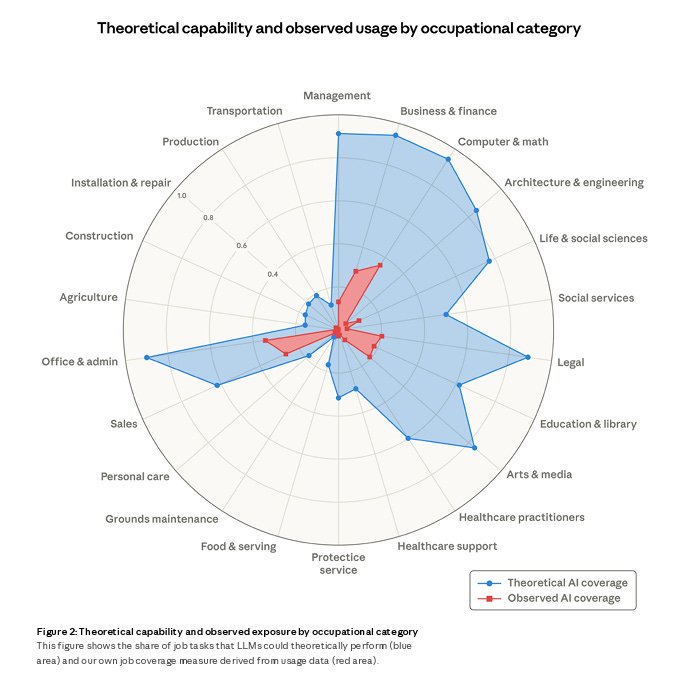
Read full report here.
TWO IDEAS, FRAMEWORKS OR CONCEPTS
This week we bring to you two Concepts - Water Glass Effect & The Donkey Principle
Water Glass Effect
The water glass effect is a popular metaphor that explains how stress and worries become harmful not because of their absolute size, but because of how long we hold on to them.
Imagine a person holding a glass of water at arm’s length and asking, “How heavy is this glass?” The actual weight is trivial, yet if they hold it for a minute, their arm feels fine; hold it for an hour and it starts to ache; hold it all day and the arm becomes numb and paralyzed. The weight of the glass never changes, but the strain on the muscles increases with time, illustrating that even small burdens grow overwhelming when they are carried continuously.
In psychological terms, everyday stresses are like that glass: briefly considered, they are manageable, but when we ruminate on them without rest, they can lead to anxiety, emotional exhaustion, and burnout. The lesson is to “put the glass down” periodically, meaning we should consciously release worries, take breaks, rest, or seek support rather than gripping our concerns all day and night. By doing so, we reset our mental and emotional capacity, allowing us to pick up the same problems later with renewed strength and clarity instead of compounding strain.
This simple image captures a core principle of stress management: it is not only the magnitude of our responsibilities that matters, but the duration and unbroken nature of our attachment to them.
🚀
The Donkey Principle
The donkey principle is a decision and focus heuristic that warns against wasting time and energy arguing with people who are not genuinely open to changing their minds.
It is often illustrated through the fable of a donkey insisting that the grass is blue while a tiger insists it is green; when they ask the lion to judge, the lion agrees the grass is blue but punishes the tiger, not for being wrong, but for foolishly arguing with someone incapable of honest dialogue.
The core idea is that some debates are structurally unproductive: the other party may be driven by ego, bad faith, or rigid beliefs rather than a shared search for truth. Continuing to engage in such arguments drains attention from meaningful work, relationships, and inner peace, even when you are objectively correct. Practically, the donkey principle encourages you to conserve your limited cognitive and emotional resources by disengaging from fruitless conflicts, especially online or in politicized contexts. Instead of proving others wrong, you prioritize where your influence, learning, and long-term goals actually benefit from discussion.
It does not tell you to avoid all disagreement; rather, it nudges you to distinguish between constructive debate with open-minded people and circular fights with “donkeys” where the only winning move is to walk away.
An Earnest Appeal
The Percolator is built like a magazine, but without the team or organisation. It takes research, writing, editing, and a steady rhythm to publish longform essays twice a week. Paid subscriptions make this work possible, and sustainable.
If you’ve found value here, I’d love for you to consider upgrading. Paid subscribers unlock every essay, can comment and join the chat, and a chance to feature their own notes and stories.
👉 Please upgrade to paid and help keep the brew strong. It costs less than two coffees a month, but unlike coffee, the energy lasts longer.
THREE NEWS FROM THE WEEK
Meta Faces U.S. Lawsuit Over AI Smart Glasses Privacy Breach
Meta Platforms has been hit with a class-action lawsuit in the United States alleging that its AI-powered Ray-Ban smart glasses violated user privacy by allowing overseas contractors to view intimate footage captured by wearers.
Filed by New Jersey resident Gina Bartone and California resident Mateo Canu, the suit accuses Meta and its manufacturing partner Luxottica of misleading customers through marketing that claimed the product was “built for your privacy.” According to the complaint, Meta failed to warn users that footage, audio, and transcripts from the glasses could be reviewed by subcontracted staff abroad.
The case stems from a February investigation by Swedish newspapers Svenska Dagbladet and Göteborgs-Posten, which revealed that workers at Sama, a Meta subcontractor in Kenya, were tasked with labelling sensitive footage, including nudity, sex acts, and scenes inside private homes, to train Meta’s AI models. A former Meta employee told reporters that the automatic blurring system meant to protect identities “does not always function.”
In response, Meta said contractors occasionally assess anonymized data to improve AI capabilities and that it applies strict privacy filters. Yet regulators are taking note: the U.K. Information Commissioner’s Office has requested information from Meta, calling the allegations “concerning,” while privacy advocates urge the U.S. Federal Trade Commission to launch a formal probe into the company’s AI data practices.
➖
Tuskegee University Unveils Photonic Crystal Light Sail to Power Future Space Missions
Researchers at Tuskegee University have developed a ground-breaking photonic crystal light sail that could revolutionize spacecraft propulsion and advance interplanetary and possibly interstellar exploration.
Published in the Journal of Nanophotonics (March 2026), the study introduces a three-material sail structure that achieves roughly 90% reflectivity at targeted wavelengths—an unprecedented level of optical performance for such lightweight materials.
Unlike traditional metallic-coated sails, the new design employs a nanoscale array of germanium pillars embedded in a polymer matrix with air voids. This configuration produces a narrow photonic bandgap cantered at around 1.2 micrometres, efficiently reflecting propulsion laser light while remaining transparent to most solar radiation. As a result, the sail avoids overheating and offers improved thermal stability during extended thrust phases.
According to lead author Dr. Dimitar Dimitrov, assistant professor at Tuskegee University, the breakthrough demonstrates “a pathway to experimentally validated, scalable, lightweight devices for laser-driven propulsion.” Simulations show the prototype could accelerate small payloads to several hundred meters per second within an hour, fast enough for interplanetary travel and a crucial step toward future interstellar missions like Breakthrough Starshot.
The team’s next phase involves real-world testing under vacuum and radiation conditions to assess durability and beam control. If successful, the innovation could redefine sustainable propulsion for the next era of deep-space exploration.
➖
NASA’s DART Mission Nudged Asteroid’s Orbit Around the Sun, Study Confirms
NASA’s Double Asteroid Redirection Test (DART) has done more than just reshape its target. A new study published in Science Advances confirms that the 2022 impact on the asteroid moonlet Dimorphos not only altered its orbit around its larger companion, Didymos, but also subtly shifted the duo’s joint path around the Sun.
Researchers found that the Didymos-Dimorphos system slowed in its solar orbit by 11.7 micrometres per second—equivalent to roughly 1.7 inches per hour. Though minute, this slowdown shortened their 769-day orbit by about 0.15 seconds, effectively shrinking the system’s path around the Sun by nearly 1,200 feet. “For the first time, we’ve shown that human intervention has changed an asteroid’s orbit around the Sun,” said Steven Chesley, senior research scientist at NASA’s Jet Propulsion Laboratory.
The analysis used nearly 6,000 radar measurements and 22 stellar occultation observations collected between 2022 and 2025, including contributions from amateur astronomers worldwide. Crucially, the study revealed that the debris ejected from Dimorphos amplified the momentum transfer, almost doubling the effect of the impact itself.
Scientists say the finding provides valuable insight for future planetary defence efforts, showing that a small push, applied early, could one day protect Earth from a potential impact. Later this year, ESA’s Hera mission will arrive at Didymos to map the impact site and confirm the deflection data with unprecedented precision.


The Sunday Brew by The Percolator brings to you curated news on tech, business & entrepreneurship, from across the internet to give your week a perfect start.
Share your thoughts and opinions on the topics covered in this newsletter by leaving a comment and joining the conversation.