

The Sunday Brew #156
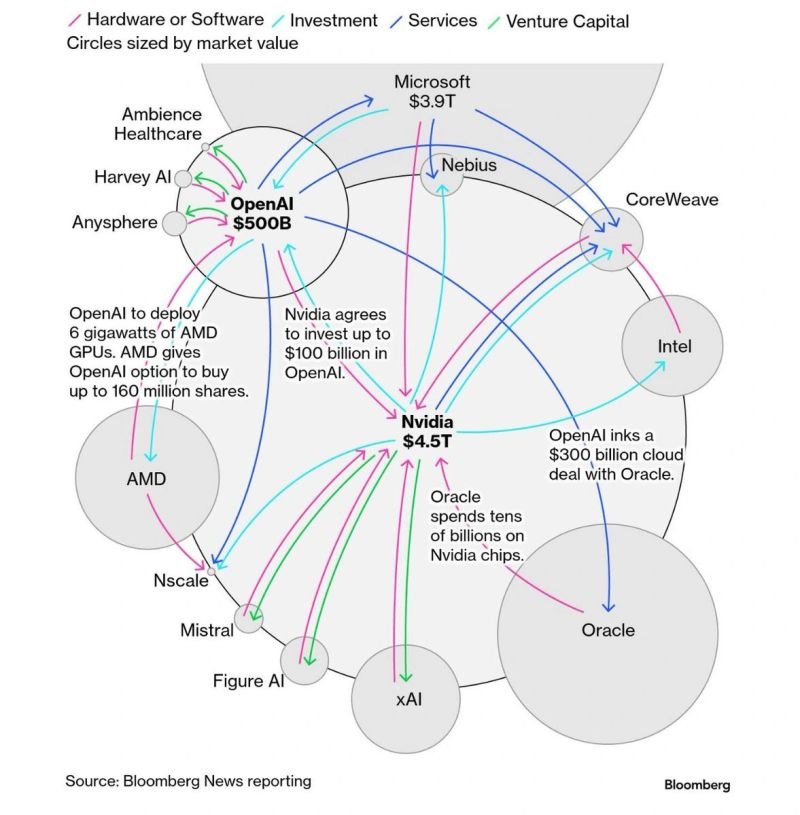
In this brew: AI Money Loop in a picture | Potato Paradox & Throat-clearing | Oil Prices Tumble, Tech Job Slash Spiked in 2025 & Google's French Assets Frozen

The Sunday Brew | Issue #2 Dec ‘25 | Free
Welcome to The Sunday Brew, weekly 1-2-3 newsletter by The Percolator. Every Sunday we drop in your inbox 1 story in a picture, 2 concepts, ideas or frameworks to expand your horizons and 3 news from the week, to keep you updated.
If you are not a paid subscriber, here is what you missed last week:


ONE STORY IN A PICTURE
TWO IDEAS, FRAMEWORKS OR CONCEPTS
This week we bring to you two Concepts - Potato Paradox & Throat-clearing
Potato Paradox
The Potato Paradox is a puzzle about how percentages can be misleading when they refer to parts of a whole that is itself changing.
You start with 100 kilograms of potatoes that are 99% water and 1% solid matter, so the solid part weighs 1 kilogram and the water weighs 99 kilograms. After drying, the potatoes become 98% water, but the key is that the amount of solid potato does not change; it is still 1 kilogram. Now that 1 kilogram of solids must be 2% of the new total weight, because if the potatoes are 98% water, the remaining 2% must be solids. If 1 kilogram is 2% of the total, then the total weight must be 50 kilograms, since 2% of 50 is 1.
That means the water now weighs 49 kilograms, making the composition 49 kilograms of water and 1 kilogram of solids, which is exactly 98% water and 2% solids. The result feels paradoxical because people often imagine the water percentage dropping from 99% to 98% as a small change, but that 1% shift in composition actually requires halving the total mass.
The lesson is that tiny changes in percentages of a component can correspond to huge changes in the total quantity when the non-changing part is very small.
🚀
Throat-clearing
Throat-clearing represents a subtle yet pervasive social ritual where individuals preface criticism of their own group, be it political, cultural, or ideological with disclaimers of loyalty, such as “I love my team, but...” or “As a true believer in X, I must say...”.
This phenomenon arises from the human tendency toward tribalism, where group identity provides security and belonging, but acknowledging flaws risks ostracism or accusations of disloyalty. People insert these affirmations to signal continued allegiance, pre-empting attacks from in-group members who view any critique as betrayal, assuming one’s perspective must align perfectly or not at all.
In polarized environments, like online debates or family dinners, this creates a performative layer: the throat-clearer navigates cognitive dissonance by reaffirming shared values before exposing weaknesses, preserving social capital while attempting nuance.
Psychologically, it stems from in-group bias, where loyalty trumps objectivity; evolutionary roots in kin selection make us hypersensitive to defection signals.
Critics of one’s tribe are often dismissed as enemies, so the preface acts as a shield, humanizing the speaker and framing dissent as loving correction rather than treason. This dynamic stifles honest discourse, as seen in politics—supporters of a leader might say, “I voted for them, but this policy is wrong”, yet it rarely softens backlash. Over time, habitual throat-clearing reinforces echo chambers, discouraging unvarnished truth-telling.
An Earnest Appeal
The Percolator is built like a magazine, but without the team or organisation. It takes research, writing, editing, and a steady rhythm to publish longform essays twice a week. Paid subscriptions make this work possible, and sustainable.
If you’ve found value here, I’d love for you to consider upgrading. Paid subscribers unlock every essay, can comment and join the chat, and a chance to feature their own notes and stories.
👉 Please upgrade to paid and help keep the brew strong. It costs less than two coffees a month, but unlike coffee, the energy lasts longer.
THREE NEWS FROM THE WEEK
Oil Prices Tumble as Oversupply Fears Eclipse Geopolitical Tensions
Global oil prices plunged over 4% this week, with Brent crude settling at $61.12 per barrel and West Texas Intermediate at $57.44, as expectations of an impending supply glut overshadowed fresh geopolitical risks.
Traders largely ignored disruptions stemming from U.S. sanctions and Ukrainian drone strikes, focusing instead on diverging forecasts from leading energy bodies that signalled persistent weakness ahead.
The International Energy Agency (IEA) warned that global oil supply could exceed demand by a massive 3.84 million barrels per day in 2026—about 4% of global consumption. While demand is expected to rise by 860,000 barrels per day next year, supply is projected to surge by nearly three times that amount. In contrast, OPEC’s latest report forecast a balanced market in 2026, highlighting sharp differences in outlooks that have fueled investor uncertainty and bearish sentiment.
Geopolitical tensions remained high as the United States seized a sanctioned Venezuelan oil tanker, sparking diplomatic outrage, and Ukraine intensified its attacks on Russian energy assets, including the Lukoil-operated Caspian platform and a major refinery in Yaroslavl. Yet, peace talks between U.S. envoys and Russian President Vladimir Putin drew market optimism, with investors betting that potential diplomatic progress could stabilize long-term supply routes, outweighing immediate disruptions.
As traders weigh oversupply fears against fragile geopolitics, oil’s near-term outlook remains clouded by volatility and diverging global expectations.
➖
Tech Giants Slash Jobs in 2025 as AI Reshapes Industry
The global technology sector witnessed a dramatic wave of layoffs in 2025, with more than 120,000 jobs eliminated as companies restructured to integrate artificial intelligence and streamline operations. According to Challenger, Gray & Christmas, the sector’s layoffs surged 17% from the previous year, marking the sharpest workforce contraction since 2020.
Intel led the downsizing, cutting nearly 24,000 employees, up to 20% of its staff, as it scaled back European expansion and lagged behind rivals in AI chip development. Tata Consultancy Services followed with 20,000 reductions, attributing the move to skill mismatches and the growing adoption of AI. Verizon, Amazon, Dell, Microsoft, Accenture, SAP, and Cisco also undertook sweeping reductions, each targeting tens of thousands of roles as part of restructuring drives.
AI automation emerged as the central force behind this transformation. Over 54,000 layoffs across industries were directly tied to AI adoption, while cost-cutting measures displaced another 50,000 positions in October alone. Routine and managerial roles were disproportionately affected as firms turned to generative AI and automation tools to handle code writing, customer support, and analytics.
Executives from Microsoft, Salesforce, and Amazon underscored that AI efficiency gains, not economic crisis, were the primary driver. Amid the upheaval, companies like Accenture and TCS warned that retraining alone may not save jobs, signalling a fundamental redefinition of work in an increasingly automated digital economy.
➖
Google’s French Assets Frozen in Cross-Border Dispute with Russia
A French court has frozen around €110 million ($129 million) of Google’s assets following a Russian court ruling, marking an escalation in Moscow’s efforts to enforce judgments against Western companies abroad.
The freeze targets shares held by Google France on behalf of Google International, linked to a 2021 Russian finding that Google made an illegal dividend payment of roughly 10 billion Rubles ($126 million).
The action originates from a Moscow arbitration court case and is part of a wider campaign led by the court-appointed liquidator of Google’s defunct Russian subsidiary, which went bankrupt after Russia seized its local bank accounts in 2022 for failing to pay fines. Legal enforcement has extended beyond France to Spain, Türkiye, and South Africa, the latter becoming the first country to order seizure of Google assets earlier in 2025.
Under French law, the current asset freeze is temporary unless formally recognized within one month, after which the Paris Judicial Court will assess whether to authorize full enforcement, a process that could take up to 18 months. Google retains the right to contest the ruling.
This battle unfolds amid broader geopolitical and financial tensions, with Russia also suing the Brussels-based depository Euroclear over €185 billion in frozen Russian sovereign assets. The European Union, meanwhile, is using interest from those assets to help fund a $50 billion loan for Ukraine, further intensifying global asset disputes.


The Sunday Brew by The Percolator brings to you curated news on tech, business & entrepreneurship, from across the internet to give your week a perfect start.
Share your thoughts and opinions on the topics covered in this newsletter by leaving a comment and joining the conversation.