

The Sunday Brew #154
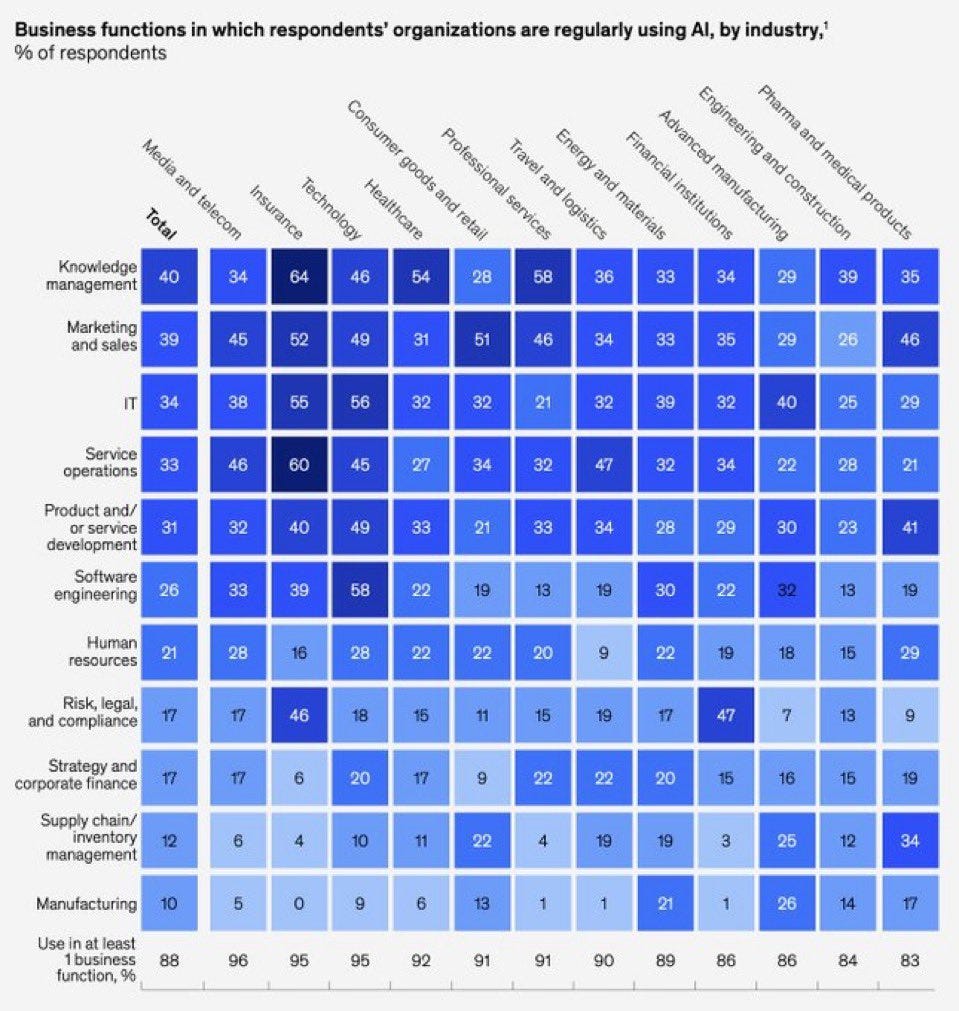
In this brew: AI usage by business function in a picture | Do Something Principle & The Lindy Effect | EU cuts tariff on US goods, Russia threatens WA ban & EU moves to ban social media for under-16

The Sunday Brew | Issue #4 Nov ‘25 | Free
Welcome to The Sunday Brew, weekly 1-2-3 newsletter by The Percolator. Every Sunday we drop in your inbox 1 story in a picture, 2 concepts, ideas or frameworks to expand your horizons and 3 news from the week, to keep you updated.
If you are not a paid subscriber, here is what you missed last week:


ONE STORY IN A PICTURE
TWO IDEAS, FRAMEWORKS OR CONCEPTS
This week we bring to you two Concepts - Do Something Principle & The Lindy Effect
Do Something Principle
The “Do Something Principle” says that action should come first, and motivation and inspiration will follow, not the other way around. Instead of waiting to feel ready, you lower the bar of success to simply taking a small step, which then creates the emotional energy to keep going.
Most people believe the sequence is: feel inspired, then get motivated, then finally act. The problem is that difficult but important changes are often surrounded by fear, shame, or uncertainty, so the required inspiration never arrives. When you are stuck in this loop, inaction reinforces the belief that you are unmotivated or incapable, which deepens the paralysis.
The Do Something Principle flips this script: you act first, even in a tiny way, which triggers new thoughts, feedback, and emotions that generate more motivation. Sending one email, writing a rough outline, or simply showing up at the gym counts as success, because any action is treated as progress instead of judging yourself by perfect outcomes. Over time, this creates a positive loop where behaviour shapes feelings, rather than passively waiting for feelings to shape behaviour.
A key implication is that clarity often emerges from engagement, not from overthinking in advance. When you take a small step, you discover what works, what doesn’t, and what you actually care about, which refines your direction and builds confidence. Even if the first attempts “fail,” they still break inertia and provide information, so failure becomes less threatening and more like a necessary cost of learning.
The principle encourages designing life and work around very low-friction starting actions that you can do regardless of mood. By repeatedly honouring these small commitments, you train yourself to rely less on fluctuating emotion and more on behaviour-led momentum, making consistency and long-term change far more achievable.
🚀
The Lindy Effect
The Lindy Effect is the idea that for certain non‑perishable things like ideas, technologies, books, or institutions, the longer they have already survived, the longer they are expected to survive into the future. Unlike people or machines that wear out over time, these things do not “age” in the normal sense; instead, each additional year of survival increases their expected remaining life, making them more robust and likely to endure.
The concept comes from a joke among comedians at Lindy’s delicatessen in New York: a Broadway show that had run for two weeks was expected to run another two weeks, while a show that had run for two years was expected to run another two years. Nassim Taleb later formalized this intuition in his book Antifragile, applying it to ideas, traditions, and technologies that don’t have a built‑in expiration date. For example, if a book has been in print for forty years, the Lindy Effect suggests it will likely stay in print for another forty years; if it then survives another decade, its expected future life grows to about fifty more years.
Mathematically, this corresponds to a power‑law distribution, where longevity is proportional to past survival, not fixed by a biological clock.
The core insight is that time acts as a filter: the longer something has withstood change, competition, and disorder, the more evidence there is that it is robust and valuable. So, when choosing what to read, adopt, or invest in, the Lindy Effect suggests favouring things that have already lasted a long time, because their survival is itself a strong signal of future staying power.
An Earnest Appeal
The Percolator is built like a magazine, but without the team or organisation. It takes research, writing, editing, and a steady rhythm to publish longform essays twice a week. Paid subscriptions make this work possible, and sustainable.
If you’ve found value here, I’d love for you to consider upgrading. Paid subscribers unlock every essay, can comment and join the chat, and a chance to feature their own notes and stories.
👉 Please upgrade to paid and help keep the brew strong. It costs less than two coffees a month, but unlike coffee, the energy lasts longer.
THREE NEWS FROM THE WEEK
EU Approves Major Tariff Cuts on US Goods in Controversial Trade Deal
The European Union member states have agreed to remove most tariffs on American industrial goods, advancing a significant and contentious trade agreement.
The deal slashes EU tariffs on US imports while setting a 15 percent tariff on most European exports to the US, including cars, semiconductors, and pharmaceuticals. New tariff-rate quotas will also open US markets to European agricultural and seafood products such as pork, dairy, tree nuts, and lobster, with duty-free access extended for US lobster imports beyond July 2025.
The framework originated from a July 2025 meeting between European Commission President Ursula von der Leyen and US President Donald Trump, following a period of transatlantic tension marked by sweeping US tariff impositions. Alongside tariff adjustments, the EU committed to purchasing $750 billion in American energy through 2028 and pledged $600 billion in new US investments, aiming to stabilize trade relations.
However, the European Parliament plans to challenge some deal terms, advocating for safeguards like a sunset clause that could end tariff concessions if no broader agreement is reached within 18 months. While member states declined to adopt this clause, mechanisms allow the European Commission to suspend the deal if the US fails to meet its obligations or if surging US imports threaten EU industries.
Negotiations continue as the European Parliament’s final vote is expected by spring 2026, amid ongoing US demands for regulatory adjustments, particularly regarding digital rules impacting trade. This deal signals a cautious step toward restoring stability in EU-US trade after a volatile period marked by tariffs and trade disputes.
➖
Russia Threatens Complete WhatsApp Ban Over Legal Non-Compliance
Russia’s state communications watchdog Roskomnadzor has escalated its campaign against WhatsApp, warning of a total ban if the messaging app fails to comply with Russian crime-prevention laws.
The regulator accused WhatsApp, owned by Meta Platforms, of facilitating terrorist acts, fraud, and recruitment for criminal activities, and declared that non-compliance will lead to a nationwide block.
This announcement follows restrictions imposed earlier in August 2025, when Russia limited voice and video calls on WhatsApp and Telegram due to their refusal to share data with law enforcement. Despite this, WhatsApp remains Russia’s most popular messaging app with 97 million monthly users, compared to Telegram’s 91 million users.
Meanwhile, Russian authorities are aggressively pushing MAX, a domestic messaging app developed by VK, the largest Russian social network. Since September 2025, MAX has been mandated to be pre-installed on all smartphones and tablets sold in Russia. With over 45 million registered users and 18 million daily active users, MAX lacks end-to-end encryption, raising concerns among human rights advocates about mass surveillance and privacy.
WhatsApp has criticized Moscow’s move as an attempt to cut off millions of Russians from secure communication channels. Rights groups warn that Russia’s measures reflect broader efforts to tighten internet control and suppress dissent in the country.
The ongoing tension highlights Russia’s drive to replace foreign-owned platforms with domestic alternatives, intensifying concerns about privacy and freedom of expression in the digital space.
➖
European Parliament Urges EU-wide Social Media Age Limit of 16 to Protect Children
The European Parliament has passed a non-binding resolution calling for a continent-wide minimum age of 16 years for access to social media platforms, heightening efforts to safeguard children from online risks.
The resolution, approved by 483 votes in favour, 92 against, and 86 abstentions, proposes that children aged 13 to 16 could use social media only with parental consent, while those under 13 face a total ban.
This landmark move addresses growing concerns over physical and mental health challenges linked to social media use among minors. Research cited by lawmakers shows one in four European children exhibit problematic smartphone use akin to addiction. Besides age restrictions, the resolution calls for banning harmful addictive features like infinite scrolling, auto-play, engagement-based recommendations, and loot boxes in games to reduce manipulation and protect young users.
Europe is not alone in this push; Australia and Denmark have implemented similar measures, with Australia banning social media for children under 16 and Denmark planning a ban for those under 15. The resolution urges the European Commission to develop robust age verification systems and digital identity tools to ensure compliance while imposing personal responsibility on platform executives for violations.
Though not legally binding, the resolution signals strong political will to regulate online environments for minors. European Commission President Ursula von der Leyen has promised expert advice by year-end to craft legislation aimed at ending what lawmakers call “an experiment” where tech giants have unrestricted access to children’s attention.


The Sunday Brew by The Percolator brings to you curated news on tech, business & entrepreneurship, from across the internet to give your week a perfect start.
Share your thoughts and opinions on the topics covered in this newsletter by leaving a comment and joining the conversation.