

The New Cap Table Ethics
Explore modern equity ethics, founder liquidity, dilution, and alignment. Learn transparent practices that sustain trust between investors, teams, and founders.

The Founder’s Brew | Issue #2, Dec ‘25 | Premium
Welcome to The Founders’ Brew, your Thursday ritual of sharp insight, data-backed thinking, and practical tools for modern founders. Each week we unpack one essential theme from the start-up world — combining frameworks, case studies, and field-tested resources you can apply immediately.
If you’re reading this on the free plan, you’re missing the deep dive, founder frameworks, and downloads that follow. Upgrade to The Founders’ Brew Premium to unlock full essays, data visuals, and subscriber-only templates.
» » » Check out subscribers’ benefits.
In this issue, we decode timing. Our term of the week, Founder Liquidity, discuss moral and strategic boundaries of selling a portion of founder equity before exit. In The Main Brew, “The New Cap Table Ethics,” explores fairness, dilution, and trust in modern funding. The Takeaway includes a Cap Table Transparency Template, and Add the Beans asks: Should founders be allowed partial liquidity before Series C?
💡STARTUP WORD OF THE WEEK
Founder Liquidity
Founder Liquidity is the controlled sale of personal equity before a full exit, commonly during secondary rounds. It offers financial relief but introduces alignment risks if founders cash out too early. Managing liquidity ethically requires transparency with investors and teams. When timed correctly, it stabilizes focus; when misused, it signals loss of conviction and erodes trust.
📰STARTUP NEWS OF THE WEEK
Founders Cash Out Big in 2025: Pre-Exit Liquidity Surges Globally
In 2025, start-up founders embraced early liquidity through massive secondary share sales, sidestepping traditional IPO waits.
India’s Urban Company cofounders Abhiraj Singh Bhal, Raghav Chandra, and Varun Khaitan offloaded ₹780 crore in pre-IPO secondaries, retaining leadership stakes. Groww founders pocketed over ₹700 crore via ESOPs and block trades post-listing.
Europe’s Brevo executed a €500m secondary-led round, led by General Atlantic, delaying IPOs by years while providing founder exits. US trends show eight-figure paydays normalizing for late-stage founders. Total Indian IPO secondaries neared ₹1 trillion, signalling a shift to de-risked entrepreneurship.
☕️THE MAIN BREW
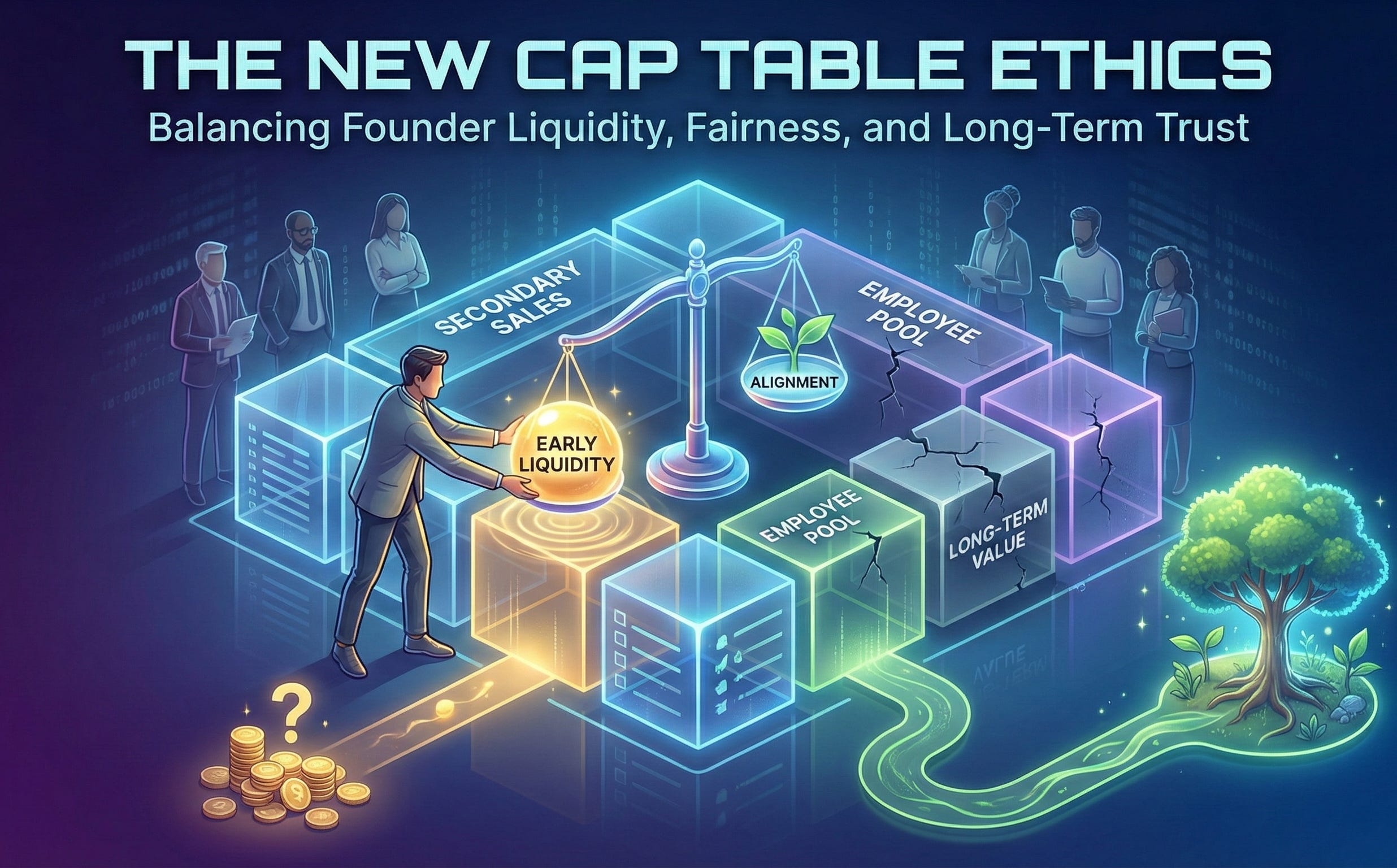
The New Cap Table Ethics
Equity has always been the quiet architect of startup behaviour. It shapes incentives, power, expectations, and long-term trust. What has changed in the past decade is the role ethics plays in how equity is distributed, monetized, and communicated.
Founder liquidity, once a late-stage privilege reserved for near-IPO certainty, now occurs as early as Series A or B. Investors justify it as a retention tool in a high-burn, high-velocity market. Founders view it as partial risk offloading in an environment where exits may take a decade. Employees observe it with mixed reactions. The public markets eventually price all of it.
This shift introduces a new category of ethical tension. The conventional view linked liquidity to demonstrated value creation. The contemporary model allows liquidity to precede proof of product-market fit, institutional stability, or reliable revenue. The new question that operators and investors are forced to confront is whether early cash-out strengthens long-term alignment or quietly erodes it. Liquidity can relieve pressure, but it can also distort future incentives. It is increasingly common for founders to hold less equity by Series C than their 2010 counterparts did at IPO. Earlier dilution, larger round sizes, and structured secondaries have reshaped the meaning of “ownership.”
We examine how founder liquidity evolved, how cap-table norms shifted, and why the ethics of equity matter more in 2025 than in any previous start-up cycle. It analyses the mechanics and moral trade-offs of secondary sales, investor expectations, employee optics, and ownership concentration. It then offers a practical framework to evaluate liquidity timing, transparency standards, and internal communication.
Many professionals assume cap-table design is a technical matter. It is increasingly an ethical one.
