

The Creator, the Contractor, the AI — and You
Exploring how creators, contractors, and AI are reshaping hybrid work identities—blurring roles, incomes, and stability—while redefining how companies and professionals build their futures.

For more than a century, the categories of “employee” and “employer” defined how most people worked. You had a contract, a manager, a workplace, and a job title. But those boundaries are rapidly dissolving.
Today, millions of people don’t fit neatly into the old structures. They are freelancers who juggle projects across platforms. They are creators building audiences on YouTube, TikTok, or Substack while selling courses or brand collaborations. They are software developers running their own small contracting firms but also contributing to open-source projects. Increasingly, they are also professionals embedding artificial intelligence into their workflows—not as a tool that sits at the margins, but as a co-worker shaping the very nature of what they produce.
This shift is not about a single trend like the gig economy or the rise of digital content. It is about hybrid identities that blur the line between employee, entrepreneur, and algorithmic collaborator.
A person may spend the morning editing client videos, the afternoon training an AI to help with marketing copy, and the evening livestreaming to subscribers. Revenue comes from contracts, ad revenue shares, subscription fees, and in some cases algorithmic arbitrage. The categories of “work” that once stood apart are now layered on top of each other, stitched together in new ways.
The implications extend beyond individual careers.
Companies are hiring more contractors than ever, in some cases relying on AI-augmented contributors instead of full-time staff. Platforms like Fiverr, Upwork, and Patreon are reshaping the supply of labor. And AI systems—from ChatGPT to Midjourney—are not just enabling productivity but also generating their own economies of plugins, prompts, and fine-tuning services.
Hybrid workers are both the input and the product of this transformation.
The critical question is how we make sense of these identities. What does it mean to be a “creator-contractor-AI hybrid”? What does this mean for stability, professional development, and the social contracts that used to underpin work? To understand where this is going, we need to move past the nostalgia for a singular “job” and confront the new reality: work is not dying, it is fragmenting—and we are all learning to live inside its fragments.
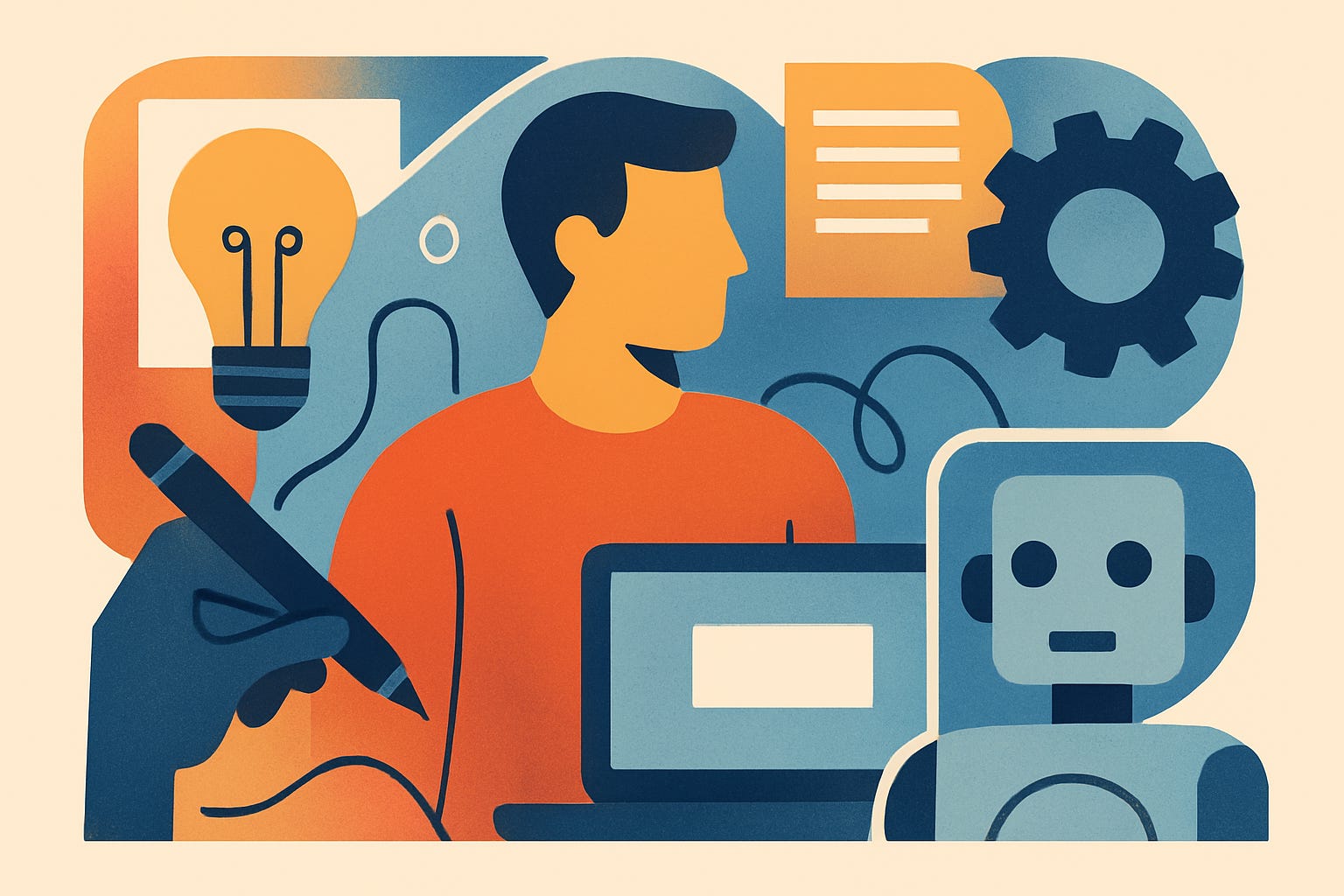
In this issue of Brewed for Work, we examine the rise of hybrid work identities—the creator who is also a contractor, the contractor who works with AI, the professional whose career is stitched together across platforms and projects. We explore how these identities are reshaping labor markets, company structures, and the meaning of professional stability. The question is not whether this is happening, but how workers and organizations adapt to a reality built on fragmentation and recombination.
More posts from this series:


Today’s Issue at a Glance:
The Convergence of Creator and Contractor
AI as a Co-Worker, Not Just a Tool
Companies in the Hybrid Era
Professional Identity and Stability in Fragments
The Future of Hybrid Work
So grab your favorite mug, and let's get brewing!
Welcome to Brewed for Work, 🔒subscribers-only🔒 offering by The Percolator dedicated to professional growth and upskilling. Each week we share essays, insights and resources to aid you in your work-life.
🚀
Now, you can Upgrade your Subscription for Free when you Invite your Friends to Subscribe to The Percolator
The idea of a career once suggested continuity: a job that led to promotion, a company that shaped your trajectory, and a professional identity tied to an industry.
That template has steadily broken apart.
First came the freelance revolution, accelerated by platforms like Upwork, Freelancer, and Fiverr. Then came the creator economy, where building an audience became as important as building a résumé. And now comes AI, a force that is simultaneously automating tasks, augmenting skills, and even shaping entirely new categories of economic activity.
Each of these shifts has been discussed separately, but they are increasingly intersecting. Freelancers are using AI tools to scale their productivity. Creators are hiring contractors to manage workflows. Companies are engaging external talent as easily as employees. In practice, people are no longer just “one thing.” They are hybrid workers, drawing income and identity from multiple overlapping roles.
→ This hybridization is not marginal.
A 2023 McKinsey study estimated that 36 percent of employed respondents in the U.S. identified as independent workers—a significant jump from pre-pandemic levels. Meanwhile, Goldman Sachs projects that AI could affect 300 million full-time jobs worldwide, not only replacing but transforming them. Overlay this with the creator economy, which is estimated to grow to nearly half a trillion dollars by 2027, and the picture becomes clear: the hybrid worker is not an exception, but the emerging norm.
The challenge is that our institutions are not built for this. Tax codes, benefits systems, training programs, and even professional associations still assume a stable, employer-based career. Companies, too, struggle to integrate contractors and AI into coherent strategies for productivity and culture. Workers themselves face instability, constant upskilling demands, and a fragmented sense of identity. Yet despite these frictions, hybrid work offers opportunities for autonomy, diversification of income, and access to global markets.
