

Heavy Intelligence: How Agentic Workflows are Modernizing the World’s Oldest Industries.
RPA is dead. Explore why autonomous agentic workflows and vertical reasoning engines are the new strategic moats for founders modernizing heavy industry sectors in 2026.

The Founder’s Brew | Issue #3, Mar ‘26 | Premium
Welcome to The Founders’ Brew, your Thursday ritual of sharp insight, data-backed thinking, and practical tools for modern founders. Each week we unpack one essential theme from the start-up world — combining frameworks, case studies, and field-tested resources you can apply immediately.
If you’re reading this on the free plan, you’re missing the deep dive, founder frameworks, and downloads that follow. Upgrade to The Founders’ Brew Premium to unlock full essays, data visuals, and subscriber-only templates.
» » » Check out subscribers’ benefits.
In this issue of The Founders’ Brew, we dismantle the era of "dumb" automation.
RPA is hitting its brittle ceiling, giving way to the rise of Agentic Workflows. We analyse the massive investment pivot from general AI "wrappers" toward sector-specific Reasoning Engines for heavy industry.
Discover why the modern moat isn't the model, but the autonomous logic layer. For founders, the mission has shifted: stop building brittle scripts and start architecting industrial-grade digital intuition.
Today’s Issue at a Glance:
The Brittle Ceiling of Legacy Automation
Defining the Agentic Shift
The Rise of Vertical Reasoning Engines
The New Moat: Data, Physics, and Integration
The Investor’s Pivot & The Path Forward

For a decade, Robotic Process Automation (RPA) was the undisputed crown jewel of enterprise efficiency. It promised a world where “digital workers” would liberate humans from the drudgery of data entry and back-office bureaucracy. But as we enter 2026, the cracks in the RPA façade have become canyons. Traditional automation is “dumb”: it is brittle, linear, and entirely devoid of context. It doesn’t understand the work it performs; it simply mimics the keystrokes of the person who came before it. When a UI changes or a supply chain fluctuates, the bots break, leaving behind a “maintenance tax” that often offsets the original ROI.
There is a fundamental shift from brittle scripts to Agentic Workflows. We are witnessing the death of the macro and the birth of the Reasoning Engine. Unlike RPA, agentic systems don’t follow a map; they are given a destination and the autonomy to navigate the terrain. They can use tools, call APIs, self-correct after an error, and, most importantly, reason through the “messy middle” of industrial logic.
The investment landscape has responded in kind. The era of the “General AI” wrapper is over. Modern moats are being dug in the specialized soil of Heavy Industry. Venture capital is moving horizontal SaaS in the favour of vertical “Reasoning Engines” designed for the power grid, the factory floor, and the shipping port. In these high-stakes environments, a general-purpose LLM is a liability. The new winners are building AI with “industrial intuition”, systems that understand physics, safety protocols, and legacy hardware.
The message for founders is: The moat is no longer the model; it is the workflow. Efficiency is no longer about how fast a bot can click, but how deeply an agent can think.
🚀
The Brittle Ceiling of Legacy Automation
For much of the last decade, Robotic Process Automation (RPA) was marketed as the “silver bullet” for digital transformation. Companies like UiPath and Blue Prism became the darlings of the enterprise world by promising a simple premise: if a human can do it on a screen, a bot can do it too. We entered the era of the “Digital Worker,” where thousands of software bots were deployed to handle the high-volume, repetitive drudgery of the back office, processing invoices, updating CRM entries, and reconciling spreadsheets.
However, as we stand in 2026, the honeymoon period is over. We have hit what many industry insiders call the “Brittle Ceiling.”
The Era of “Dumb” Automation
The fundamental flaw of RPA lies in its DNA: it is deterministic and coordinate-based. Traditional RPA doesn’t actually “see” a process; it follows a rigid script of pre-defined “if-then” rules. It is effectively a macro on steroids. While this works in a perfectly static environment, the modern enterprise is anything but static.
This has led to the rise of “Dumb Automation”, systems that are exceptionally fast at execution but possess zero understanding of the underlying logic. They can move data from Point A to Point B with 99% accuracy, but they cannot tell you why they are doing it, or what to do if Point B has moved three pixels to the right.
The Fragility Factor
This lack of contextual awareness creates the Fragility Factor. In a typical industrial or enterprise environment, systems are constantly evolving. A SaaS provider updates their UI; a legacy ERP system undergoes a security patch; a web portal adds a single mandatory field. To a human, these are minor inconveniences. To an RPA bot, they are catastrophic failures. Because the bot relies on “screen scraping” and hardcoded coordinates, even the slightest deviation from the “golden path” causes the entire workflow to collapse.
Recent industry data suggests that nearly 30-50% of RPA implementations fail to reach their initial ROI targets precisely because they cannot handle the variability of the real world. They are built for a world of “standardized” processes that rarely exist in practice.
The Maintenance Trap
The most insidious by-product of this fragility is the Maintenance Trap. Founders often overlook the “Total Cost of Ownership” (TCO) of RPA. For every hour saved by a bot, a significant portion of that time is reinvested by IT teams into “bot herding”, manually fixing broken scripts and re-mapping workflows every time a system changes. Estimates show that in mature RPA deployments, up to 70% of the automation budget is swallowed by maintenance and support rather than new innovation.
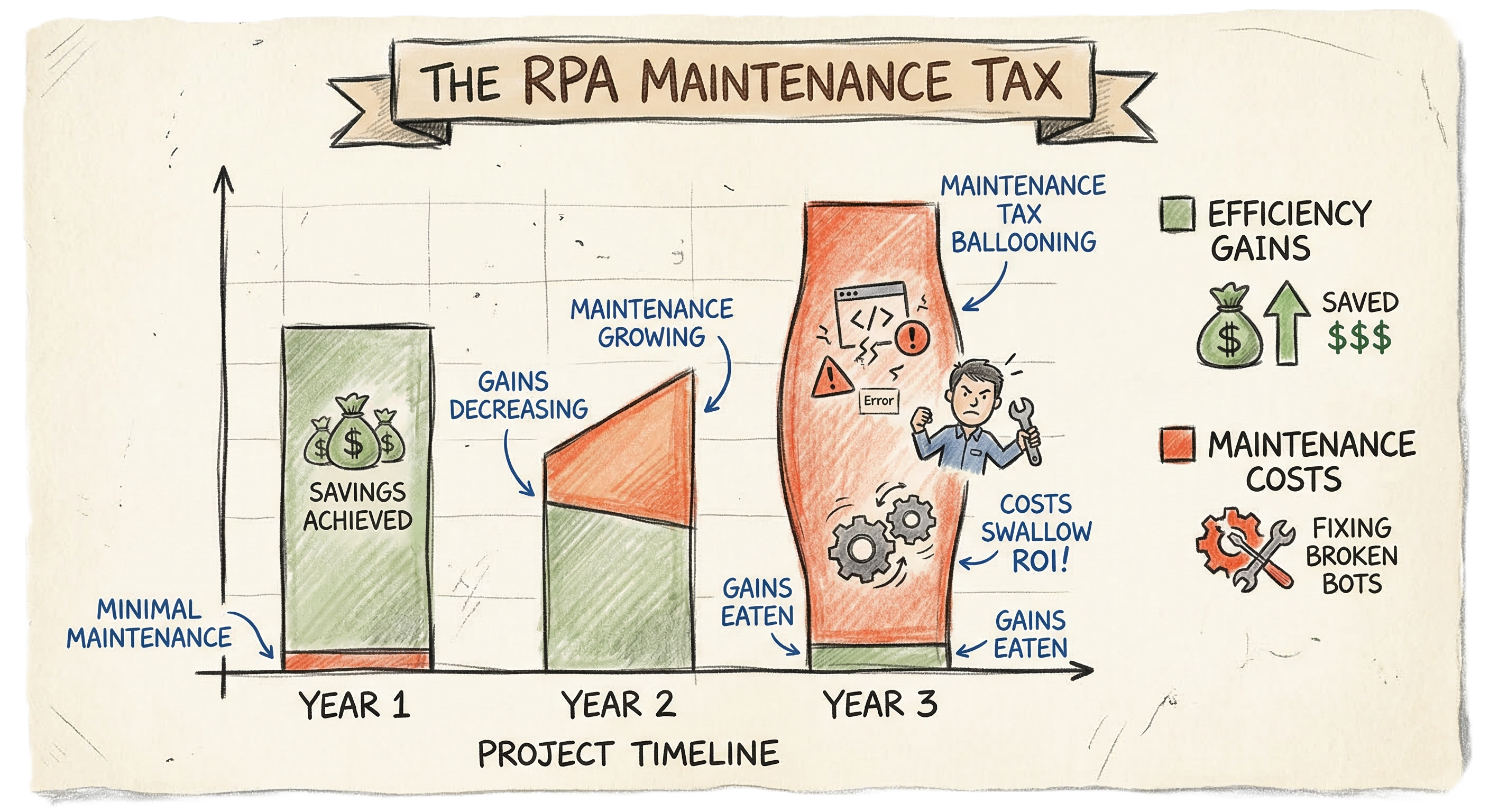
We’ve moved from paying humans to do manual work to paying expensive engineers to maintain “automated” versions of that same work.
In the high-stakes world of heavy industry, where downtime isn’t just a loss of productivity but a potential safety hazard, this level of fragility is no longer an acceptable trade-off.
The ceiling has been reached, and it’s made of glass.
🚀
