

Generations at Work: What Happens When Values Collide
Boomers, Millennials, Gen Z; all in one Slack channel. How to turn friction into fuel?

Brewed for Work | Issue #2, Feb ‘26 | Premium
Welcome to Brewed for Work, your Tuesday ritual for sharper thinking about careers, workplaces, and the shifting nature of professional life.
If you’re reading this as a free subscriber, consider upgrading to the paid tier for full access to deep-dive essays, exclusive workbooks, and interactive polls. Your subscription keeps this independent newsletter fully brewed and your career better caffeinated.
» » » Check out subscribers’ benefits.
In this issue, we unpack the Workplace Social Contract: how each generation defines loyalty, purpose, and success. The essay explores friction and synergy across Boomers to Gen Z, backed by Gallup and Deloitte data. Paid readers get the Team Culture Charter Template to align values across ages.
Question: Which workplace norm should your generation retire, and which should it defend?
💡WORK WORD OF THE WEEK
Workplace Social Contract
Workplace Social Contract is the unwritten agreement between employers and employees about loyalty, flexibility, and purpose.
Every generation rewrites it: Boomers traded stability for tenure; Millennials seek growth and meaning; Gen Z demands transparency and autonomy. When that contract frays, disengagement follows. The healthiest organizations treat it as a living document: constantly negotiated, never assumed.
☕️THE MAIN BREW
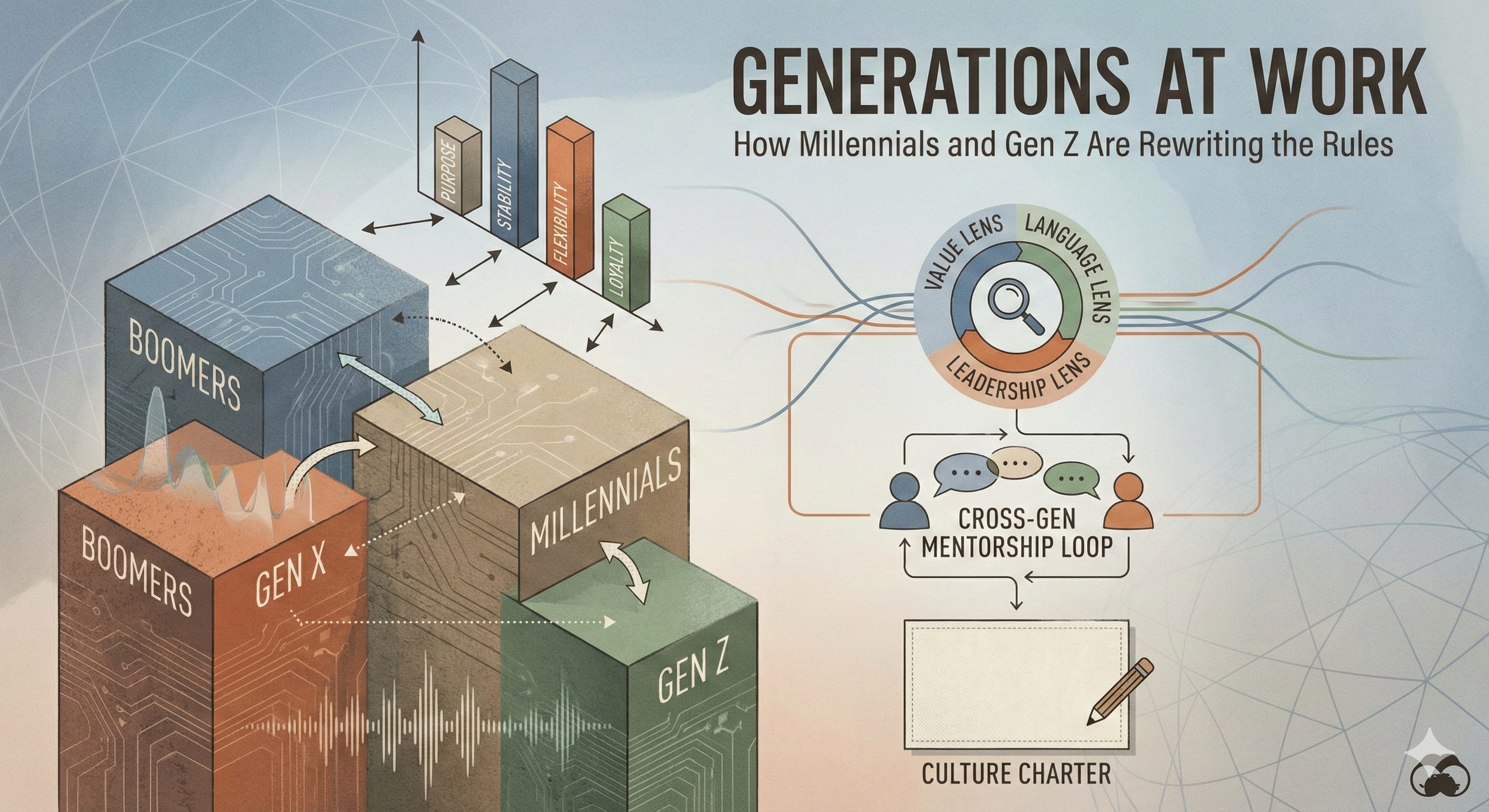
Generations at Work: How Millennials and Gen Z Are Rewriting the Rules
For most of modern corporate history, workplaces were shaped by a single dominant generational logic at a time. Norms around authority, career progression, loyalty, and communication evolved gradually, with one cohort largely replacing another. That pattern has broken. Today, four generations work side by side, often in the same teams, each shaped by different economic shocks, technologies, and social contracts.
Baby Boomers entered organizations built on hierarchy, long tenure, and linear advancement. Generation X learned to navigate uncertainty, downsizing, and early digital disruption by valuing independence and pragmatism. Millennials came of age during globalization and the internet boom, absorbing ideas of continuous learning, feedback, and mission-driven work. Gen Z arrived amid climate anxiety, pandemic disruption, and algorithmic culture, with expectations shaped by speed, transparency, and optionality.
The result is not merely difference in preference but difference in how work itself is interpreted. What one generation calls commitment, another may call rigidity. What one sees as ambition, another may read as burnout risk. Surveys increasingly show these gaps have material consequences. Gallup’s 2024 research finds that Gen Z ranks purpose and flexibility above compensation when evaluating roles, while older cohorts continue to prioritize stability and role clarity. These are not superficial disagreements. They are competing definitions of what a fair deal between employer and employee looks like.
Organizations often respond by labelling this tension as a culture problem or a motivation problem. That framing misses the core issue. The friction is not primarily about attitude. It is about translation. Each generation operates with a different internal logic for why work matters, how trust is built, and how authority should function. When these logics collide without interpretation, teams drift into resentment, miscommunication, and silent disengagement.
Understanding intergenerational dynamics as overlapping social contracts changes the problem statement. The question shifts from “Who is right?” to “How do we translate values across generations without flattening them?” Most professionals, however, default to assuming their own work model is neutral and universal. That assumption is the mistake, and it quietly erodes trust long before conflict becomes visible.
