

Founder Energy Management as Strategy
Treat energy as capital. Use data-driven tools to track focus, reduce cognitive overload, and sustain high-quality founder decisions.

The Founder’s Brew | Issue #4, Jan ‘26 | Premium
Welcome to The Founders’ Brew, your Thursday ritual of sharp insight, data-backed thinking, and practical tools for modern founders. Each week we unpack one essential theme from the start-up world — combining frameworks, case studies, and field-tested resources you can apply immediately.
If you’re reading this on the free plan, you’re missing the deep dive, founder frameworks, and downloads that follow. Upgrade to The Founders’ Brew Premium to unlock full essays, data visuals, and subscriber-only templates.
Happy New Year!
To make your 2026 a little more insightful and satiate your curiosity here is a small gift from us: Avail 26% discount when you upgrade your subscription in the month of January.
Wishing you clarity, steadiness and momentum in 2026.
» » » Check out subscribers’ benefits.
In this issue, we focus on focus. Our term of the week, Cognitive Capital, treats attention and judgment as scarce resources. The Main Brew, “Founder Energy Management as Strategy,” links decision quality to rest and structure. The Takeaway delivers the Cognitive Capital Tracker, and Add the Beans asks: How many hours of deep work do you really get daily?
💡STARTUP WORD OF THE WEEK
Cognitive Capital
Cognitive Capital is a founder’s total mental energy—attention, focus, and judgment—that can be allocated like financial capital.
Over-spending it leads to burnout and poor decisions. Protecting cognitive capital through structured rest, delegation, and deliberate learning multiplies strategic clarity. Managing it consciously turns personal wellbeing into a business advantage.
☕️THE MAIN BREW
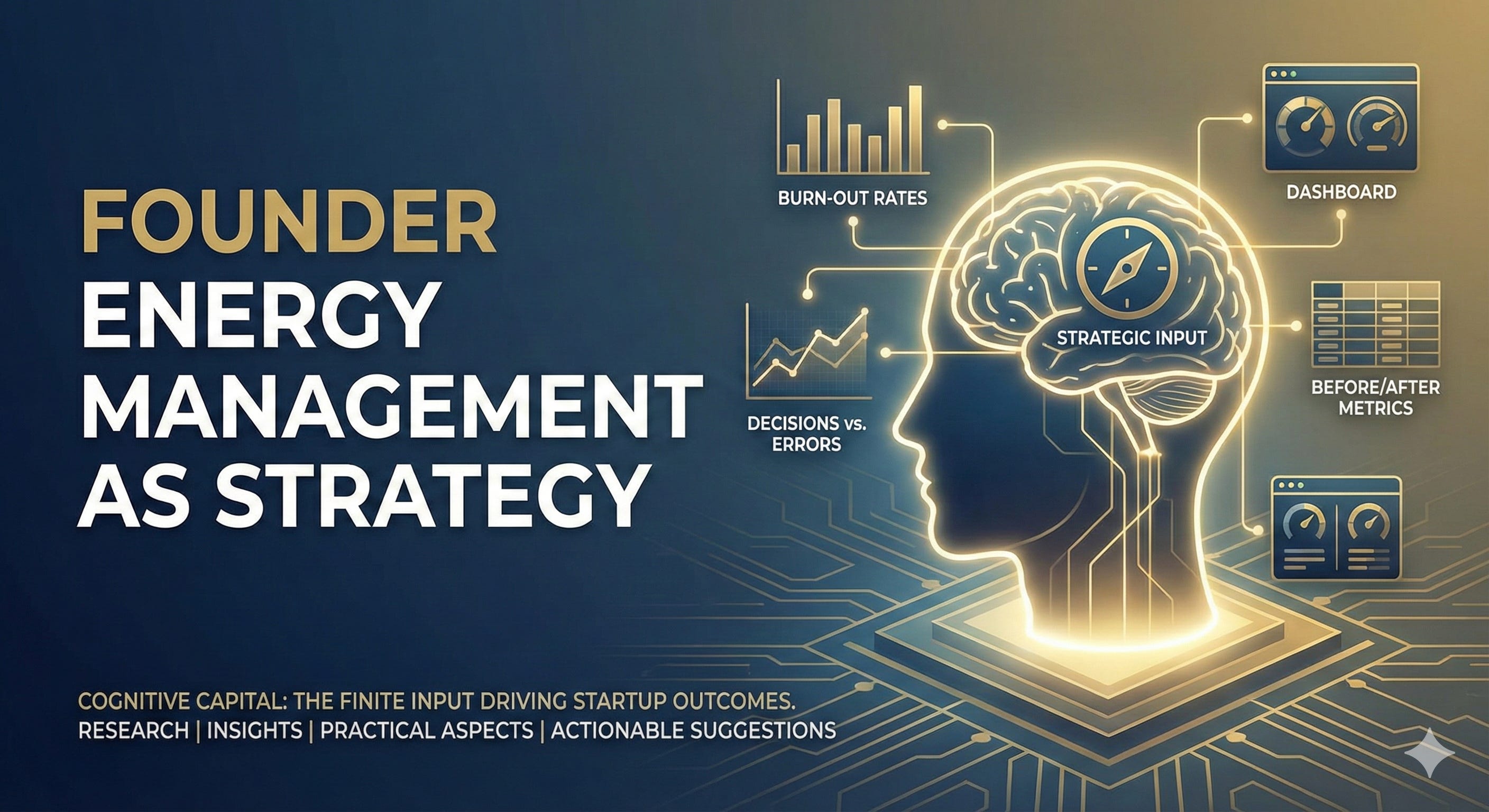
Founder Energy Management as Strategy
Founder performance is not simply a function of hours worked. Cognitive capital, the finite reservoir of attention, decision capacity, and sustained focus, drives strategic outcomes for start-up teams and investor confidence.
Conventional start-up math treats time as the scarce resource while ignoring the cost of depleted energy. Surveys from 2024–2025 show that more than half of founders report burnout within a year, and a large majority acknowledge high stress and mental health impacts that impair decision-making.
These patterns suggest investors and teams implicitly misprice burnout risk in evaluations and funding decisions. Empirical evidence indicates that burnout correlates with reduced clarity in judgment and increased error rates in high-stakes decisions; it also cascades through organizations, lowering employee wellbeing and psychological safety. The consequences extend beyond individual health to influence runway management, fundraising velocity, team retention, and pivot execution.
Cognitive capital should be treated as a strategic input in the same category as cash runway or market traction. The costs of ignoring energy constraints include avoidable operational errors, loss of strategic optionality, and higher likelihood of founders exiting prematurely. In reframing founder energy as a scarce strategic input, leaders can align decision budgets with peak performance windows, delegate non-core tasks, and build institutional buffers that protect cognitive capacity.
The start-up strategy must integrate energy accounting into planning, resource allocation, and governance to improve long-term outcomes and align investor expectations with sustainable performance capacity.
🚀
