

Distribution Is the Product
Growth depends on distribution velocity. Learn to measure GTM speed, optimise channels, and scale efficiently beyond early adopters.

The Founder’s Brew | Issue #5, Jan ‘26 | Premium
Welcome to The Founders’ Brew, your Thursday ritual of sharp insight, data-backed thinking, and practical tools for modern founders. Each week we unpack one essential theme from the start-up world — combining frameworks, case studies, and field-tested resources you can apply immediately.
If you’re reading this on the free plan, you’re missing the deep dive, founder frameworks, and downloads that follow. Upgrade to The Founders’ Brew Premium to unlock full essays, data visuals, and subscriber-only templates.
Happy New Year!
To make your 2026 a little more insightful and satiate your curiosity here is a small gift from us: Avail 26% discount when you upgrade your subscription in the month of January.
Wishing you clarity, steadiness and momentum in 2026.
» » » Check out subscribers’ benefits.
In this issue, we argue that distribution, not features, defines survival. Our term of the week, Go-to-Market Velocity, measures speed from launch to revenue. The Main Brew, “Distribution Is the Product,” maps channels that scale reliably. The Takeaway includes the GTM Velocity Dashboard, and Add the Beans asks: Which channel has produced your most reliable early users?
💡STARTUP WORD OF THE WEEK
Go-to-Market Velocity (GTM V)
Go-to-Market Velocity tracks how fast a product converts from launch readiness to its first 100 paying customers. It compresses product validation, distribution, and conversion into one pace metric. High GTM V correlates strongly with funding success and survivability. Measuring and improving it forces focus on real adoption instead of vanity milestones.
☕️THE MAIN BREW
Distribution Is the Product
Most products do not fail because they lack features, technical quality, or even user value. They fail because distribution lags behind product ambition.
In earlier eras, a strong product could rely on scarcity, brand, or incumbency gaps to find users. That assumption no longer holds. Markets are saturated, switching costs are low, and customer attention is fragmented across platforms and formats. In this environment, distribution is not an accessory to product development. It is the product.
→ Product market fit is increasingly shaped by how efficiently a product moves through channels rather than how elegantly it is designed. A well built product with weak distribution often fails faster than a mediocre product with strong reach and repeatable acquisition loops. This is not a rhetorical claim. Data from SaaS, marketplaces, and consumer start-ups consistently shows that early growth trajectories correlate more with go to market execution than with product differentiation alone.
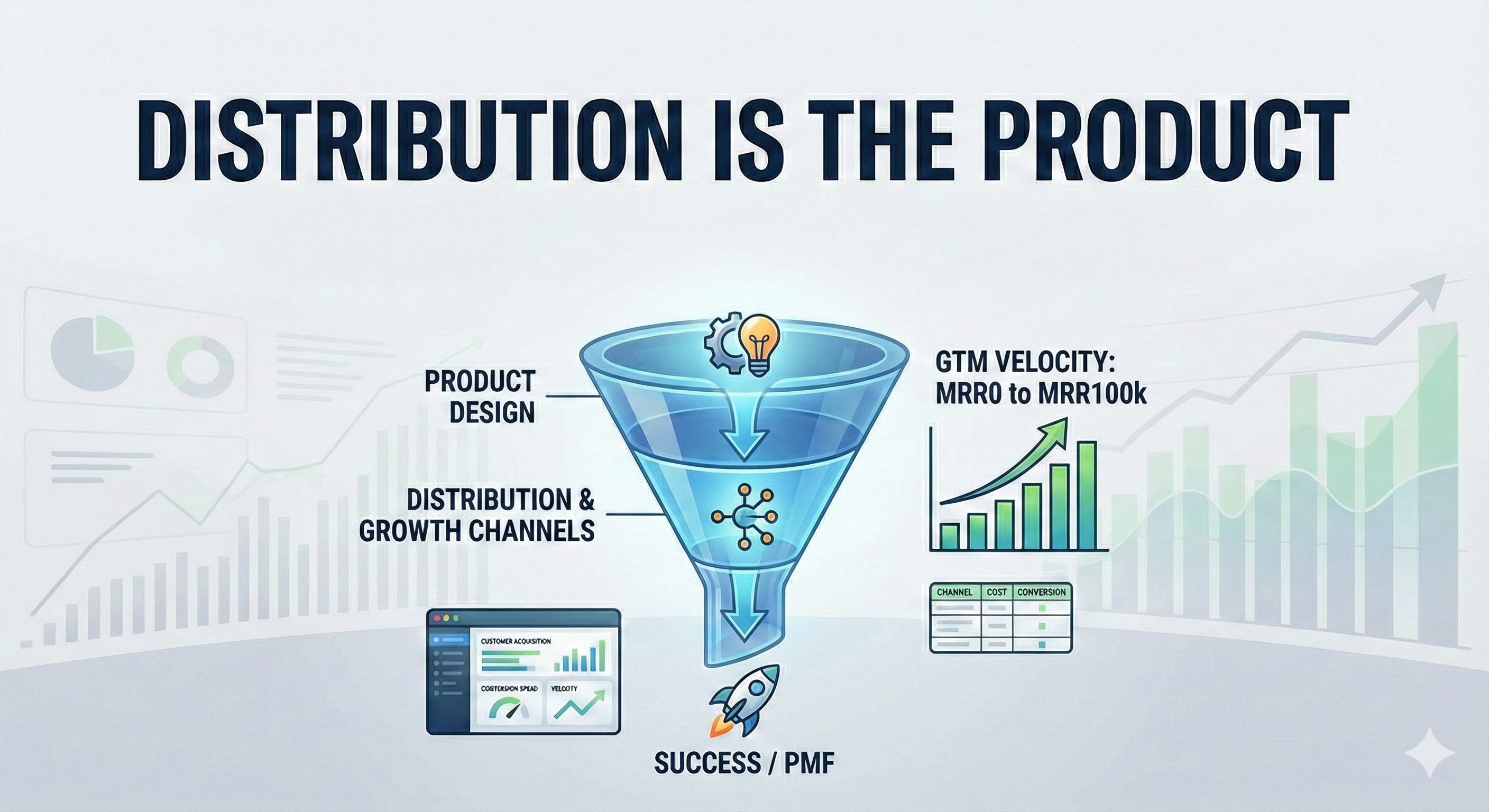
This shift requires a change in how founders define fit. Instead of asking whether users like the product, the more predictive question is whether the product can be distributed at increasing speed and declining marginal cost. This essay frames that capability as GTM Velocity, abbreviated as GTM V. GTM V measures how quickly a company converts product value into paying users through defined channels.
When GTM V is low, even strong retention cannot compensate for slow acquisition and long sales cycles. When GTM V is high, distribution itself becomes a competitive moat, shaping product decisions, pricing, and even roadmap priorities. And yet, most founders still treat distribution as a downstream problem to solve after the product is finished.
That assumption is the mistake.
🚀
