

Code, Cells, and Consensus: The Rise of the Bio-Data Engineer
Bridge the gap between bench and server. Explore how Bio-Data Engineers manage genomic data and translate biological nuances into scalable pipelines in our latest Brewed.

Brewed for Work | Issue #3, Mar ‘26 | Premium
Welcome to Brewed for Work, your Tuesday ritual for sharper thinking about careers, workplaces, and the shifting nature of professional life.
If you’re reading this as a free subscriber, consider upgrading to the paid tier for full access to deep-dive essays, exclusive workbooks, and interactive polls. Your subscription keeps this independent newsletter fully brewed and your career better caffeinated.
» » » Check out subscribers’ benefits.
In this issue of Brewed for Work, we explore the critical friction point between the laboratory bench and the server room: the Bio-Data Engineer.
As biotech evolves into a data-led industry, translating messy biological experiments into scalable digital pipelines is the new competitive advantage.
We examine how these hybrid professionals bridge cultural divides, manage high-velocity genomic data, and build the "Bio-OS" infrastructure required to power the next generation of high-impact DeepTech breakthroughs.
Today’s Issue at a Glance:
The Linguistic Divide: Lost in Translation
Taming the Firehose: High-Velocity Genomic Data
Designing for the Bench: The Internal Tooling Challenge
The Hybrid Skillset: Building a Bio-Data Career
The Future: Engineering the Living Machine
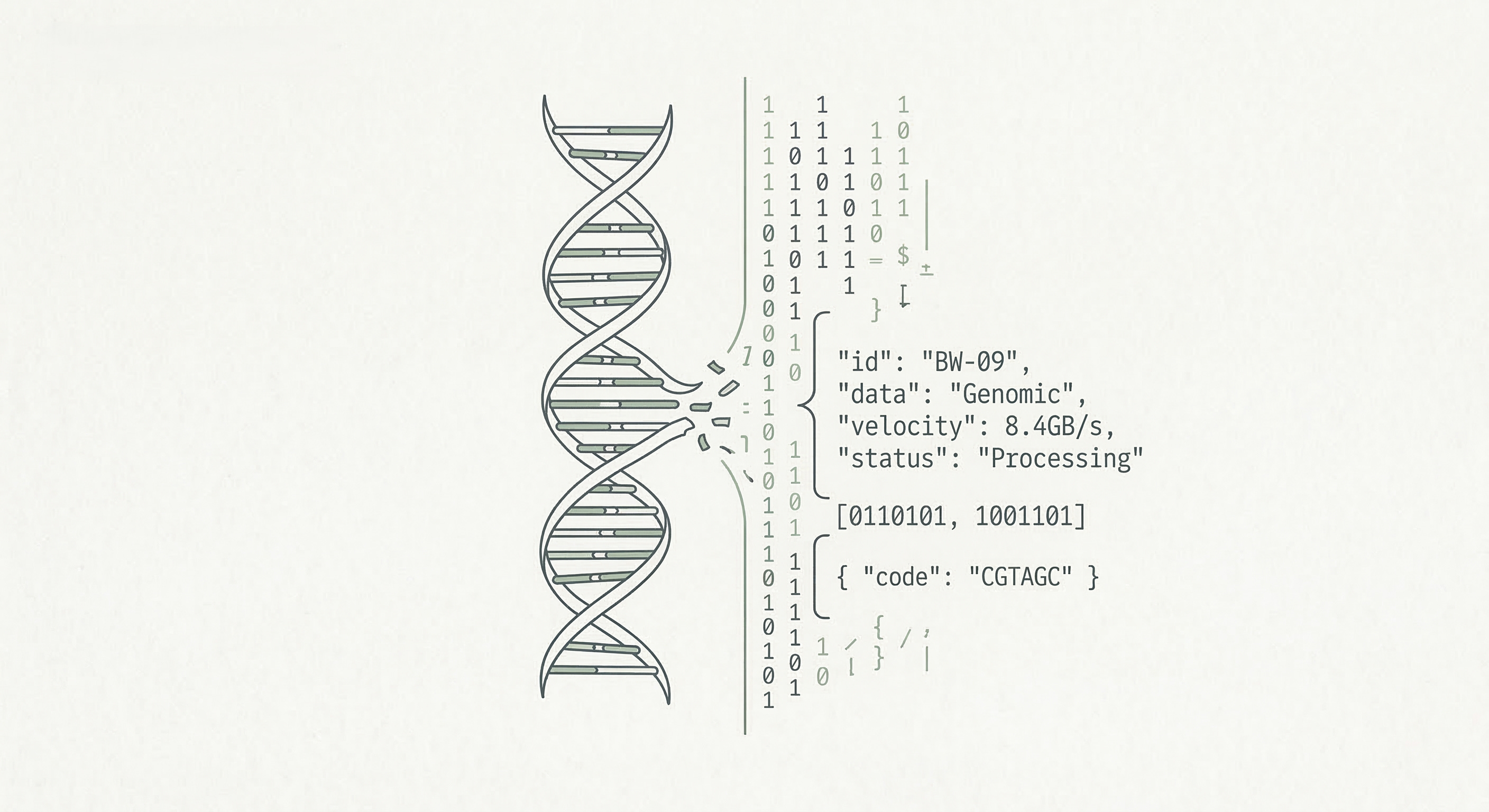
The era of biology as a descriptive science is over. In its place has emerged a high-velocity, data-driven discipline where the bottleneck to discovery is no longer the speed of a pipette, but the throughput of a pipeline.
As “omics” technologies—genomics, proteomics, and transcriptomics—generate petabytes of raw information, a new friction point has emerged at the intersection of the wetlab and the server room. On one side are the biologists, navigating the inherent variability and “noise” of living systems; on the other are data engineers, striving for the immutability and scalability of cloud-native architectures.
This interaction has given rise to a critical new role: the Bio-Data Engineer.
Unlike a traditional software engineer, the Bio-Data Engineer must operate as a technical translator, bridging two distinct professional cultures that often speak the same words but mean entirely different things. They are tasked with building the infrastructure that transforms messy, physical samples into clean, actionable digital insights, all while managing the staggering velocity of modern genomic data.
To succeed, these professionals must move beyond simple code execution. They must develop an “empathy for the bench,” understanding that a “library” in a lab is a physical collection of DNA fragments, not a software dependency. They must design systems that prioritize data provenance: ensuring that every digital result can be traced back to the specific reagent batch or temperature setting of the physical experiment.
