

Adapting to Q-Day: How Quantum Computing Alters Finance Careers
Prepare your finance career for Q-Day by mastering new encryption concepts, evaluating vendor vulnerabilities, and guiding the complex migration towards quantum compliance standards.

Brewed for Work | Issue #5, June ‘26 | Premium
Welcome to Brewed for Work, your Tuesday ritual for sharper thinking about careers, workplaces, and the shifting nature of professional life.
If you’re reading this as a free subscriber, consider upgrading to the paid tier for full access to deep-dive essays, exclusive workbooks, and interactive polls. Your subscription keeps this independent newsletter fully brewed and your career better caffeinated.
» » » Check out subscribers’ benefits.
In this issue of Brewed for Work, we examine the practical implications of quantum computing for finance professionals.
The theoretical timeline for quantum-resistant encryption has collapsed into an immediate operational deadline known as Q-Day. Malicious actors are already storing intercepted data to decrypt it once quantum hardware matures. This impending structural shift requires a distinct recalibration of your skillset. You do not need a background in physics to adapt, but you must understand how cryptographic agility affects procurement, vendor risk management, and regulatory compliance.
We outline the core competencies required to manage this critical transition and secure your career trajectory.
Today’s Issue at a Glance:
Defining the Q-Day Horizon
Recalibrating Professional Competencies
Managing the Internal Migration
Navigating Vendor Risk and Third-Party Dependencies
The Post-RSA Career Trajectory
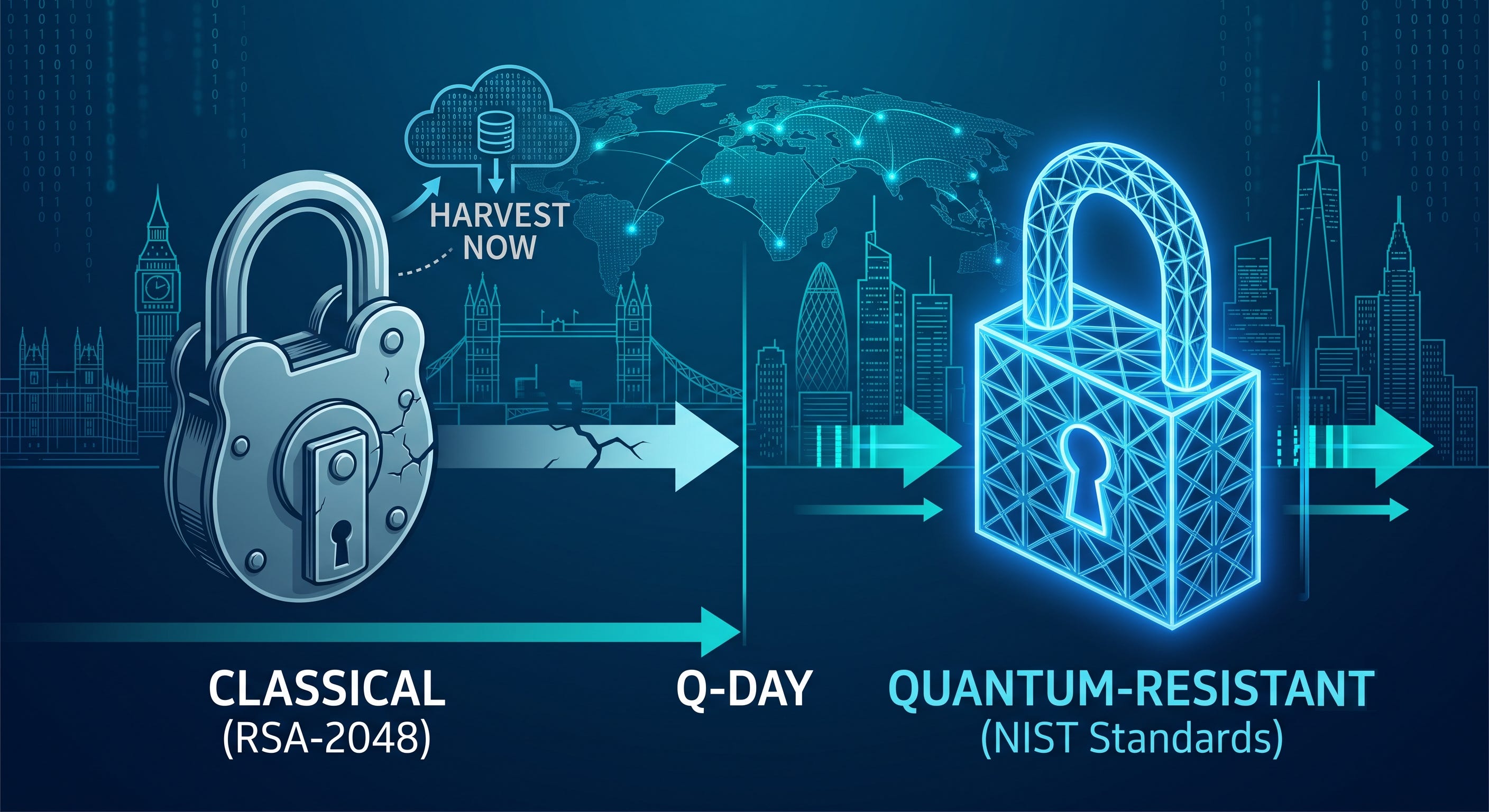
The financial sector operates on the assumption that asymmetric encryption guarantees data privacy and operational security, but this assumption is nearing its expiration date.
Quantum computing introduces a novel threat model that invalidates the mathematical foundations of RSA and Elliptic Curve Cryptography. Current cryptographic protocols rely on the extreme difficulty of factoring large prime numbers or solving discrete logarithms using classical computers.
However, quantum processors operating at sufficient scale will execute Shor’s algorithm to collapse these problems from exponential to polynomial time. This theoretical eventuality is referred to as Q-Day, and it represents a strict operational deadline for anyone managing financial infrastructure. Furthermore, Q-Day is not a distant concern reserved for physicists because threat actors are actively executing "harvest now, decrypt later" attacks. They intercept and store encrypted proprietary trading algorithms, client communications, and transaction ledgers with the intention of decrypting these archives retroactively once quantum computers mature.
The National Institute of Standards and Technology has already published the first finalised post-quantum cryptographic standards, meaning financial institutions must now begin the complex process of replacing vulnerable algorithms across legacy systems.
This migration creates an immediate demand for a new professional competency within corporate finance. Professionals do not need to understand quantum mechanics to remain competitive, but they do need to understand how cryptographic agility affects procurement, vendor risk management, and regulatory compliance. System architects must design modular databases capable of supporting larger encryption keys, while compliance officers must update data retention policies to account for the retroactive decryption threat. Project managers will need to coordinate extensive cryptographic audits across disparate business units.
Developing quantum literacy allows you to translate these highly technical security requirements into clear business objectives. Those who can navigate the operational mechanics of the post-quantum transition will secure a distinct career advantage during the impending infrastructure overhaul. The transition will span several years and require substantial budgetary allocations. Understanding the risk profiles of different encryption modules enables better resource prioritisation, ensuring that financial professionals who anticipate these shifts transition from passive software users to active participants in securing the digital ledger.
